Every year, following the main celebrations dedicated to Our Lady of the Angels, one of Costa Rica’s most important religious images temporarily changes home.
On August 3, the Virgin of the Angels once again takes part in the traditional “Pasada,” a procession that carries her from the Basilica of Our Lady of the Angels to the Cathedral of Our Lady of Mount Carmel in downtown Cartago.
The tradition, which dates back to the late 18th century, once again turns the city’s streets into a gathering place for thousands of people and connects religious devotion with cultural expressions deeply rooted in the province.
A Tradition Dating Back to 1782
The so-called “Pasada de la Virgen” dates back to 1782.
According to historical documentation preserved by Costa Rican institutions, the decision to temporarily move the image was related to the way celebrations surrounding the Virgin had developed during the 18th century.
At the time, Bishop Esteban Lorenzo de Tristán, bishop of Nicaragua and Costa Rica, visited Cartago and observed that the festivities had taken on characteristics that he considered distant from their religious purpose.
As a result, it was established that the image would be transferred to the central parish of Cartago after the August 2 celebrations.
Over time, this decision became an annual tradition.
The Municipality of Cartago states that the “Pasada” takes place on August 3 and that the image remains at the cathedral until the first Sunday of September, when she returns to the Basilica of Our Lady of the Angels.
From the Basilica to the Cathedral
The procession connects two of Cartago’s most important religious landmarks.
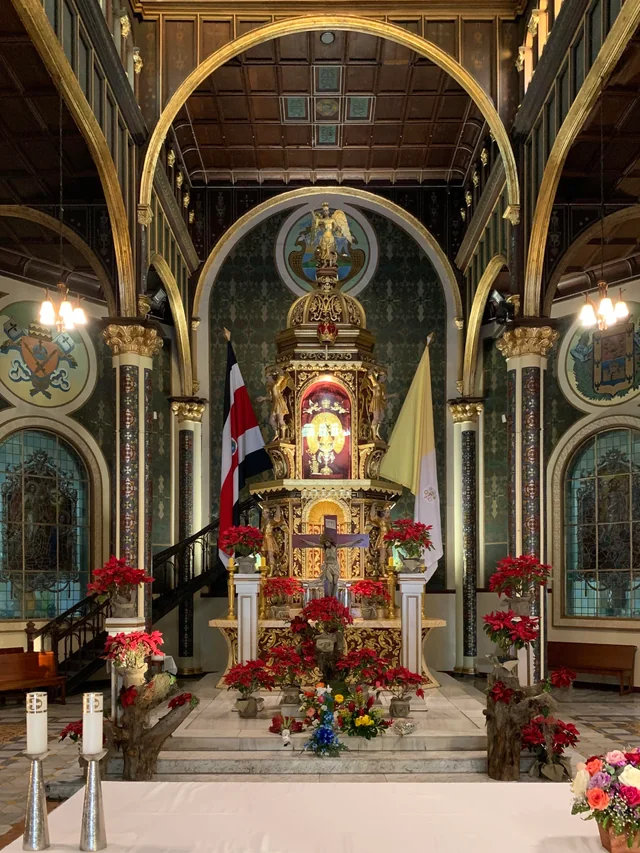
The Basilica of Our Lady of the Angels is the sanctuary where the image is normally kept, while the Cathedral of Our Lady of Mount Carmel, located in the center of the city, becomes her temporary home for several weeks.
The tradition can also be understood as part of Cartago’s urban history. During the procession, the image travels through the city streets accompanied by worshippers, religious authorities, and different traditional expressions from the province.
The Costa Rica Institute of Technology notes that August 3 is traditionally marked by the transfer of the Virgin from the Basilica to the Cathedral.
A Celebration Bringing Faith and Culture Together
Although the “Pasada” has a religious origin, over the years it has also become an important cultural expression in Cartago.
One of its most distinctive elements is the participation of farmers and agricultural producers from the province, who traditionally present agricultural products as offerings.
Flowers, fruits, and other products from the countryside are incorporated into the decorations and recall the historical importance of agriculture to the province’s economy and identity.
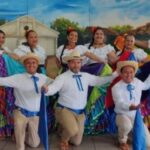
The participation of traditional ox-cart drivers also helps preserve a cultural tradition closely linked to Costa Rica’s rural heritage.
In this way, the procession represents more than the transfer of a religious image. It also brings together different elements of Cartago’s cultural identity around a shared tradition.
The Virgin of the Angels and the History of Costa Rica
The importance of the Virgin of the Angels extends far beyond the province of Cartago.
According to tradition, the image was discovered on August 2, 1635, by Juana Pereira. It was later declared the patron saint of Cartago and, in 1824, the official patron saint of Costa Rica.
The National Sanctuary of Our Lady of the Angels subsequently became one of the country’s most important pilgrimage sites.
The Ministry of Culture and Youth has documented the history of the Basilica and its architectural development, including the different churches that preceded the current building and the impact of earthquakes on earlier structures.
A Procession Followed by Thousands
The “Pasada” takes place immediately after one of the most important pilgrimage days on Costa Rica’s calendar.
Every August 2, thousands of people travel to Cartago to participate in the celebrations dedicated to Our Lady of the Angels. The following day, the image leaves the Basilica and begins her temporary stay at the cathedral.
The procession therefore becomes a continuation of the celebrations, but with a different character: Cartago’s streets take center stage and different communities participate along the route.
In recent years, farmers, traditional ox-cart drivers, families, and groups of worshippers have accompanied the image throughout the journey.
Protecting a Historic Image
Moving the Virgin requires special preparation.
The image is considered to have enormous religious and cultural value, and its transportation is therefore carried out under specific security protocols.
Costa Rica’s Air Surveillance Service has participated in protecting the Virgin during the main August celebrations since 2013. The institution states that its officers provide security around the image and also participate in official transfers.
This work forms part of a broader security operation designed to protect both the image and the people taking part in the celebrations.
A Tradition That Continues to Evolve
Although the procession follows a structure that has been repeated for centuries, each edition of the “Pasada” has its own characteristics.
Local communities prepare decorations, floats, and offerings to accompany the image. The streets may also be transformed with flowers, handcrafted elements, and decorations created especially for the occasion.
The tradition remains alive precisely because different generations continue to participate in it.
History is preserved not only through documents, but also through the people who prepare the floats, grow the agricultural products used as offerings, decorate the streets, and accompany the procession.
A Tradition at the Heart of Cartago’s Heritage
The “Pasada de la Virgen” is one of the clearest examples of how a religious tradition can also become an expression of collective identity.
For several weeks, the image temporarily leaves her usual sanctuary and remains in central Cartago. When she returns to the Basilica in September, the annual cycle is completed once again.
More than two centuries after its origins, the tradition continues to bring together communities, farmers, families, and visitors around an event combining history, religion, and culture.
For Cartago, the “Pasada” is more than the transfer of an image from one church to another. It is a tradition connecting the present with a history that began more than 240 years ago and continues to shape the identity of the city.
Sources
Ministry of Culture and Youth — Center for Research and Conservation of Cultural Heritage: historical documentation on the Basilica of Our Lady of the Angels and its development.
Municipality of Cartago: historical information about the traditional “Pasada” and its celebration every August 3.
Ministry of Public Security — Air Surveillance Service: official information on the protection of the Virgin of the Angels during the celebrations.
Costa Rica Institute of Technology (TEC): historical information about the National Sanctuary, the Virgin of the Angels, and the “Pasada” tradition.