Mangroves cover a relatively small portion of Costa Rica, but they play a fundamental role in biodiversity, coastal communities and the protection of coastal areas. However, these ecosystems face a combination of threats linked to pollution, coastal development, agriculture and the effects of climate change.
Recent research on the state of Costa Rica’s mangroves has brought renewed attention to the issue. The situation is not caused by a single factor, but by the accumulation of different pressures that affect both water quality and the ability of these forests to survive and regenerate.
Small Ecosystems with a Major Role
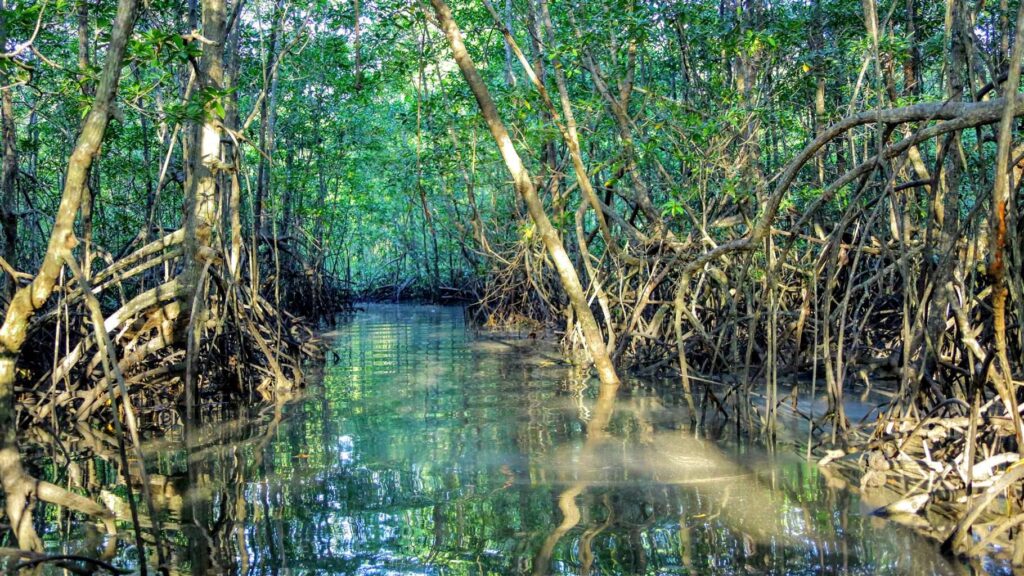
Mangroves grow in areas where marine and freshwater environments meet, particularly around estuaries, river mouths and coastal areas affected by tides.
In Costa Rica, most mangrove ecosystems are located along the Pacific coast. According to data compiled by CATIE, in 2021 the country had approximately 52,802 hectares of mangroves, with around 99.85% located on the Pacific side, including Isla del Coco.
Although mangroves cover only around 1% of the country’s territory, their ecological importance is considerable. They provide shelter, feeding grounds and breeding areas for fish, crustaceans, mollusks and numerous bird species.
The Costa Rican Tourism Institute (ICT), for example, identifies the Estero de Puntarenas and Associated Mangroves Wetland as an important feeding, refuge and breeding area for numerous wildlife species.
A Natural Barrier Against Climate Change
In addition to their importance for biodiversity, mangroves provide ecosystem services related to coastal protection and carbon storage.
Their complex root systems help stabilize sediments and can reduce the effects of erosion and certain coastal hazards. At the same time, these ecosystems store significant amounts of carbon in both their vegetation and the sediments they accumulate.
The World Bank recognizes Costa Rica’s mangroves as important for biodiversity conservation, carbon sequestration and the livelihoods of rural communities.
Pollution Comes From Inland Areas
One of the most significant problems affecting mangroves is the arrival of pollutants transported by rivers from inland areas.
A scientific review published in August 2026 by CATIE, with participation from researchers from the University of Costa Rica, the National University and the Costa Rica Institute of Technology, analyzed more than four decades of research on water pollution.
The study identified agriculture and untreated domestic wastewater as some of the main sources of river pollution. On beaches, urban wastewater plays an especially important role, particularly in areas with intense tourism activity.
This pollution can eventually reach coastal ecosystems through river basins.
Pesticides Also Reach Wetlands
The connection between agricultural activities and mangroves has recently been documented through scientific research.
A study published in 2026 analyzed pesticide residues in the Térraba-Sierpe National Wetland and areas influenced by the region’s rivers.
Researchers detected different substances in water and in specimens of Anadara tuberculosa, a native mollusk used as a bioindicator. Among the compounds identified were diuron, carbendazim, diazinon and ethoprophos. The findings suggested a possible relationship with agricultural activities, particularly pineapple production in the surrounding area.
This type of research helps demonstrate how pollutants used inland can travel through river systems before reaching wetlands and marine ecosystems.
Coastal Development Adds Further Pressure
Pollution is not the only threat.
Urban and tourism expansion, infrastructure construction, changes to waterways, sedimentation and certain productive activities can also alter mangrove ecosystems.
The Organisation for Economic Co-operation and Development (OECD) has reported that Costa Rica’s coastal areas and wetlands have experienced degradation, with infrastructure, settlements, tourism, agriculture, fishing, pollution and climate change placing pressure on biodiversity.
The issue is closely linked to planning. When the natural flow of a river is altered or a coastal area is transformed without considering the ecosystem’s characteristics, salinity, sedimentation and water availability can change in ways that affect mangroves.
Térraba-Sierpe: One of the Country’s Great Natural Refuges
One of the most important mangrove areas in Costa Rica is the Térraba-Sierpe National Wetland, in Puntarenas province.
The ICT describes it as one of the country’s largest mangrove forests and highlights its importance for biodiversity in the Osa region.
The wetland lies at the mouths of the Térraba and Sierpe rivers and consists of an extensive network of channels, flooded areas and forests adapted to saline conditions and tidal cycles. These environments provide habitat for fish, crustaceans, mollusks and birds.
The wetland also has an economic dimension: several coastal communities depend on resources associated with these ecosystems, as well as activities such as fishing, traditional shellfish harvesting and nature tourism.
Mangroves Also Support Tourism
These ecosystems have value beyond science and conservation.
Mangroves form part of Costa Rica’s nature-tourism offering. The ICT includes different wetlands and mangrove areas in its tourism guides, promoting activities such as birdwatching and boat tours.
At the Estero de Puntarenas and Associated Mangroves Wetland, for example, visitors can travel through channels to observe different mangrove species and birds, while the ecosystems provide refuge and feeding areas for numerous species.
Tourism can therefore become both a source of pressure and an opportunity to generate conservation-related income when it is developed responsibly.
Conservation Requires Planning
Costa Rica has several mechanisms to protect its coastal ecosystems and promote more sustainable use of natural resources.
The National System of Conservation Areas (SINAC) participates in the management of protected wildlife areas and marine-coastal ecosystems, while other institutions work on water management, tourism, land-use planning and pollution.
The Ecological Blue Flag Program is another example of institutional collaboration. Its categories include beaches, communities, watersheds, protected natural areas and climate change.
These tools can help improve environmental management, but they require monitoring, funding and coordination between institutions, communities and productive sectors.
Protecting Mangroves Also Means Protecting Communities
Conserving these forests is not simply about protecting trees and wildlife.
Mangroves help maintain fish and shellfish populations, provide shelter for numerous species and contribute to coastal protection. For communities living nearby, their degradation can have both ecological and economic consequences.
The World Bank has specifically highlighted how communities dependent on mangroves can benefit from their ecosystem services, while also noting the challenge of ensuring that these economic benefits are distributed fairly among local populations.
An Ecosystem That Can Still Recover
The situation facing mangroves presents important challenges, but it does not mean their decline is irreversible.
A recent review by the United Nations Environment Programme (UNEP) notes that, globally, mangrove loss has slowed and that natural regeneration and the expansion of some forests are offsetting part of the historical losses.
This shows that conservation, restoration and appropriate management can produce positive results.
In Costa Rica, protecting mangroves means reducing pollution entering from watersheds, improving wastewater treatment, controlling activities that degrade wetlands and carefully planning development in coastal areas.
The Future of Forests Between Rivers and the Sea
Mangroves may appear modest compared with the country’s vast tropical forests or iconic beaches. Yet their role is far greater than their size might suggest.
They are places where rivers, the ocean, wildlife and human communities meet. Their conservation depends on decisions that extend far beyond the coastline: it begins in watersheds, continues with wastewater and agricultural management, and reaches into the way cities, infrastructure and tourism are planned.
The challenge for Costa Rica will be finding a balance between developing its coastal regions and protecting ecosystems that provide essential benefits to both nature and people.
Information Sources
CATIE: scientific review of more than four decades of research on water pollution in Costa Rica.
National System of Conservation Areas (SINAC): documentation on the conservation and management of marine-coastal ecosystems.
Costa Rican Tourism Institute (ICT): official information on wetlands, mangroves, nature tourism and protected areas.
World Bank: analysis of the ecological and socioeconomic value of mangroves and the challenges surrounding their conservation.
OECD: environmental assessment of Costa Rica and pressures affecting biodiversity, coastal areas and wetlands.
Scientific research on pesticide pollution: study published in Marine Pollution Bulletin concerning the Térraba-Sierpe National Wetland.