
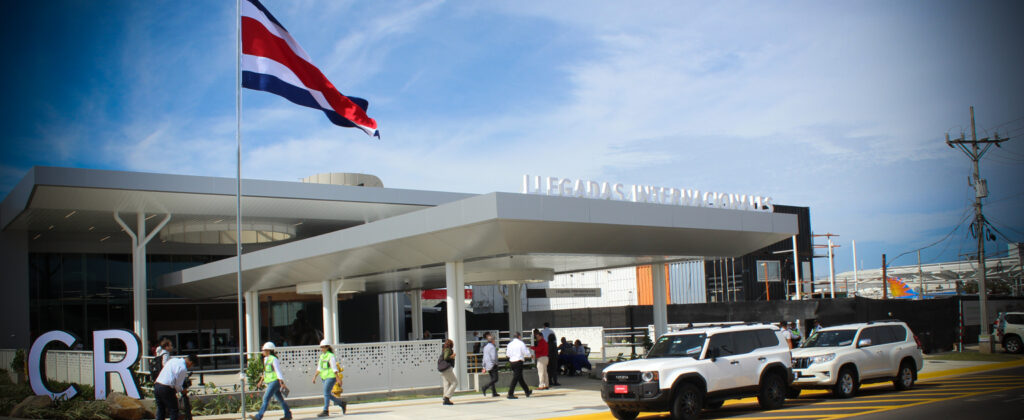
The Costa Rican government has announced a series of airport infrastructure projects designed to increase airport capacity, improve air connectivity and create new opportunities for tourism, trade and investment.
The initiatives focus mainly on Tobías Bolaños, Daniel Oduber Quirós and Limón International Airports, located in San José, Guanacaste and the Caribbean. The announcement forms part of a broader strategy to make better use of the country’s air infrastructure and distribute economic activity across different regions.
Modernizing Tobías Bolaños Airport
One of the most significant projects concerns Tobías Bolaños Palma International Airport, located in Pavas, San José.
The government is planning an investment of approximately US$30 million to modernize the facilities. The work is expected to include improvements to the terminal, an extension of the runway, expansion of the aircraft parking apron and upgrades to lighting systems.
The proposal also includes transferring domestic flights currently operating from Juan Santamaría International Airport to Tobías Bolaños.
According to the government’s plan, this would free up capacity at the country’s main international airport and potentially allow for an increase in international flights. The government estimates that capacity for these operations could increase by up to 40%.
The General Directorate of Civil Aviation recognizes Tobías Bolaños as one of Costa Rica’s international airports and notes that it currently plays an important role in general aviation.
Guanacaste Also Looks to Air Cargo
At Daniel Oduber Quirós International Airport in Liberia, the government announced an investment of approximately ₡3 billion, equivalent to around US$6.6 million according to the information released, to expand the apron used for private aircraft.
However, one of the projects with the greatest potential economic impact is the incorporation of an air cargo terminal into the airport’s new master plan and future concession process.
The objective is for Guanacaste’s airport infrastructure to serve not only as a gateway for tourists but also as a tool for facilitating the export of products to international markets.
Products that could benefit from greater air cargo capacity include fresh foods, agricultural products, meat and dairy products from the province.
The project is being considered as a long-term initiative and is expected to be incorporated into planning toward 2030.
Key Infrastructure for Guanacaste Tourism
Daniel Oduber International Airport plays a strategic role in tourism in Guanacaste, one of Costa Rica’s main tourism regions.
The Costa Rican Tourism Institute (ICT) identifies the airport as one of the main gateways to the North Pacific region and works with airlines to expand international connectivity.
In April 2026, for example, the ICT announced a new connection between Vancouver and Guanacaste operated by Air Canada, scheduled to run from December 2026 to April 2027. The route forms part of efforts to strengthen connectivity with the Canadian market.
The ICT also maintains updated statistics on scheduled flights, airlines, routes, countries and cities of origin, making it possible to track changes in Costa Rica’s air connectivity.
A Major Transformation for Limón Airport
The third major project concerns Limón International Airport, where an investment of approximately US$40 million is planned.
The project involves a comprehensive modernization of the terminal rather than simple maintenance work.
Planned improvements include an approximately 600-meter runway extension, a new passenger terminal, security and fire-protection facilities, fuel infrastructure, new access roads and parking areas, as well as coastal protection works.
The goal is to improve operating conditions and facilitate the arrival of new flights to Costa Rica’s Caribbean region.
For a province such as Limón, modernizing this infrastructure could also help strengthen tourism, commercial activity and investment.
The General Directorate of Civil Aviation currently lists Limón International Airport among the country’s main international airports.
Greater Connectivity Across Different Regions
The three projects share a common objective: using airport infrastructure as a tool for regional development.
The ICT points out that improving air connectivity can increase visitor numbers, diversify tourism markets, encourage longer stays and distribute tourist flows more widely across the country.
This strategy is particularly relevant for Costa Rica, where tourism represents an important source of foreign exchange and economic activity.
Official ICT statistics provide information on international tourist arrivals and their monthly, semiannual and annual evolution, based on data supplied by the General Directorate of Migration and Immigration.
Airports as Drivers of Economic Activity
The government’s plan takes a broader approach to airport infrastructure.
Beyond transporting passengers, airports can play an important role in exporting products, attracting investment, developing tourism and creating employment.
In Guanacaste, for example, an air cargo terminal could provide new logistical options for producers who need to ship perishable goods to international markets.
In Limón, a modernized terminal could improve Caribbean connectivity and facilitate the arrival of visitors and investors.
In San José, reorganizing operations between Tobías Bolaños and Juan Santamaría aims to make better use of existing airport capacity.
A Strategy Requiring Long-Term Planning
Modernizing these airports is not an entirely new process. Costa Rica has invested in airport infrastructure for decades, including projects at Juan Santamaría, Daniel Oduber, Tobías Bolaños and Limón.
Current legislation also establishes specific mechanisms for financing the expansion and modernization of international airports such as Limón, Tobías Bolaños and Daniel Oduber.
The new projects, however, present a more integrated vision: using airports not only to accommodate growing air traffic but also to strengthen the competitiveness of different regions.
A New Chapter for Air Infrastructure
The investments announced for Tobías Bolaños, Daniel Oduber and Limón represent projects of different scales and objectives, but they share the same broader goal: strengthening connectivity and using air infrastructure as a tool for economic development.
If the projects move forward as planned, they could change the distribution of air operations across the country, facilitate new international connections and create opportunities for transporting goods from regions outside the Greater Metropolitan Area.
For a country whose economy relies significantly on tourism, exports and international investment, modernizing its airports is a strategic element in maintaining and expanding its connection with the rest of the world.
Official Sources
Costa Rican Tourism Institute (ICT): information on air connectivity, tourism statistics, international routes and investment attraction.
General Directorate of Civil Aviation (DGAC): official information on international airports, infrastructure and airport planning.
Technical Council of Civil Aviation (CETAC): official documentation concerning airport infrastructure projects.
Costa Rican Tourism Institute – 2026 statistics: official data on international arrivals and tourism activity.
Costa Rican Legal Information System: legislation concerning the financing of the expansion and modernization of international airports.