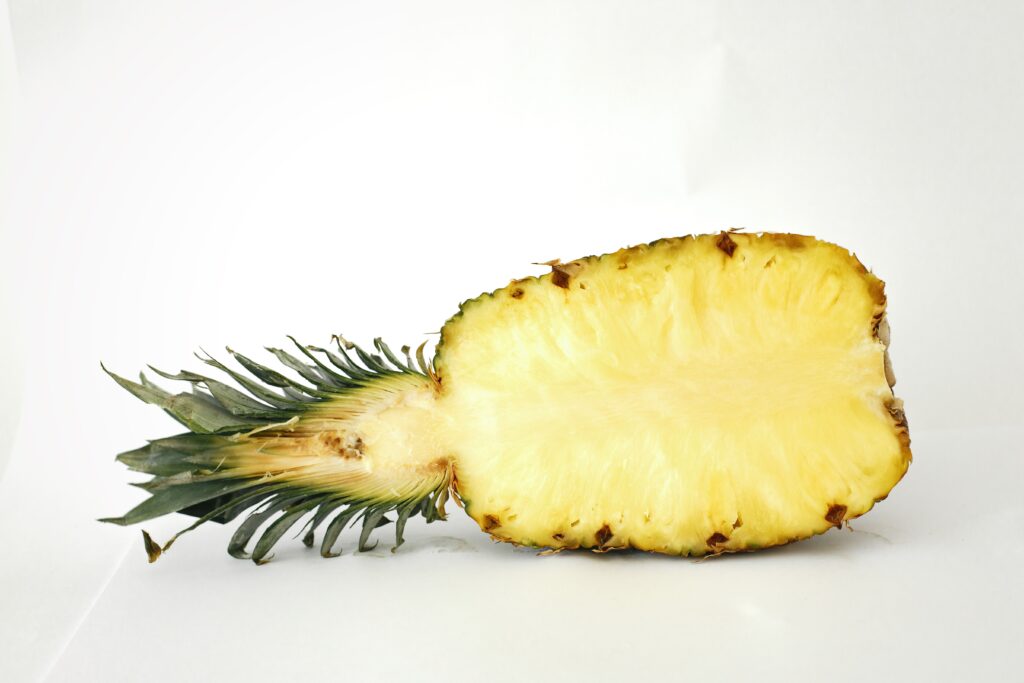
What would normally be considered agricultural waste can become a raw material for food production. In San Carlos, a research and development initiative has been exploring precisely this possibility: using residues from pineapple production as a substrate for growing oyster mushrooms.
The project presents an example of a circular economy approach, in which a byproduct of the agricultural industry can acquire new value before becoming waste.
The initiative focuses on Pleurotus ostreatus, commonly known as the oyster mushroom, an edible species capable of growing on a variety of plant-based materials.
Giving Pineapple Residues a Second Life
Pineapple production generates large quantities of biomass that do not always reach the market as commercial products. Some of this material can become agricultural waste, creating challenges related to its management and disposal.
The Costa Rica Institute of Technology has studied the possibility of using these materials as a substrate for producing oyster mushrooms in San Carlos for several years.
Research conducted by the institution includes the development of production and post-harvest processes for growing Pleurotus using residues from pineapple intended for export. Researchers have also examined aspects such as product quality, preservation, commercialization, and culinary applications.
Why Use Mushrooms to Make Use of Agricultural Residues?
Mushrooms from the Pleurotus genus have a characteristic that makes them particularly interesting for projects of this kind.
They can break down components of plant-based materials, including lignin. As a result, certain agricultural residues and byproducts can be used as substrates for mushroom cultivation.
Research conducted by the Costa Rica Institute of Technology indicates that oyster mushrooms can be commercially cultivated using residues from different agricultural activities and that biomass generated by pineapple production can be used through a process of biotransformation.
This creates a connection between two activities that are often considered separately: agricultural production and food production using residual biomass.
Research That Began More Than a Decade Ago
The idea is not entirely new.
Research projects developed by the Costa Rica Institute of Technology at its San Carlos campus began exploring this possibility as early as 2012. Over the years, the work has expanded from assessing cultivation feasibility to examining the potential for larger-scale production.
The research has included studying the conditions required for mushroom production, developing production and commercialization models, establishing post-harvest management protocols, and determining appropriate storage conditions.
Researchers have also examined sensory characteristics and possible culinary applications, which are important elements when seeking to transform an experimental project into a productive activity.
From the Laboratory to Potential Agroindustrial Production
One of the main challenges of initiatives like this is moving from research to a process that can operate consistently and remain commercially viable.
For this reason, researchers have also worked on quality management and food safety systems for an agroindustrial facility dedicated to producing oyster mushrooms from residual biomass generated by pineapple production in San Carlos.
The research highlights the need to establish appropriate production, handling, and food safety conditions if this type of initiative is to be developed on an agroindustrial scale.
A Food With Nutritional Value
The project is not limited to the environmental benefits of reusing agricultural residues.
Oyster mushrooms are edible and are also of interest from a nutritional perspective. Research conducted at the Costa Rica Institute of Technology specifically examined the functional properties and nutritional value of Pleurotus ostreatus produced using residual biomass from pineapple cultivation.
The University of Costa Rica has also worked for years on research, training, and outreach related to edible mushroom production. Its Center for Agronomic Research has noted that mushroom cultivation can make use of recycled materials such as straw, sawdust, coffee pulp, and pineapple residues as substrates.
This creates a model in which agricultural residues can potentially be transformed not only into a material that requires management, but also into a product intended for human consumption.
Applying the Circular Economy to Agriculture
The project represents an example of how circular economy principles can be applied to agriculture.
Instead of following a linear model in which a crop produces a product and subsequently generates waste, the approach seeks to incorporate that residue back into the production chain.
In this case, biomass generated by pineapple production can be used as a substrate for growing mushrooms. After cultivation, the remaining material may still have potential uses, depending on its characteristics and the process employed.
Research carried out by EARTH University has also examined the use of different agroindustrial residues as substrates for producing Pleurotus ostreatus, including pineapple, coffee, and coconut residues.
An Especially Relevant Opportunity for San Carlos
San Carlos is one of Costa Rica’s important agricultural regions and has significant activity related to pineapple production and processing.
Developing alternatives for making use of the byproducts generated by this industry could have environmental and economic implications for the region.
Research conducted by the Costa Rica Institute of Technology has focused specifically on San Carlos, examining not only mushroom production but also commercialization, preservation, and culinary applications.
This could create opportunities for new value chains linked to the local agricultural industry, particularly if the processes can reach an economically viable scale.
Innovation Connecting Agriculture, Food, and Sustainability
The project is particularly interesting because it connects several different sectors.
On one side, there is an agricultural activity that generates residual biomass. On the other, there is a demand for food and an opportunity to develop new production systems.
Mushroom cultivation can serve as a bridge between the two.
The Costa Rican experience also demonstrates that this type of innovation takes time. More than a decade of research has made it possible to progressively study production conditions, product characteristics, and the potential for commercial development.
A Model That Could Inspire New Solutions
Using pineapple residues to produce oyster mushrooms is a concrete example of how innovation can seek solutions within existing production systems.
Instead of viewing residual biomass solely as a waste-management problem, it can be considered a potential resource for generating new products and economic activities.
For an agricultural industry as important as pineapple production, finding new uses for its byproducts could contribute to more efficient resource use and the development of more circular production models.
The work carried out in San Carlos demonstrates how scientific research, agriculture, and entrepreneurship can come together in a single process: transforming agricultural residues into a food product with economic and nutritional value.
Sources of Information
Costa Rica Institute of Technology (UTN) — Research on the production of Pleurotus ostreatus using residual biomass from pineapple cultivation in San Carlos.
University of Costa Rica (UCR), Center for Agronomic Research — Information on edible mushroom production and the use of agricultural residues as substrates.
EARTH University — Research on the use of agroindustrial residues as substrates for Pleurotus ostreatus production.
Ministry of Agriculture and Livestock (MAG) — Technical information and publications related to agricultural production, resource use, and sustainable food systems.