Two Costa Rican students received honorable mentions at the 67th International Mathematical Olympiad (IMO), held in Shanghai, China, from July 10 to 21, 2026.
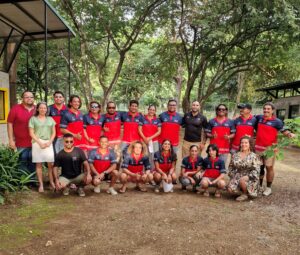
The Costa Rican delegation consisted of six students who competed alongside young mathematicians from more than one hundred countries. Their participation once again highlighted the mathematical talent being developed in Costa Rica and the extensive preparation behind these international competitions.
Two Honorable Mentions for the Costa Rican Delegation
The awards were received by Julián José Ramírez Aguilar and Sofía Rojas Cordero.
According to the competition’s official results, both students earned honorable mentions, with Julián Ramírez scoring 15 points and Sofía Rojas scoring 10 points.
An honorable mention is one of the individual distinctions awarded at the IMO. It recognizes participants who achieve an outstanding performance without reaching the score required for a medal.
For Costa Rica, these results represent another strong presence on the international mathematics stage and reflect the continuity of a training process that begins with national competitions.
Six Students Represented Costa Rica in Shanghai
The national delegation consisted of six young mathematicians: Dylan Joel Laguna Arias, Julián José Ramírez Aguilar, Kailash Kleinman Siddharth, Luisa Rodríguez Soto, Sara Fonseca Carrión, and Sofía Rojas Cordero.
The team was accompanied by professors Daniel Campos Salas, from the University of Costa Rica, and David Masís Flores, from the Costa Rica Institute of Technology.
Participation in international competitions of this level requires a selection and training process that takes place throughout much of the year through the Costa Rican Mathematical Olympiads, known as OLCOMA.
A Competition Bringing Together the World’s Top Young Mathematicians
The International Mathematical Olympiad is one of the world’s leading international academic competitions for secondary-school students.
The 2026 edition brought together 666 participants from 117 countries and regions, who competed by solving six highly challenging mathematical problems.
The competition primarily evaluates reasoning and problem-solving skills. Rather than simply applying formulas learned in class, participants must develop strategies to solve complex problems and provide rigorous mathematical justifications.
The structure of the examination tests different areas of mathematical reasoning, making the IMO an important international meeting point for young people with exceptional mathematical abilities.
Preparation Begins Long Before the Competition
Reaching an international competition such as the IMO requires months of intensive training.
Before traveling to China, the six members of the Costa Rican delegation participated in the International Mathematics Summer Camp (IMSC), organized by the Beijing Institute of Mathematical Sciences and Applications (BIMSA).
During three weeks of intensive training, students attended classes and seminars led by specialists from different countries. The program helped strengthen their mathematical knowledge and exposed them to problems similar to those they would later encounter during the competition.
The process demonstrates that results at an international olympiad are the outcome of extensive preparation and the support of teachers, coaches, and specialized organizations.
The Role of the Costa Rican Mathematical Olympiads
International participation forms part of a broader educational process developed in Costa Rica through OLCOMA.
The program aims to promote mathematics among secondary-school students by developing reasoning and problem-solving skills. It also seeks to encourage a deeper interest in mathematics and science.
OLCOMA operates through collaboration between Costa Rica’s public universities — UCR, TEC, UNA, UNED, and UTN — together with the Ministry of Public Education (MEP) and the Ministry of Science, Innovation, Technology and Telecommunications (MICITT).
This structure makes it possible to identify students with mathematical talent, provide them with specialized training, and prepare the teams that later represent Costa Rica in international competitions.
Promoting STEM Education and Scientific Careers
Scientific olympiads also serve a purpose beyond competition.
MICITT highlights these programs as opportunities to bring students closer to science and encourage interest in scientific and technological careers. Through these experiences, young people can develop their knowledge while exploring possible careers related to STEM fields: science, technology, engineering, and mathematics.
In the case of the Costa Rican Mathematical Olympiads, the program is open to students from both public and private schools and aims to encourage those who demonstrate interest and aptitude in mathematics.
A Growing International Track Record
The achievements of 2026 add to Costa Rica’s long-standing participation in international mathematical competitions.
Official IMO records show that Costa Rica regularly participates in the competition, with several students having received honorable mentions and medals in previous editions.
In 2025, for example, Costa Rican student Sebastián Aguilar Pineda received an honorable mention.
OLCOMA also maintains records of awards obtained by Costa Rican students in different international competitions, demonstrating the continuity of the country’s mathematical training programs.
More Than an Academic Achievement
For the participating students, an international olympiad is also an opportunity to learn outside the classroom.
During their time in Shanghai, members of the Costa Rican delegation highlighted the opportunity to meet young people from different countries who share their passion for mathematics.
Julián Ramírez explained that the competition allowed him to take on new challenges and develop his potential, while Sofía Rojas highlighted the opportunity to discover new abilities and share the experience with students from around the world.
Other members of the delegation also emphasized the friendships and cultural exchange created during the trip.
This is an important aspect of international olympiads: in addition to measuring academic performance, they create connections between young people with similar scientific and academic interests.
A New Generation of Mathematical Talent
Costa Rica’s participation in the 2026 IMO demonstrates that the country continues to create opportunities to identify and support young people with mathematical talent.
The two honorable mentions earned by Julián Ramírez and Sofía Rojas are the visible result of a process involving selection, training, academic support, and participation in national and international competitions.
Beyond medals and distinctions, these experiences can help inspire scientific careers and bring younger generations closer to disciplines that are fundamental to education, research, and innovation.
The presence of six Costa Rican students among the 666 participants in the 2026 edition therefore represents another opportunity to showcase the country’s young talent on one of the world’s most demanding mathematical stages.
Sources of Information
International Mathematical Olympiad (IMO) — Official results of the 67th International Mathematical Olympiad 2026.
OLCOMA — Costa Rican Mathematical Olympiads — Information on the program, its structure, and Costa Rica’s participation in international competitions.
Ministry of Science, Innovation, Technology and Telecommunications (MICITT) — Official information on Costa Rica’s scientific olympiads and their role in promoting STEM careers.
Ministry of Public Education (MEP) — Information on mathematical olympiads and the development of mathematical skills among Costa Rican students.