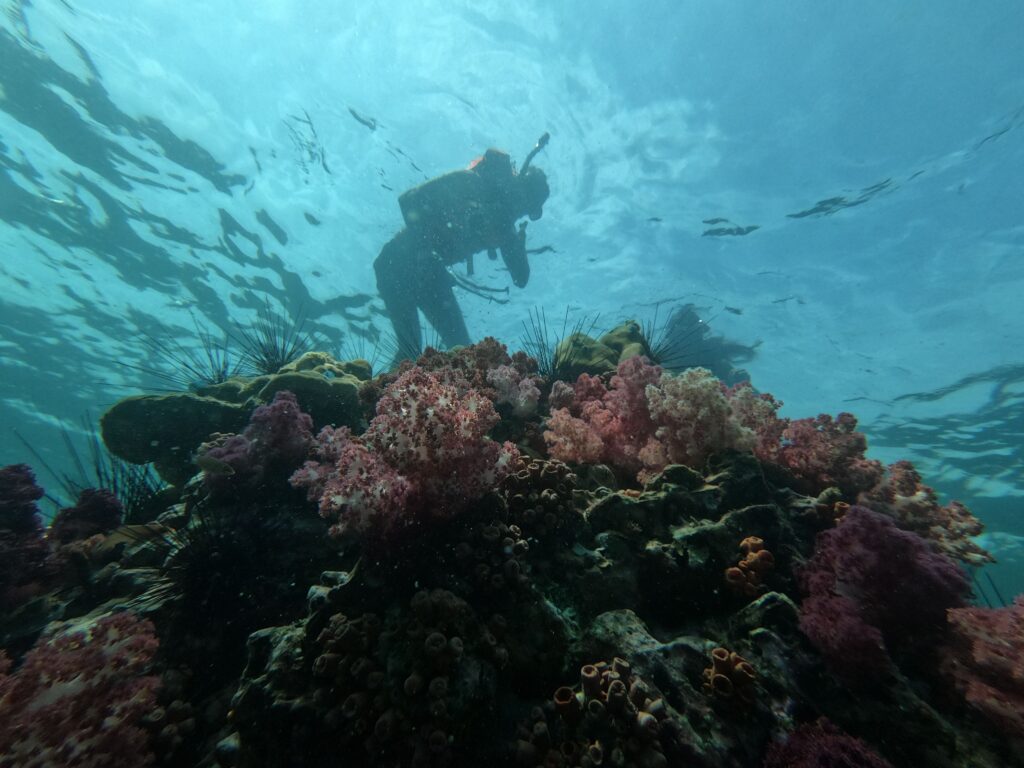
A temporary laboratory to reproduce corals in Manzanillo
Researchers have achieved a major milestone in coral restoration in Costa Rica. For the first time in the country, a team successfully raised coral larvae in a laboratory and returned nearly one million fertilized coral embryos to the reef at Manzanillo, on the southern Caribbean coast.
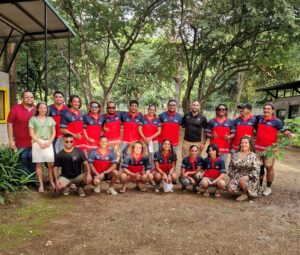
The project was carried out by Raising Coral Costa Rica in collaboration with the Scripps Institution of Oceanography at the University of California, San Diego. Between August and September 2026, researchers set up a temporary laboratory at the visitor center of the Gandoca-Manzanillo National Wildlife Refuge to work during the coral spawning season.
On the nights of September 3 and 4, around 20 participants collected coral reproductive material using nets. The team then fertilized eggs with sperm from different colonies, creating the conditions needed to produce new larvae.
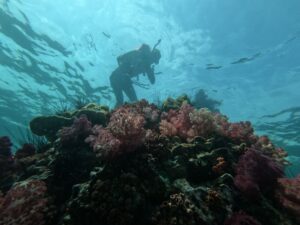
The project focused on species including elkhorn coral (Acropora palmata), which is critically endangered, and knobby brain coral. Tens of thousands of larvae were raised in the laboratory, while hundreds settled and developed into young coral polyps before being transferred to a coral nursery. The remaining larvae were released into the reef at the end of the spawning season.
Why sexual reproduction can help restore coral reefs
Corals can reproduce in different ways. One commonly used restoration method involves fragmenting existing colonies and growing the fragments into new corals. However, this process generally produces genetically identical organisms, or clones, of the original colony.
Sexual reproduction, by contrast, combines genetic material from different parent colonies. This creates greater genetic diversity, which may help coral populations respond more effectively to diseases, rising ocean temperatures and other environmental pressures.
The return of nearly one million fertilized embryos to the Manzanillo reef therefore represents an important step in testing new approaches to coral restoration. However, the number of embryos released does not guarantee that they will all survive and develop into mature colonies. Their success depends on several factors, including environmental conditions and their ability to settle on suitable surfaces.
The challenge of turning larvae into new colonies
One of the main challenges in coral restoration is helping larvae settle and develop into young corals. Researchers are studying the role of bacteria that may act as signals and encourage larvae to settle on the reef.
The team is also exploring the possibility of incorporating these bacteria into hydrogels that could be used to coat reef surfaces or restoration structures. The aim is to create conditions that make it easier for larvae to settle and establish themselves.
This research could help improve restoration techniques in the future by increasing the chances that young corals will survive beyond the initial release stage.
The project is part of a three-year research initiative funded by the Coral Research and Development Accelerator Platform (CORDAP). Two additional coral spawning seasons remain, allowing the researchers to continue testing and refining their methods.
A protected reef within the Gandoca-Manzanillo Wildlife Refuge
The work is taking place within the Gandoca-Manzanillo National Wildlife Refuge, located on Costa Rica’s southeastern Caribbean coast, in the province of Limón, near the border with Panama.
The protected area covers more than 10,000 hectares of land and marine environments. Its ecosystems include beaches, wetlands, lagoons, flooded forests, seagrass beds and coral reefs. The refuge protects approximately five square kilometres of coral reef around Punta Uva, Manzanillo and Punta Mona.
These ecosystems are important for marine biodiversity and provide habitats for a wide range of species. Protecting them is essential, particularly as coral reefs face increasing pressure from warming oceans, pollution and other environmental changes.
In addition to restoration projects, responsible visitor behaviour remains important. The refuge recommends avoiding stepping on corals or removing them, as even seemingly minor damage can affect these fragile ecosystems.
Coral restoration already has a history in Costa Rica
The Manzanillo project builds on several years of coral restoration work in Costa Rica. Research and restoration initiatives have been developed along both the Pacific and Caribbean coasts, including projects in Golfo Dulce, Manuel Antonio, Sámara, Bahía Culebra and Cahuita.
A national protocol for restoring coral reefs and coral communities was developed by Costa Rica’s National System of Conservation Areas (SINAC) and the German Agency for International Cooperation (GIZ). Published in 2020, this document provides guidance for restoration work, including coral cultivation and transplantation.
Scientific studies have also documented progress in restoration initiatives across the country, as well as observations of coral spawning at several locations along the Caribbean coast.
The Manzanillo initiative adds a new dimension to these efforts by testing the laboratory rearing of coral larvae and their subsequent release into the natural environment. The results could help inform future restoration projects in Costa Rica and elsewhere.
Local communities also contribute to coral recovery
The project relies not only on scientific research but also on the participation of local communities. Residents, members of the local development association, refuge staff, SINAC representatives, boat captains, diving instructors, educators, coral farmers and volunteers have all contributed to the initiative.
Students have also visited the temporary laboratory and taken part in releasing coral larvae. These activities provide an opportunity to learn about coral reproduction and the challenges involved in protecting marine ecosystems.
Local participation is particularly important for long-term conservation projects, which depend on cooperation between researchers, public institutions and the communities living near the ecosystems being restored.
A new opportunity for Costa Rica’s Caribbean reefs
The return of nearly one million fertilized coral embryos to the Manzanillo reef marks an important step for coral restoration in Costa Rica. By combining laboratory research, fieldwork and community participation, the project is testing ways to support the recovery of threatened coral populations.
The results will need to be monitored over time to determine how many larvae settle, survive and eventually develop into new colonies. The next two spawning seasons will provide further opportunities to assess the method and improve the restoration process.
Although coral reef recovery remains a long-term challenge, this initiative offers a new avenue for protecting the biodiversity of Costa Rica’s Caribbean coast.
Sources
- The Tico Times. “Coral Larvae Raised in Costa Rica for the First Time.” October 13, 2026.
- Delfino.cr. “Investigadores logran criar larvas de coral por primera vez en Costa Rica.” October 12, 2026.
- SINAC. Institutional information on the Gandoca-Manzanillo National Wildlife Refuge.
- SINAC and GIZ. Protocol for the Restoration of Coral Reefs and Coral Communities in Costa Rica. 2020.
- Revista de Biología Tropical, University of Costa Rica. Coral Reefs Restoration Initiatives in Costa Rica: Ten Years Building Hope.
- CORDAP. Information on its research and development program to accelerate coral reef restoration.