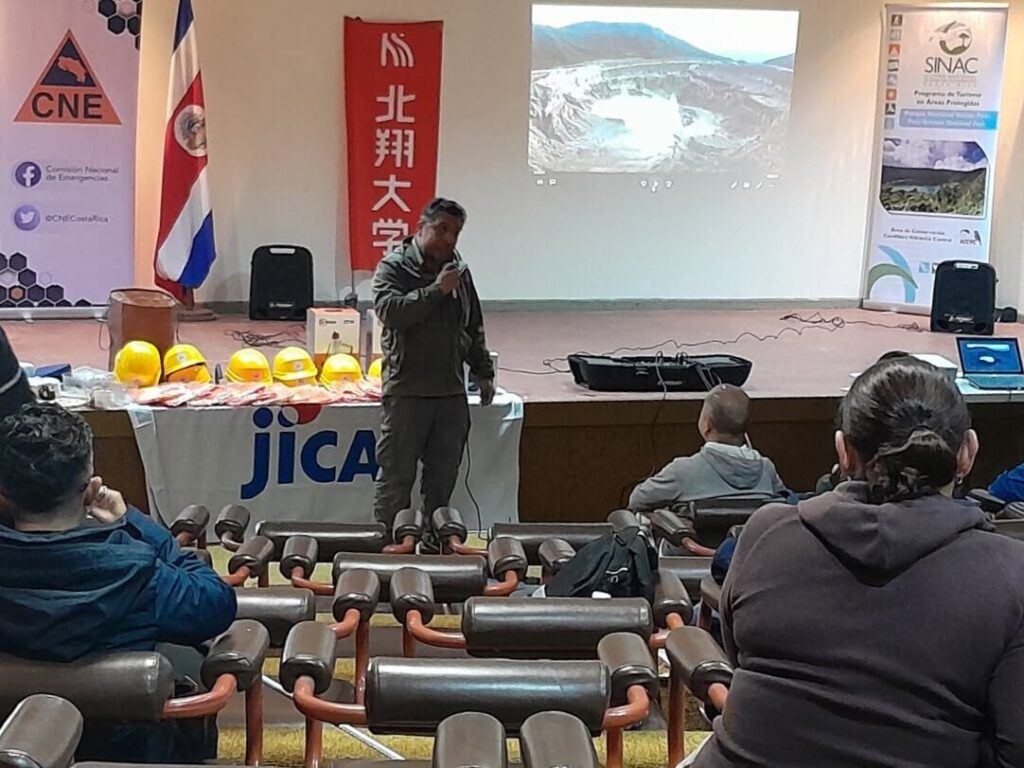
A strategic program for volcanic disaster prevention
Costa Rica has graduated a second cohort of the “Meisters of Volcanoes” program, an initiative designed to strengthen the country’s technical capacity in volcanic risk management. The program aims to train highly qualified specialists in monitoring, analyzing, and responding to volcanic activity, a critical need in a country with a high concentration of active volcanoes.
The initiative responds to the need to reinforce institutional and community preparedness in the face of potential volcanic emergencies, integrating scientific knowledge, technology, and inter-institutional coordination.
Costa Rica and its high volcanic activity
Costa Rica lies along the Pacific Ring of Fire, one of the most seismically and volcanically active regions in the world. The country is home to several active volcanoes, including Poás, Turrialba, Irazú, and Rincón de la Vieja.
These volcanic systems represent both a source of geological richness and tourism value, as well as a natural hazard that requires constant monitoring and preventive planning.
Volcanic risk management in Costa Rica is based on the joint work of scientific and emergency institutions that continuously monitor seismic and volcanic activity.
What is the Meisters of Volcanoes program?
The “Meisters of Volcanoes” program is designed to train professionals specialized in the comprehensive understanding of volcanic systems and the management of associated risks.
Its approach combines theoretical training, technical instruction, and fieldwork in active volcanic areas, allowing participants to gain direct experience in monitoring geological phenomena.
Training areas include:
- Monitoring seismic and volcanic activity
- Interpretation of geophysical and geological signals
- Risk management and emergency planning
- Risk communication to communities
- Inter-institutional coordination during crisis situations
Strengthening national technical capacity
The graduation of new cohorts contributes to strengthening the country’s capacity to prevent and respond to volcanic emergencies.
These professionals play a key role in scientific institutions and risk management agencies, supporting evidence-based decision-making and continuous analysis of volcanic activity.
Strengthening human capital in this field is essential to improving national resilience against extreme natural events.
The importance of continuous volcanic monitoring
Monitoring active volcanoes is essential to reduce risk and protect nearby populations.
In Costa Rica, this monitoring includes seismic stations, volcanic gas sensors, satellite imagery, and direct field observation.
The data collected allows authorities to issue early warnings, establish activity levels, and coordinate preventive actions with emergency agencies.
Risk management and vulnerable communities
Volcanic risk management is not limited to scientific monitoring; it also includes preparedness efforts in communities located near volcanoes.
Education, evacuation drills, and effective risk communication are essential components in reducing population vulnerability.
Collaboration between scientists, public institutions, and communities helps improve response capacity in the event of eruptions or related hazards.
Applied science for national safety
Programs such as the Meisters of Volcanoes highlight the importance of applied science in natural risk management.
Scientific knowledge not only improves understanding of volcanic processes but also translates into concrete measures for civil protection and land-use planning.
This type of initiative strengthens the link between scientific research and public decision-making.
A country prepared to live with volcanoes
Costa Rica has developed a strong culture of prevention regarding volcanic activity. Specialist training, continuous monitoring, and institutional cooperation form part of an integrated strategy for coexisting with these active natural systems.
The ongoing strengthening of technical capacities represents an important step toward reducing risks and protecting both the population and the country’s natural heritage.
Official sources consulted
National Commission for Risk Prevention and Emergency Response (CNE)
Volcanological and Seismological Observatory of Costa Rica (OVSICORI-UNA)
National Seismological Network (RSN-UCR)
Ministry of Environment and Energy of Costa Rica (MINAE)
UNESCO – Disaster Risk Management and Education
United Nations Office for Disaster Risk Reduction (UNDRR)