A historic milestone for South American wildlife conservation
Argentina has achieved a major conservation milestone with the release of a family of giant otters (Pteronura brasiliensis) into Gran Iberá Park, in the province of Corrientes. It is the country’s first successful reintroduction of a locally extinct mammal and one of the most ambitious wildlife restoration projects ever carried out in South America.
The initiative is the result of more than eight years of scientific work and international collaboration aimed at returning this iconic species to an ecosystem where it disappeared nearly forty years ago.
Beyond restoring a single species, the project seeks to rebuild the ecological balance of one of the continent’s most important wetland ecosystems.
A family prepared for life in the wild
The released family consists of Nima, a female from Madrid Zoo Aquarium in Spain; Coco, a male from Givskud Zoo in Denmark; and their two cubs, Pirú and Kyra, born in November 2024 as part of the Iberá conservation program.
All four animals are part of the European Endangered Species Programme (EEP) coordinated by the European Association of Zoos and Aquaria (EAZA), an international network that manages breeding programs for threatened species.
After several years of preparation, behavioral training, and adaptation, the family was released into Laguna Paraná, in the heart of Gran Iberá Park.
The return of South America’s largest aquatic predator
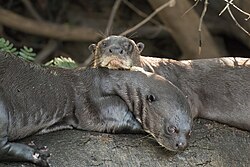
The giant otter, also known as the river wolf or giant river otter, is the largest aquatic mammal predator in South America.
Adults can grow up to 1.8 meters (6 feet) long and weigh approximately 33 kilograms (73 pounds). They are highly social, diurnal animals that live in close-knit family groups led by a breeding pair.
Their diet consists primarily of fish, making them apex predators in freshwater ecosystems. By regulating fish populations, giant otters help maintain healthy aquatic environments and balanced ecosystems.
Why did the species disappear from Argentina?
Until the mid-20th century, giant otters inhabited many rivers and wetlands across Argentina. However, intense hunting for the international fur trade, combined with habitat degradation and increasing human pressure on waterways, caused a dramatic population decline.
The country’s last known family groups were recorded in 1986, after which the species became locally extinct.
Globally, the International Union for Conservation of Nature (IUCN) classifies the giant otter as Endangered, mainly due to habitat loss, water pollution, and fragmentation of its remaining populations.
Iberá offers ideal conditions for recovery
With more than 756,000 hectares of protected wetlands, Gran Iberá Park is one of South America’s largest and most valuable freshwater ecosystems.
Its abundant fish populations, legal protection, and absence of major threats such as hunting make it an ideal location for restoring locally extinct species.
Over the past two decades, Iberá has become an internationally recognized model for ecological restoration through successful reintroductions of species including the jaguar, giant anteater, collared peccary, red-and-green macaw, and now the giant otter.
A project that required years of preparation
Planning for the reintroduction officially began in 2017, although the original concept dates back more than a decade earlier.
Scientists faced an unprecedented challenge: Argentina no longer had any captive or wild giant otters, making international cooperation essential to establish a founding population.
The project involved veterinary protocols, quarantine facilities, specialized transport methods, pre-release enclosures, training with live fish, and behavioral conditioning to prepare the animals for survival in the wild.
Researchers also developed new handling and transportation techniques specifically designed for this species.
Technology supports long-term conservation
Following the release, researchers continue to monitor the otter family using specially designed tracking devices.
The animals’ movements and behavior are closely observed, while environmental DNA (eDNA) analysis helps confirm their presence and assess their adaptation without disturbing them.
This long-term scientific monitoring will provide valuable information for evaluating the project’s success and guiding future reintroduction efforts worldwide.
International cooperation made the project possible
The return of the giant otter has been made possible through close collaboration among numerous national and international organizations.
The initiative brings together Rewilding Argentina, Argentina’s National Parks Administration, the Government of Corrientes Province, Projeto Ariranha in Brazil, and several zoological institutions across Europe and the United States that contributed animals, expertise, and scientific support.
This collaborative model demonstrates how modern conservation depends on partnerships between governments, research institutions, conservation organizations, and international breeding programs.
A new hope for South America’s biodiversity
The return of the giant otter to Gran Iberá Park represents far more than the recovery of a single species.
As a top predator, the giant otter plays a vital role in restoring ecological processes that had been absent for decades while strengthening one of South America’s richest wetland ecosystems.
The project demonstrates that, through scientific planning, international cooperation, and long-term habitat protection, locally extinct species can successfully return to the wild.
Official sources consulted
- Argentina National Parks Administration (APN).
- Rewilding Argentina Foundation.
- International Union for Conservation of Nature (IUCN) Red List of Threatened Species.
- European Association of Zoos and Aquaria (EAZA).
- Projeto Ariranha (Brazil).
- Convention on International Trade in Endangered Species of Wild Fauna and Flora (CITES).