Last Friday, May 8th, Costa Rica once again witnessed the greatest triumph of its democratic system: the peaceful transfer of power. With the echoes of celebrations still present and the presidential sash already draped over the shoulders of Laura Fernández Delgado, the country formally begins a new political chapter that will be written into the history books.
The Value of a Consolidated Tradition
Beyond the solemnity of the protocol and the decorated streets of San José, the weekend’s events served as a reminder of Costa Rica’s social pact. In a region where changes of power often bring tension, the transfer of power in Costa Rica remains a “civilian torch relay,” a pillar reaffirmed decade after decade that demonstrates the maturity of its institutions.
The Milestone of 2026 and the Continuity of the Mandate
The images from Friday not only documented the beginning of the 2026–2030 term, but crystallized a historic moment: the rise of the second woman to the Presidency of the Republic.
However, Fernández’s mandate goes beyond gender symbolism. Following a decisive first-round victory last February, the new president takes control of the Executive not as a figure of rupture, but with solid popular support to continue and evolve the outgoing administration’s governance model. Now, with the ceremonial acts concluded, the real test begins for this new government.
The Key Players: A Reaffirmed Mandate
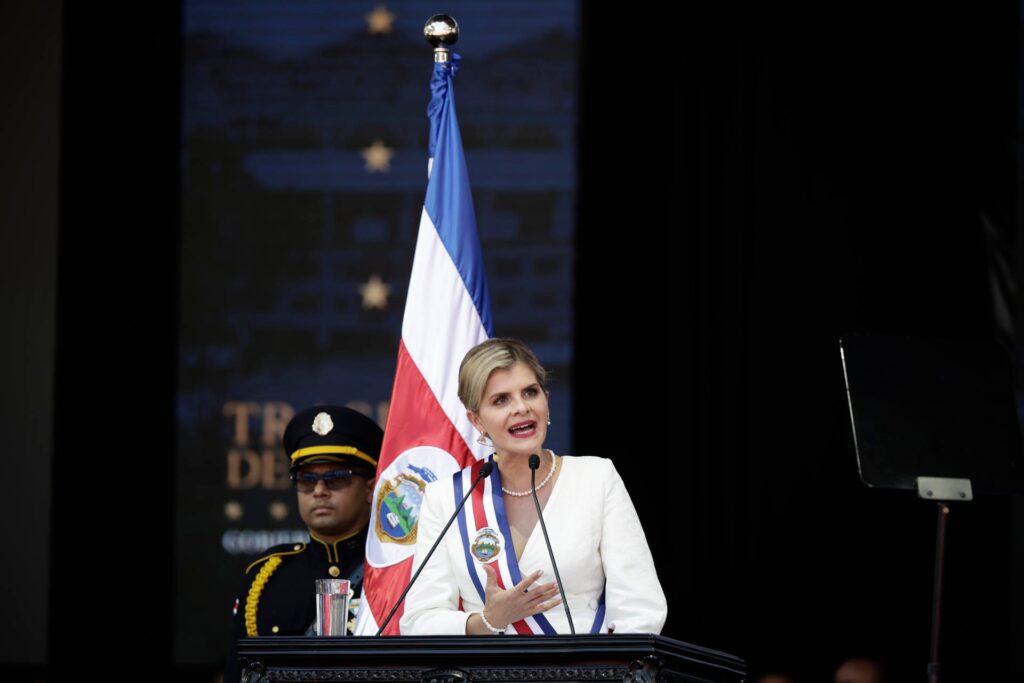
Last Friday, the faces of the new administration ceased to be campaign profiles and became, officially, the stewards of the country’s destiny. The central figure of the day, Laura Fernández Delgado, assumed her role projecting the firmness of someone who knows the state apparatus from the inside. As a political scientist and former head of Planning and the Presidency, her bearing during the ceremony sent a message of technical authority and control.
Alongside her, the swearing-in of her vice presidents complemented the strategic vision of the new government:
- Francisco Gamboa (First Vice President): His presence reaffirmed the administration’s commitment to economic reactivation, attracting investment, and constant dialogue with productive sectors.
- Douglas Soto (Second Vice President): He projected the financial stability and administrative strength needed to execute the promised infrastructure and social development projects.
Fernández enters the Presidential House of Zapote with considerable political capital. The decisive 48.5% of votes obtained in February under the banner of the Pueblo Soberano party materialized in the strong popular support seen in the streets. The ceremony demonstrated that the new president takes power with robust legitimacy, backed by an electorate that voted explicitly for continuity and the deepening of a governance model.
The Protocol: The Symbolic Weight of the Presidential Sash
The transfer of power in Costa Rica is an event where civic forms are just as important as political substance. Under the strict rigor of the Legislative Assembly’s Solemn Session, San José was transformed for a few hours into the epicenter of Latin American civism.
The democratic liturgy followed its steps to perfection:
- The Constitutional Oath: With hand on the Constitution, the commitment demanded by the Legislative Directorate marked the exact legal moment at which Fernández assumed the weight of the Republic.
- The Transfer of the Sash: This was the defining image of the day. Watching outgoing president Rodrigo Chaves Robles remove the Presidential Sash — the supreme symbol of Executive Power — to have it placed on Laura Fernández’s shoulders encapsulated the essence of May 8th. It is the visual reminder that, in Costa Rica, power is transitory and belongs exclusively to the people.
- International Support: The solemnity of the event was witnessed by a significant global presence. The attendance of Central American heads of state, high-level diplomatic missions from the Americas and Europe, and representatives of multilateral organizations served to validate the new government on the global stage and reaffirm Costa Rica’s position as a strategic and unwavering ally of international democracy.
Beyond the Protocol: The First Speech and the Civic Celebration
Once the formality of the inauguration concluded, Friday unfolded on two equally vital fronts for national life: the outlining of the new government policy and the traditional citizens’ celebration in the streets of the capital.
The First Address to the Nation: Laura Fernández Delgado’s inaugural speech was, above all, a declaration of operational intent. Far from electoral rhetoric, the president used her first official address to set the roadmap for the next four years and send clear signals of governability. Analysis of her words revealed three non-negotiable pillars for this administration:
- Public Safety: Her message was emphatic in addressing the country’s greatest concern. A frontal stance against organized crime was outlined, with specific promises to strengthen police forces and a clear demand for efficiency from the judicial system.
- Continuity and Economic Growth: She reaffirmed the promise to maintain fiscal discipline and continue reducing the cost of living. Fernández’s words sought to project certainty to international markets as well as to the local business and productive sector.
- Call for National Consensus: Aware of the legislative challenges ahead, the president extended bridges toward different political factions, emphasizing that current crises require “patriotic agreements” above partisan flags.
Challenges and Prospects: The 2026–2030 Horizon
With the lights of the National Stadium now off and the echo of celebrations faded, the administration of Laura Fernández Delgado faces the reality of governing. The post-electoral grace period is historically short in Costa Rica, and the mandate conferred at the ballot box demands results in critical areas from day one.
The outlook for the next four years presents structural challenges that will test the new Executive’s capacity for execution and negotiation:
- Legislative Dynamics: Unlike her predecessor, Fernández begins with an extremely favorable scenario in the Legislative Assembly. The ruling party’s bloc of 31 deputies grants her political muscle that no recent president has had. However, this near-majority power is a double-edged sword: it facilitates the passage of key bills, but eliminates excuses for lack of progress.
- Security and Organized Crime: This is undoubtedly the administration’s ultimate test. The country demands a halt to the wave of violence that has historically hit coastal provinces and spread to the Central Valley.
- Cost of Living and State Modernization: Although the macroeconomy shows signs of stability, the challenge is for those figures to reach the average citizen’s pocket. Fernández must balance strict fiscal discipline with reactivation policies that generate formal employment.
- Building Her Own Legacy: Politically, Laura Fernández’s greatest challenge will be consolidating her own identity as a stateswoman. Having come to power as the continuity figure of the movement begun by Rodrigo Chaves, she must prove she is not merely the executor of an inherited project, but a leader with her own vision.
May 8, 2026 is already history. From today, the success of the second woman to occupy the Presidency of Costa Rica will not be measured by the applause received during the transfer of power, but by the concrete solutions she manages to deliver to the country over the next four years.