An unexpected natural laboratory for studying wildlife
Decades after the Chernobyl nuclear accident, the exclusion zone remains one of the most studied places on Earth for understanding how nature responds to major human-caused disturbances.
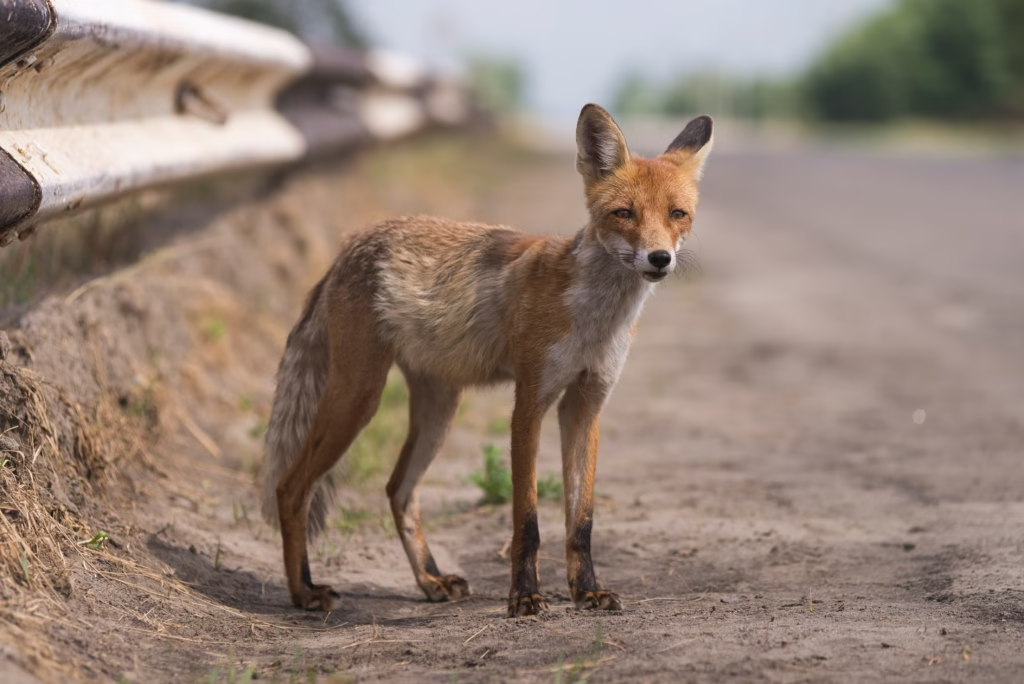
Researchers have observed that several wild species, including foxes, deer, and lynx, have changed some of their behavioral patterns in this territory shaped by radioactive contamination, limited human activity, and more recently, the effects of armed conflict in the region.
These studies reveal wildlife’s ability to adapt, while also showing that ecosystems can be influenced by several factors at the same time, not only by radiation.
A territory transformed over decades
The accident at the Chernobyl nuclear power plant in 1986 led to the evacuation of thousands of people and the creation of an exclusion zone around the affected area.
With the reduction of human presence, large areas of forests, wetlands, and abandoned agricultural land began transforming into habitats for numerous species.
The decline of activities such as farming, hunting, and urban development allowed some animal populations to expand, turning the region into an important research area for studying ecological recovery.
Foxes, deer, and lynx reveal new ecological patterns
Studies conducted in the region have made it possible to analyze how different species respond to a landscape where environmental conditions have changed over several decades.
Among the animals observed are:
- Foxes, known for their ability to adapt to different environments.
- Deer and other herbivores, which benefit from recovering vegetation areas.
- European lynx, a species that has returned to certain areas after long periods of absence.
Researchers study their movements, diets, reproduction, and interactions with the environment to understand how wildlife uses this transformed territory.
War introduces new challenges for the ecosystem
Although Chernobyl was already an area affected by major environmental changes, the armed conflict in the region has introduced additional pressures on ecosystems.
Military activity, human movement, infrastructure damage, and reduced scientific monitoring can influence the conditions affecting wildlife.
Researchers point out that separating the effects of radiation, reduced human activity, and the consequences of conflict is a complex scientific challenge.
Human absence and the return of species
One of the most studied aspects of Chernobyl is the impact of reduced human presence on biodiversity.
The exclusion zone has provided an opportunity to observe processes similar to those occurring in areas where human activity has significantly declined.
Some species have found favorable conditions due to lower hunting pressure, expanding vegetation, and increased habitat availability.
However, scientists emphasize that the presence of animals does not necessarily mean the ecosystem is free from problems. Radioactive contamination remains an important factor, especially in certain areas.
The importance of studying disturbed ecosystems
Chernobyl provides valuable information for understanding how ecosystems function after major disturbances.
This knowledge can help develop better conservation strategies in areas affected by:
- Industrial pollution.
- Land-use changes.
- Environmental disasters.
- Reduced human activity.
- Climate-related changes.
Long-term research makes it possible to observe ecological processes that cannot be understood over short periods.
Lessons for biodiversity conservation
The Chernobyl experience shows that nature has a remarkable ability to recover, but it also demonstrates that ecosystems respond to multiple complex factors.
The recovery of some animal populations does not eliminate the need to protect habitats and monitor environmental impacts.
For countries with high biodiversity, such as Costa Rica, these studies provide important examples of the relationship between human activity, conservation, and species adaptation.
Nature continues to reveal its ability to adapt
The changes observed in Chernobyl’s wildlife show that ecosystems can transform in unexpected ways when environmental conditions change.
Foxes, deer, lynx, and many other species continue to provide scientific information about the resilience of wildlife in extreme environments.
Studying these territories reminds us that understanding nature requires continuous observation, scientific research, and a broad view of all factors influencing biodiversity.
Official sources consulted
- International Atomic Energy Agency (IAEA)
- United Nations Environment Programme (UNEP)
- International Union for Conservation of Nature (IUCN)
- European Environment Agency (EEA)
- Chernobyl Exclusion Zone Management Authority