
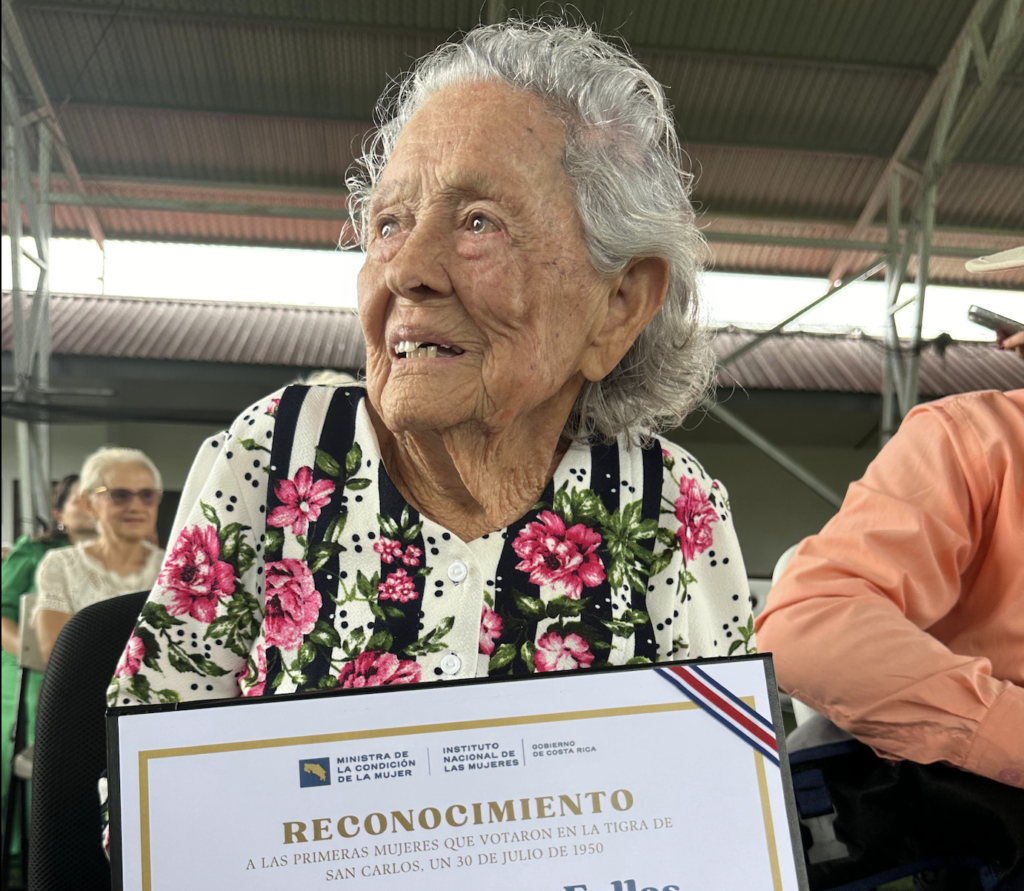
The 1949 Constitution laid the legal foundations, but the true test for Costa Rican democracy occurred in the years immediately afterward. Between 1950 and 1953, the country experienced an unprecedented expansion of its electoral base, finally integrating two historically marginalized sectors: women and the Afro-descendant population.
The Debut of Women’s Suffrage: From La Tigra to the Entire Country
Although the struggle for women’s suffrage in Costa Rica dates back to the late 19th century and intensified with the founding of the Liga Feminista in 1923, it was not until 1950 that it was exercised for the first time.
The setting was not a presidential election, but a local event: the plebiscite of La Tigra and La Fortuna on July 30, 1950. This technical event to decide the jurisdiction of these districts became a national milestone. Bernarda Vásquez Méndez was the first woman to cast her vote in the country’s history. Sources from the time highlight that, despite mocking and patriarchal speeches circulating in the press, the process was an example of civic responsibility that silenced criticism about the supposed “incapacity” of women to decide on public affairs.
1953: Full Citizenship and the End of Racial Exclusion
The 1953 general elections were the first in which women voted to elect a president and national deputies. However, this process also marked the formal integration of the population of Limón.
Historically, inhabitants of African descent in the Caribbean region had faced systemic barriers to obtaining nationality and, therefore, the right to vote. The triumph of the 1948 Revolution and the new Constitution eliminated mobility restrictions and facilitated mass issuance of identification cards in peripheral provinces.
Alex Curling Delisser: A Symbol in Congress
The culmination of this democratic opening materialized with the election of Alex Curling Delisser as Costa Rica’s first Afro-descendant deputy in 1953. Curling, a lawyer by profession, not only represented his province but became the “Soldier of Equality,” promoting laws that fought racial discrimination and encouraged cultural integration. His presence in the Legislative Assembly broke the myth of a national identity that was exclusively white and centralist.
The Impact on Democratic Culture
This stage transformed democracy from a “reduced format” into an inclusive polyarchy. The incorporation of new voters forced political parties to diversify their promises and to look toward the coasts and the needs of women, who began to occupy positions on boards of directors and within the social bases of the parties.
Sources consulted:
- Hace 75 años las mujeres votaron por primera vez en Costa Rica, Archivo Histórico.
- La lucha por el sufragio femenino en Costa Rica (1923-1953), Revista UCR / SciELO.
- Alex Curling Delisser, Biografía oficial de la Asamblea Legislativa.
- Afrodescendientes de valía, Documento de UNICEF.
- 60 años de la participación política de las mujeres, Instituto Nacional de las Mujeres (INAMU).