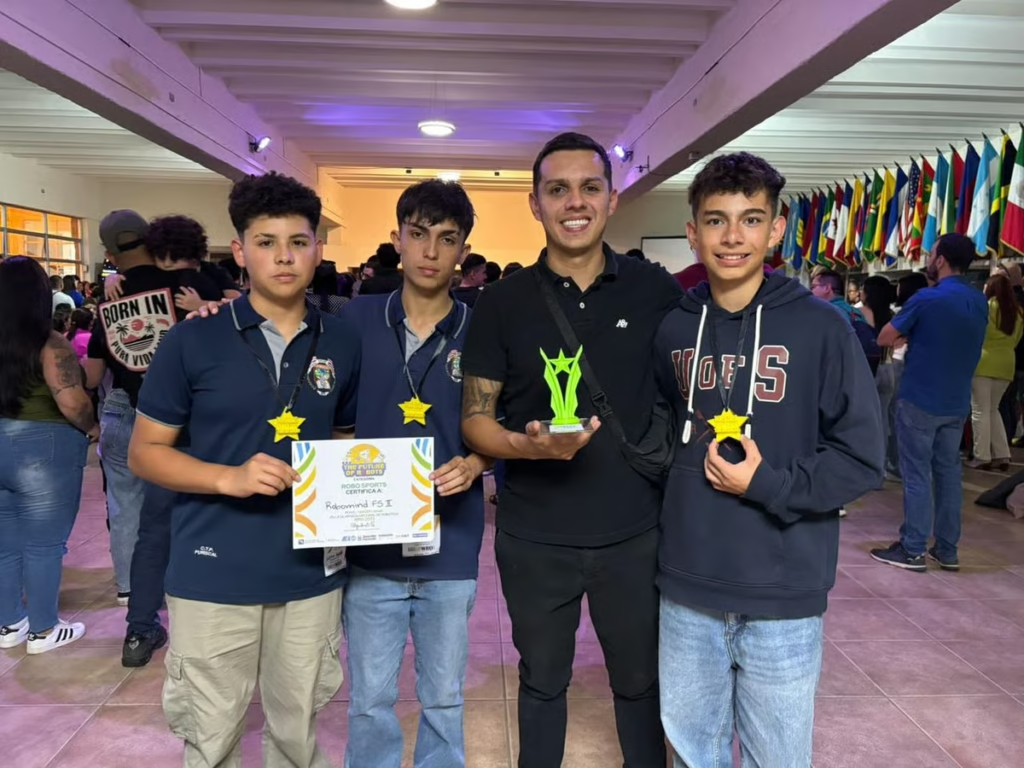
A group of students from Puriscal is preparing to take robots they designed and built themselves to a competition in the United States, combining programming, electronics, creativity, and problem-solving.
Their participation gives these young Costa Ricans the opportunity to put their knowledge to the test on an international stage and demonstrate that technological education can flourish beyond the country’s main urban centers.
The project is particularly relevant as education in science, technology, engineering, and mathematics — commonly known as STEM — continues to play an increasingly important role in education.
From Puriscal to an International Competition
The students developed their own robots as part of their preparation for the international competition. The process involves much more than simply building a machine: students must design a solution, program it, test it, and correct problems that arise during development.
Competitions of this kind allow students to move from theory to practical application while working with tools and concepts also used in engineering, programming, and technology-related professions.
The experience also highlights the potential of young people from Puriscal to take part in educational initiatives with an international reach.
Robotics as an Educational Tool
Robotics is playing an increasingly important role in technological education in Costa Rica.
The Ministry of Public Education (MEP) includes Physical Computing and Robotics within its National Technological Education Program. The program includes competencies related to creating physical devices or robots capable of addressing problems in their surroundings through functional prototypes.
The curriculum also seeks to develop skills related to programming, algorithms, electronics, and computational thinking.
Building a robot therefore involves much more than learning how to work with electronic components. Students must identify problems, develop solutions, program their prototypes, test them, and make improvements.
Learning Through Practice
One of the main benefits of these experiences is that students work directly on concrete projects.
During the development of a robot, they may encounter programming errors, component failures, movement problems, or design challenges. Solving them requires knowledge from different fields as well as teamwork.
Costa Rica’s technical education system also includes specific training related to robotics. MEP programs establish competencies involving robot programming and understanding the operating principles of different types of robots.
This creates a connection between classroom education and skills that can later be applied in fields such as engineering, computer science, robotics, electronics, and industry.
An Experience That Goes Beyond the Competition
Taking part in an international competition is itself an educational experience.
Students have the opportunity to meet young people from other countries, compare their projects, exchange knowledge, and face new challenges.
Costa Rican students have participated in various international robotics competitions in recent years. In 2025, for example, a Costa Rican delegation made up of 17 teams participated in the Open Championship Americas Panama, a competition endorsed by the World Robot Olympiad (WRO) that brought together participants from 26 countries.
The Costa Rican delegation included students from educational institutions in different parts of the country, including the Costa Rican Scientific High School of Puriscal.
The Potential of Technological Education Beyond the Greater Metropolitan Area
The students’ story also highlights the importance of bringing technological opportunities to communities outside Costa Rica’s main urban centers.
Puriscal has educational institutions involved in science and technology initiatives, while MEP has incorporated technological education into the competencies students are expected to develop throughout their education.
Access to these experiences can help young people discover interests and abilities that could eventually lead them toward careers in engineering, computer science, robotics, electronics, or the sciences.
Creativity as Part of Learning
Robotics competitions are not simply about determining who has built the most advanced robot.
Participants must find solutions to specific challenges while working within established rules. This makes creativity and adaptability just as important as technical knowledge.
For students, every error during development can become an opportunity to modify a design, change a program, or find a different solution.
This process of testing and learning from mistakes is one of the reasons robotics can be such a valuable educational tool.
A Representation That Begins in the Classroom
Behind an international competition lies a process that begins long before the trip: hours of learning, designing, programming, testing, and teamwork.
The robots created by the students from Puriscal are, in this sense, the visible result of a much broader educational process.
Their participation in the United States also offers a different perspective on Costa Rican talent: young people using technology to create, experiment, and compete internationally from a community outside the capital.
Sources
Ministry of Public Education (MEP): National Technological Education Program and official educational materials concerning technological education and robotics.
Ministry of Public Education (MEP): Information on Costa Rican students’ participation in the 2025 Open Championship Americas Panama and the involvement of the Costa Rican Scientific High School of Puriscal.
Ministry of Public Education (MEP): Technical education curriculum related to Electrotechnics, electronics, automation, and technological training.