• Costa Rica protects 24,000 hectares of mangroves with Marine PSA
• 129 people from Térraba and Sierpe signed contracts yesterday in Puntarenas
• 600 mollusk-harvesting families from the Pacific will receive a financial incentive for conservation in 2026
• Resources from the National Budget of the Republic make it possible to increase the number of beneficiary associations
• The program is permanent and operates along the entire Pacific coast
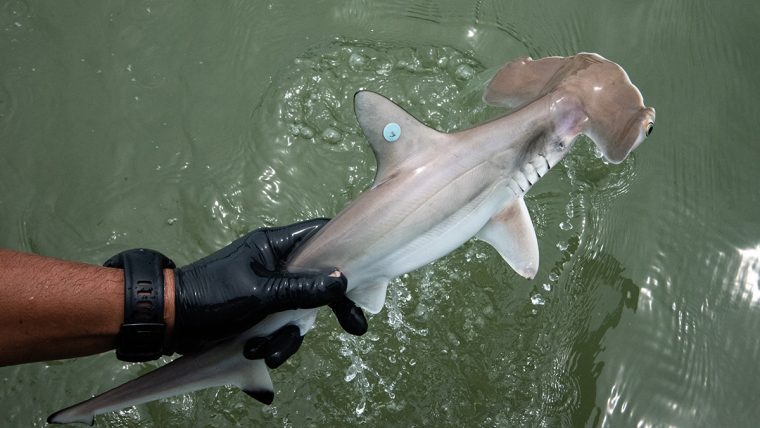
The Ministry of Environment and Energy, through the National System of Conservation Areas (MINAE-SINAC), together with the Environmental Bank Foundation (FUNBAM), began designing a new payment for the marine ecosystem service—Marine PSA (PSAM)—provided by releasing hammerhead sharks.
Within this stage, SINAC together with FUNBAM are designing a PSEM to recognize the ecosystem service generated by the release of hammerhead sharks. This occurs within the framework of Decree 43900-MAG-MINAE, which prohibited the capture, onboard retention, transshipment, landing, storage, and commercialization of products and by-products of hammerhead sharks, and which was later amended to additionally prohibit the transport of hammerhead fins within national territory, thus preventing the entry into the country of hammerhead fins caught abroad and their export to foreign markets. This PSEM is of great importance for SINAC and INCOPESCA since data from longline vessels will help make informed decisions regarding this fishery.
This new step is part of the Marine-Coastal Ecosystem Services Payment Program (PSEM), in which the State economically compensates sustainable management practices in mangrove ecosystems along the entire Pacific coast.
In the new stage, the National Ecosystem Services Payment Program (Law No. 10,507), implemented by MINAE (FONAFIFO-SINAC), together with INCOPESCA, is developing operational manuals to include new activities in the National Program.
Through the PSEM mechanism, work is also being done on a recognition scheme for artisanal fishers, which includes the installation of devices called “beacons” on vessels. This system emits a signal via satellite to allow real-time vessel location, providing fishers with an alert service in case of incidents at sea.
The process is being developed with technical support from key marine-coastal institutions: MINAE through the National Forestry Financing Fund, the National System of Conservation Areas (FONAFIFO-SINAC), the Environmental Bank Foundation (FUNBAM), and MAG through the Costa Rican Institute of Fisheries and Aquaculture (INCOPESCA). Together, these entities provide technical support to the various associations and cooperatives engaged in this activity.
“This effort seeks to expand the traditional land-based PSA program by taking it to the ocean and is based on technical plans that ensure the sustainable management of marine ecosystems by working with the people who care for the ocean and live in coastal areas,” explained the Minister of Environment and Energy, Franz Tattenbach.
Announcements to Protect the Ocean WITH and FOR People
The government, through the Ministries of Environment and Energy and Agriculture and Livestock (MINAE-MAG), announced yesterday that the country now has 24,000 hectares of mangroves protected under Marine PSA.
Among the positive milestones of this initiative for 2026, it was highlighted that 129 new mollusk-harvesting families from Térraba and Sierpe signed contracts with the State to receive Marine PSA—an economic recognition for conserving mangroves. These are four mollusk-harvesting cooperatives from Térraba and Sierpe (southern region of the country).
| Organization Name | Number of People |
|---|---|
| Family Association of Fishers and Piangua Harvesters of Sierpe | 29 |
| Mixed Association of Piangua Harvesters and Artisanal Fishers of Ciudad Cortés and Bocas del Río Térraba | 40 |
| Association of Piangua Harvesters and Agro-livestock Ecotourism of the Térraba-Sierpe Wetland | 20 |
| Association of Piangua Harvesters and Marine Resources of Ajuntaderas and Related | 40 |
| Total | 129 |
Beneficiary families receive disbursements (quarterly), through their associations, amounting to $216 (around 98,000 colones) per month.
These associations safeguard two mangroves in the southern part of the country, specifically in the Térraba-Sierpe area, where efforts have been carried out jointly with the Ministry of Public Security in matters of control and surveillance.
With these four organized groups from the Osa region, training workshops have been conducted by authorities from the Ministry of Environment and Energy through the National Forestry Financing Fund and the National System of Conservation Areas (FONAFIFO-SINAC) together with INCOPESCA from MAG.
Currently, there are a total of 544 mollusk harvesters under Marine Ecosystem Services Payment (PSEM) contracts, distributed among 15 associations along the Pacific coast: 7 groups in the Gulf of Nicoya, 4 groups in the central Puntarenas area, and 4 groups in the southern zone (Osa). The projection is to reach 600 mollusk harvesters in 2026.
The Ecosystem Services Payment scheme in mangrove forests began through a plan in 2024 with 6 organizations from the Gulf of Nicoya, benefiting 157 families. This was made possible thanks to financial resources from the international prize the country received, the Earthshot Prize, awarded by The Royal Foundation in the “Environmental Solutions” category for the Environmental Services Payment program implemented by FONAFIFO and SINAC’s Protected Areas System. It is worth noting that this first stage was strengthened by the government with an investment from the Ordinary National Budget amounting to 1.7 billion colones allocated this year by the Ministry of Finance to scale the mechanism nationwide.