Research from the University of Costa Rica (UCR) shows that knowledge about the country’s fungi remains incomplete. The study analyzed more than 78,000 records collected over approximately 170 years and helped update the number of fungal species known in Costa Rica.
The results indicate that 6,789 fungal species have currently been documented in the country. However, different methods used by researchers estimate that the actual diversity could be considerably greater, with estimates reaching as many as 40,373 species.
This figure is an estimate of potential diversity and does not mean that all 40,373 species have already been found and scientifically identified.
A Database Built Over 170 Years
The study, led by researchers from the University of Costa Rica, compiled 78,333 fungal records from national and international biological collections.
The records cover approximately 170 years of research, from the mid-19th century to recent years. Most of the specimens come from fungaria, specialized scientific collections that preserve fungal specimens, while a smaller proportion comes from culture collections.
Among the main Costa Rican collections used were those of the Luis Fournier Origgi Herbarium at the University of Costa Rica and the National Herbarium, associated with the National Museum of Costa Rica. Specimens preserved at scientific institutions in other countries were also included.
The UCR explained that building this database involved compiling information from thousands of records, standardizing data from different sources, and updating taxonomic classifications that had become outdated.
The Number of Known Species Increased
Before information from collections and scientific literature was integrated, 5,676 fungal species were recognized for Costa Rica.
The study increased this figure to 6,789 known species, representing an increase of nearly 20%.
However, the researchers point out that scientific collections do not represent all of the diversity present throughout the country. Of the 78,333 records analyzed, a large proportion has still not been identified to the species level.
In particular, approximately 80% of the records were identified only to the genus level. This means that researchers could determine which group a fungus belonged to, but could not necessarily identify its exact species.
This situation makes it difficult to determine whether some fungi are truly rare or have simply been collected very few times.
How Many Fungal Species Could Exist?
To estimate the diversity that may still be undocumented, the researchers used different estimation methods.
When only data from collections were analyzed, the study estimated a potential richness of around 4,155 species. This figure is lower than the total number of known species because the collections and the species list do not contain exactly the same information.
The researchers also used methods that did not depend exclusively on collections. Depending on the method used, the estimates were approximately 6,911 species, 25,798 species, or as many as 40,373 species.
The highest estimate was obtained by comparing fungal diversity with plant diversity in the country.
Therefore, the study does not establish that Costa Rica has 40,373 confirmed fungal species. The figure represents one of the scenarios used to estimate how much diversity could remain undiscovered or undocumented.
Regions That Remain Poorly Studied
The records compiled also show that fungal research has not been distributed evenly throughout the country.
Some regions have a greater number of records, including areas of the Talamanca mountain range, the Osa Peninsula, and certain areas of Guanacaste.
In contrast, other areas have much less representation in scientific collections. These include parts of the Nicoya Peninsula, the Central Pacific, and some forested areas in the mountains of Guanacaste.
This uneven distribution means that the absence of records in a region does not necessarily indicate lower fungal diversity. It may also reflect the fact that relatively little research or collection work has been carried out there.
The Relationship Between Fungi and the Rainy Season
The study also examined when fungi were collected throughout the year.
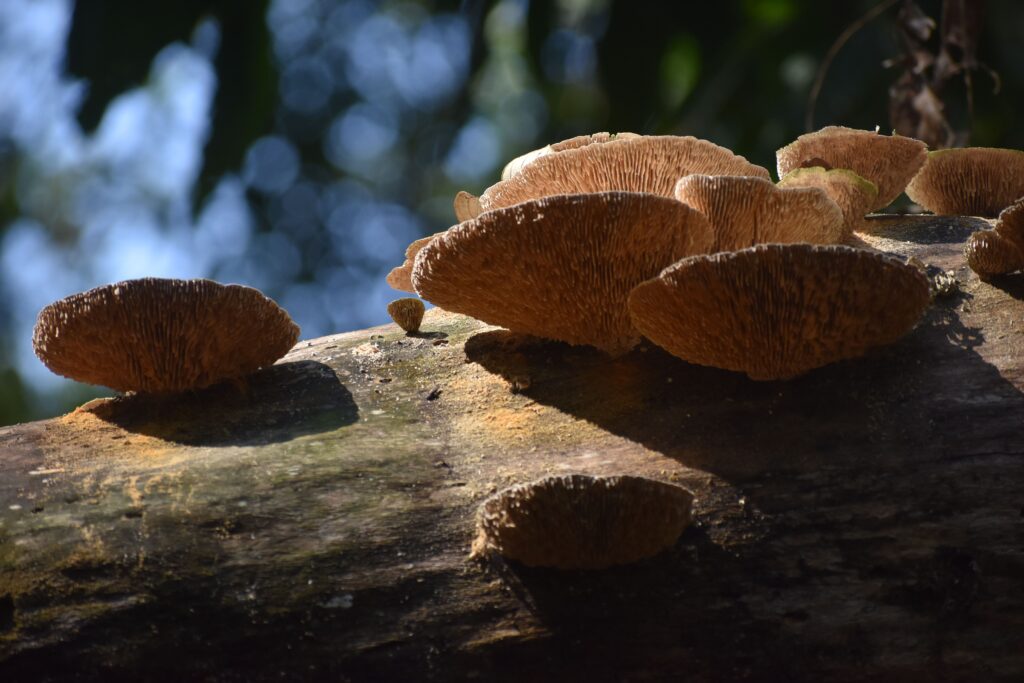
Researchers observed a greater number of specimens collected during the rainy season. The production of fruiting bodies, the structures through which many fungi become visible and reproduce, was associated with periods of greater humidity.
Among the records analyzed, the median was 98 specimens collected per day during the dry season, compared with 181 during the rainy season.
The researchers caution that this difference may also be influenced by scientists’ collection habits. More field expeditions may have been conducted during the wetter months, when many fungi are more visible.
Even so, the observed pattern shows an important relationship between humidity levels and recorded fungal activity.
Fungi Play Essential Roles in Ecosystems
Although they often receive less attention than mammals, birds, or plants, fungi perform fundamental functions within ecosystems.
They participate in the decomposition of organic matter and contribute to nutrient cycling in soils. Some species form relationships with plant roots and can help plants obtain water and minerals.
Other fungi are associated with plant diseases, while some species have potential applications in areas such as medicine, agriculture, and biological pest control.
The UCR research specifically highlights the need to incorporate fungi more systematically into biodiversity studies and conservation strategies.
Scientific Collections as a Record of Biodiversity
The researchers also emphasize the value of biological collections for understanding how biodiversity has changed over time.
Each preserved specimen can provide information about the place and date where it was collected. By bringing together thousands of these records, scientists can analyze distribution patterns and compare different historical periods.
In Costa Rica, fungal collections grew significantly between 1990 and 2015, a period during which numerous studies and collection efforts were carried out in different regions of the country.
Researchers now consider it necessary to continue expanding these collections and improve the identification of specimens that have not yet been studied to the species level.
A Challenge for Research and Conservation
The study identifies several needs for improving knowledge of Costa Rica’s fungi: conducting more fieldwork in poorly studied regions, better identifying specimens already held in collections, standardizing information about the locations where fungi are found, and strengthening the preservation of samples for future research.
The authors also highlight the importance of establishing a national microbial culture collection that would allow living samples to be preserved and facilitate their long-term study.
For Costa Rica, which has an extensive history of biodiversity research and conservation, the findings show that a significant part of the country’s biological diversity remains poorly studied.
Fungi represent one of these areas of knowledge. Studying them not only makes it possible to expand the country’s species inventory, but also to better understand how ecosystems function and the potential changes they could undergo in response to environmental transformations.
Sources
- University of Costa Rica (UCR): “Una base de datos de la UCR forma parte del Informe sobre el Estado Mundial de las Plantas y los Hongos 2026”, June 16, 2026.
- Mardones, Melissa; Carranza-Velázquez, Julieta; Rojas, Carlos: “Exploring Costa Rica’s fungal trends: Insights from digitized specimens”, Plants, People, Planet, published March 31, 2026.
- University of Costa Rica — Center for Research in Biodiversity and Tropical Ecology (CIBET): information on research related to the diversity and ecology of Costa Rica’s fungi.
- National Museum of Costa Rica: “Biodiversidad en la Gran Área Metropolitana, Hongos”.
- The Tico Times: “Costa Rica Could Be Home to More Than 40,000 Fungal Species, Study Finds”, September 28, 2026.