Researchers document a little-known species in Costa Rica’s Pacific waters
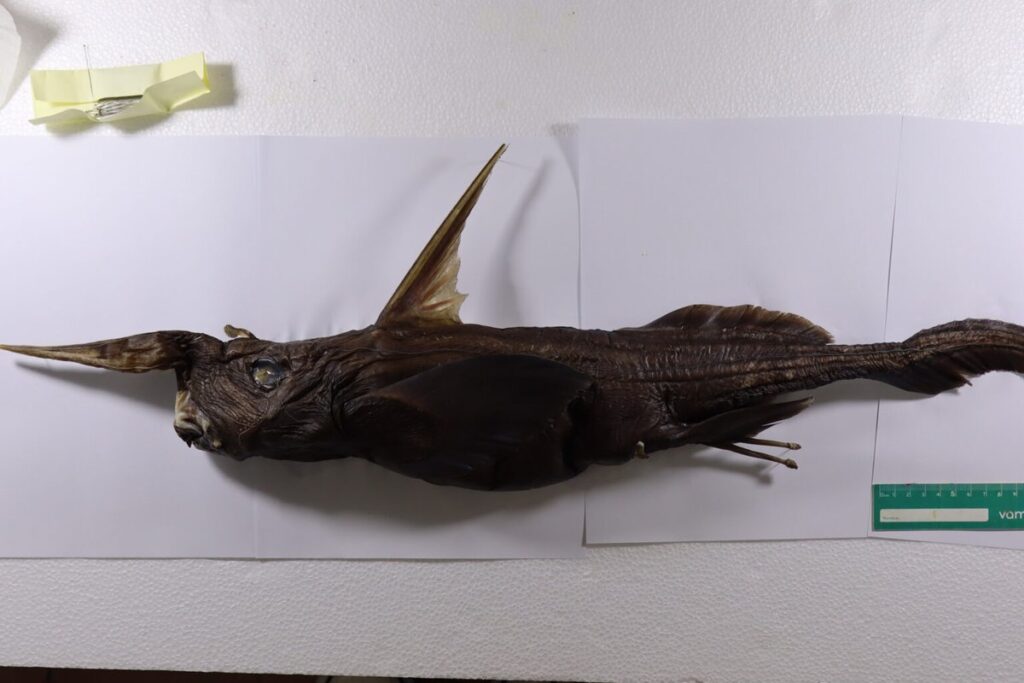
An international team of researchers, including scientists from the University of Costa Rica (UCR), has contributed to the study and description of a little-known cartilaginous fish found in the Pacific waters of Puntarenas. The discovery provides new information about a group of animals considered close relatives of sharks and rays, highlighting the scientific value of Costa Rica’s extraordinary marine biodiversity.
The research is part of ongoing efforts to better understand the evolution of cartilaginous fishes and to document species that remain poorly studied in the world’s oceans. This type of work also demonstrates the importance of scientific research carried out through collaboration between national universities and international institutions.
What are cartilaginous fishes?
Cartilaginous fishes belong to the class Chondrichthyes, a group that includes sharks, rays, skates, and chimaeras. Unlike most bony fishes, their skeletons are composed primarily of cartilage, a flexible yet highly durable tissue.
These animals represent one of the oldest groups of vertebrates still inhabiting the oceans, having evolved for more than 400 million years. Studying them helps scientists better understand the evolutionary history of marine ecosystems and the adaptation processes that have occurred over geological time.
A little-known group: the chimaeras
The species studied belongs to the group commonly known as chimaeras, or ghost sharks, deep-sea animals that are rarely observed because they typically live hundreds or even thousands of meters below the ocean’s surface.
Although they share a common ancestor with sharks and rays, chimaeras followed a different evolutionary path hundreds of millions of years ago, developing unique characteristics such as a single external gill opening, tooth plates instead of individual teeth, and a long, slender tail.
Because they inhabit deep-water environments, many species within this group remain poorly understood by science.
The contribution of the University of Costa Rica
The participation of researchers from the University of Costa Rica (UCR) highlights the growing role of Costa Rican science in international marine biodiversity research.
Scientists collaborate on studies combining morphological analyses, genetic research, anatomical comparisons, and the examination of scientific collections to identify the characteristics that distinguish one species from another.
This type of research requires cooperation among specialists from different countries as well as access to advanced laboratory technologies capable of confirming the identity of little-known organisms.
Puntarenas: a natural laboratory for marine research
Costa Rica’s Pacific coast is home to extraordinary biological diversity thanks to the convergence of multiple ocean currents and the wide variety of marine habitats found throughout the region.
Puntarenas has become one of the country’s leading centers for marine research, where universities and scientific institutions conduct studies on fish, marine mammals, invertebrates, coral ecosystems, and deep-sea environments.
Each new scientific record expands the national inventory of marine species and provides valuable information for understanding how these ecosystems function.
Why are discoveries like this important?
The identification of new species or the detailed study of little-known organisms helps improve marine conservation and resource management strategies.
Understanding a species’ distribution, biology, and population status is essential for evaluating threats such as accidental fishing, climate change, marine pollution, and habitat degradation in deep-sea ecosystems.
This scientific knowledge also strengthens the evidence needed to develop public policies aimed at protecting marine biodiversity.
Science, biodiversity, and international cooperation
The participation of the University of Costa Rica in this discovery reflects the important role that Costa Rican academic institutions play in global scientific research.
Through collaboration among universities, natural history museums, and research centers around the world, scientists continue expanding our understanding of species that remain poorly documented while contributing to the conservation of the world’s oceans.
Each new study demonstrates that Costa Rica’s marine ecosystems continue to offer remarkable scientific opportunities and still hold many species capable of deepening our understanding of marine evolution.
Recommended Official Sources
- University of Costa Rica (UCR)
- University of Costa Rica Museum of Zoology
- Center for Research in Marine Sciences and Limnology (CIMAR-UCR)
- Ministry of Environment and Energy (MINAE)
- National System of Conservation Areas (SINAC)
- International Union for Conservation of Nature (IUCN)
- FishBase