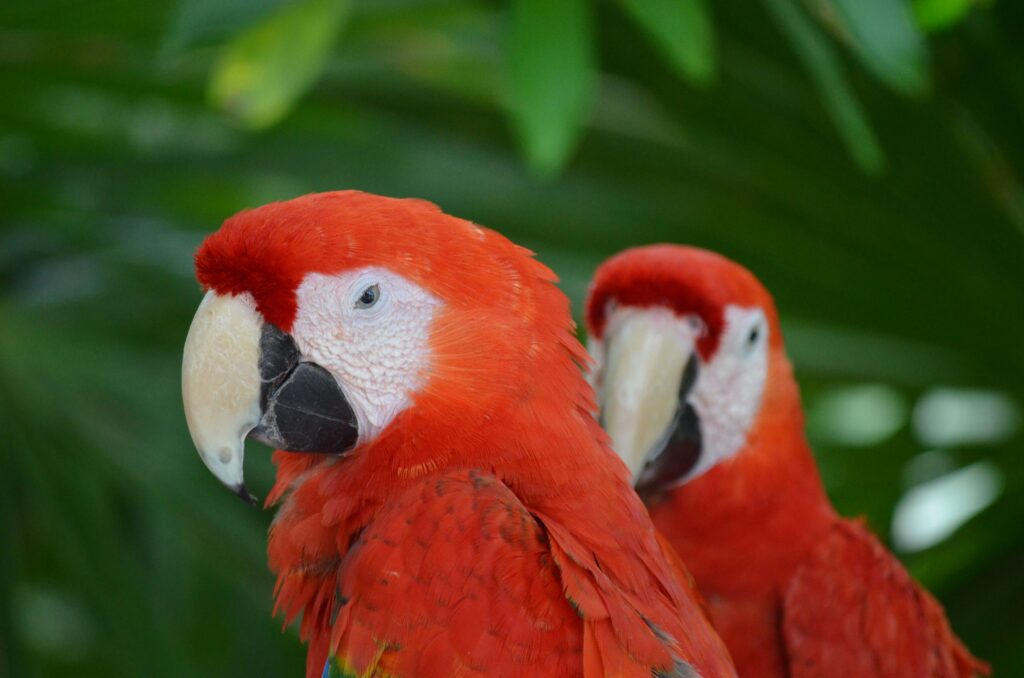
The possibility of allowing private ownership of certain wild birds in Costa Rica has sparked renewed concern among conservation organizations. The Tropical Science Center (CCT) has asked the Ministry of Environment and Energy (MINAE) to maintain the general prohibition on keeping macaws, parrots, parakeets and other wild birds as pets.
The position was presented in a 32-page technical assessment prepared by specialists in conservation, biology and wildlife management, as part of the process to develop new Wildlife Regulations. The CCT warns that greater flexibility around private ownership could make it more difficult to trace the origin of birds, facilitate illegal wildlife trafficking and create risks for wild populations and their genetic diversity.
A New Regulation Under Discussion
The debate stems from a process led by MINAE to replace the current regulations governing Costa Rica’s Wildlife Conservation Law.
According to information published about the proposal, the new regulations include provisions concerning the captive keeping of certain birds from the Psittacidae family, which includes macaws, parrots and parakeets. The proposal also addresses exotic species and hybrids under certain conditions.
The CCT believes that any changes should be analyzed not only from the perspective of the welfare of individual animals kept in captivity, but also by considering their potential effects on wild populations.
The Challenge of Traceability
One of the main arguments presented by the Tropical Science Center concerns the difficulty of determining the origin of certain birds with certainty.
The organization warns that broader private ownership could make it more difficult to distinguish between legally captive-bred individuals and birds illegally removed from their natural habitat.
This could create opportunities for wild-caught animals to enter the market under claims of domestic breeding, gifts or an old legal origin that is difficult to verify.
The concern is particularly relevant for species that have historically faced pressure from capture and trade.
The Great Green Macaw as a Conservation Example
One of the species at the center of the CCT’s analysis is the Great Green Macaw (Ara ambiguus), which the organization has studied and worked to conserve since 1994 through its Great Green Macaw Research and Conservation Program.
According to CCT records, the Costa Rican population numbered just over 200 individuals in the 1990s, while recent counts have recorded at least 500 individuals. The organization attributes this recovery to a combination of protection measures, environmental education, habitat conservation and restrictions on the theft of chicks.
However, the CCT considers the recovery fragile and believes that any changes to rules concerning the ownership and breeding of these birds must take potential effects on wild populations into account.
The organization also notes that the species remains closely linked to the conservation of its habitat, particularly the almendro de montaña (Dipteryx panamensis).
The Connection Between the Great Green Macaw and the Almendro Tree
The conservation of the Great Green Macaw is closely connected to the protection of its habitat.
The almendro de montaña (Dipteryx panamensis) is particularly important to the species. According to the CCT, this tree plays a major ecological role for the Great Green Macaw, providing an important food source and suitable nesting sites.
This relationship demonstrates that protecting a species does not simply mean preventing its capture. It also means protecting the ecosystems and plant species it depends on for food and reproduction.
The Risk to Genetic Diversity
Another issue highlighted by the CCT concerns genetics.
Specialists argue that every wild individual forms part of a population with genetic diversity developed over thousands of years of evolution. Removing individuals from the wild can therefore represent a loss that extends beyond the individual bird.
The organization also warns about the potential consequences of uncontrolled private breeding, including inbreeding, mixing different lineages or species, and producing individuals that may later be unsuitable for conservation or reintroduction programs.
Bird Welfare Is Also Part of the Debate
The discussion is not limited to the conservation of wild populations.
The CCT also points out that psittacines — the group that includes macaws, parrots and parakeets — have specific needs related to flight, social interaction, cognitive stimulation and nutrition.
Domestic captivity can create welfare problems when these needs cannot be adequately met. The organization also warns that prolonged habituation to humans can make it more difficult for birds to return to the wild later.
What Would Happen to Birds Already Kept by Private Individuals?
The CCT is not proposing that every bird currently kept by private individuals should automatically be confiscated.
For existing cases, it recommends establishing a strict transitional regularization system that would allow authorities to identify individual birds and assess their situation.
The proposed measures include individual identification, veterinary assessments, restrictions on breeding and trade, and, when necessary for welfare or legal reasons, transfer to authorized facilities.
Specialized Centers as an Alternative
For confiscated, rescued or voluntarily surrendered animals, the CCT proposes that they remain in specialized facilities such as rescue centers, conservation zoos, non-commercial sanctuaries or other facilities authorized by SINAC.
These facilities would need to have management plans, veterinary care, biosecurity measures, traceability systems and professional supervision.
The objective would be to ensure that the animals receive appropriate care and that their management contributes, whenever possible, to conservation objectives.
A Position Rooted in Conservation Policy
Costa Rican legislation recognizes the importance of protecting wildlife and its habitats.
The CCT’s position is based in part on the country’s wildlife conservation framework and on the principle that wildlife should be managed with the protection of populations and ecosystems in mind.
In the case of the Great Green Macaw, the organization also points to legal and constitutional protections connected to the species and the ecological importance of the almendro tree.
A Debate That Goes Beyond Pets
The current debate raises a broader question: how should Costa Rica manage wild animals that have historically been kept by people as pets?
For conservation organizations, the answer should consider not only the welfare of individual animals but also the cumulative impact on populations, ecosystems and biodiversity.
Costa Rica has a long tradition of protecting its natural heritage. The discussion surrounding the new Wildlife Regulations therefore represents an opportunity to examine how effective controls against illegal wildlife trafficking can be maintained while establishing clear mechanisms for animals that are already being kept in captivity.
The Process Continues
The Tropical Science Center’s request comes as the process of developing new Wildlife Regulations led by MINAE continues.
The proposal has prompted comments and concerns from different organizations and specialists. In July, the Association for the Preservation of Wildlife and Flora (Apreflofas) also asked MINAE to pause the process, expressing concerns about several provisions of the proposed regulations.
For now, the debate continues, and the final provisions will depend on the relevant regulatory process.
What is at stake is not simply whether certain birds can be kept at home, but how Costa Rica will continue balancing animal welfare, species conservation, the prevention of illegal wildlife trafficking and the protection of its natural heritage.
Official and Technical Sources
Tropical Science Center (CCT): technical information on the conservation of wild birds and the Great Green Macaw.
National System of Conservation Areas (SINAC): information on wildlife conservation and protected areas.
Ministry of Environment and Energy (MINAE): institution responsible for Costa Rica’s environmental and wildlife policies.
Costa Rican legal framework: legislation governing wildlife conservation and the protection of species.