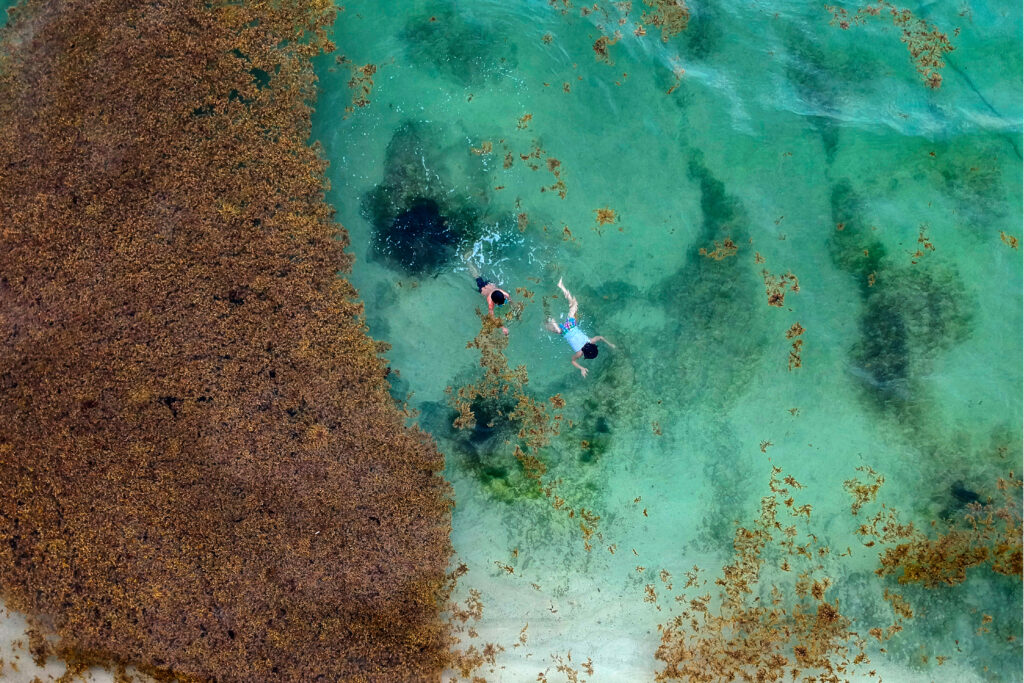
A Natural Phenomenon Reaching Historic Levels
The Caribbean coastline is experiencing an exceptional sargassum season. Throughout 2026, scientists and international monitoring systems have reported record amounts of this floating seaweed across the tropical Atlantic Ocean, the Caribbean Sea, and the Gulf of Mexico. Several Caribbean regions are already seeing accumulations exceeding those observed in previous years, and experts warn that the season has not yet reached its peak.
Along Costa Rica’s Caribbean coast, beaches and coastal communities have begun to experience a significant increase in sargassum arrivals, creating environmental and tourism-related challenges, particularly during June and July, which are traditionally the months of highest activity.
What Is Sargassum and Why Does It Reach the Shore?
Sargassum is a type of floating brown seaweed that naturally develops in the Atlantic Ocean. In open waters, it plays an important ecological role by providing shelter and food for numerous marine species, including juvenile fish, sea turtles, crustaceans, and other forms of ocean life.
However, when large quantities are carried toward the coast by ocean currents, winds, and tides, they can accumulate on beaches. As the seaweed decomposes, it may produce unpleasant odors and temporarily alter coastal ecosystems, while also affecting the experience of visitors and local residents.
Record Levels Raise Concern Across the Region
Satellite data collected by the University of South Florida’s Sargassum Watch System indicate that May 2026 saw approximately 28.9 million tons of sargassum spread across the tropical Atlantic, Caribbean, and Gulf of Mexico. This represents one of the highest figures recorded since systematic monitoring began in 2011.
Researchers have observed substantial increases across nearly all monitored regions compared to previous years, reinforcing expectations that 2026 could become one of the most intense sargassum seasons ever documented.
Impact on Tourism and Coastal Communities
The Caribbean is one of the world’s most popular beach destinations. When large quantities of sargassum wash ashore, local authorities and tourism businesses often organize extensive cleanup efforts to keep beaches accessible and reduce impacts on economic activity.
Several Caribbean destinations have already reported significant accumulations during 2026, prompting stronger monitoring and coastal management measures. Although the phenomenon is natural, its growing scale has drawn increased attention from scientists, governments, local communities, and tourism operators.
Ongoing Research and Monitoring
Numerous scientific institutions are closely monitoring the evolution of the Great Atlantic Sargassum Belt, a vast mass of floating seaweed stretching between West Africa, the tropical Atlantic, and the Caribbean.
Several studies suggest that factors such as increased nutrient levels in ocean waters, climate-related changes, and variations in marine currents may contribute to the growth of these large algal blooms.
Thanks to satellite imagery, oceanographic models, and international observation systems, scientists are now able to predict sargassum movements and potential landfalls with greater accuracy than ever before.
Costa Rica’s Caribbean Coast Faces a Regional Challenge
While sargassum is not new to the Caribbean coast, 2026 records indicate that the region is experiencing a particularly intense episode within a trend that has become increasingly evident over the past decade.
For Costa Rica, continuous monitoring, institutional cooperation, and scientific research will be essential to better understand this phenomenon and minimize its impacts on coastal ecosystems and the communities that depend on tourism and marine resources.
Official and Reference Sources
- University of South Florida – Sargassum Watch System
- National Oceanic and Atmospheric Administration (NOAA)
- Center for Marine Sciences and Limnology Research (CIMAR-UCR)
- Ministry of Environment and Energy of Costa Rica (MINAE)
- National System of Conservation Areas (SINAC)