
Listen to the podcast version of this article.
The maritime-terrestrial zone (zona marítimo-terrestre) is the coastal strip extending from the high-tide line (línea de pleamar) inland for 50 meters. Under Costa Rican law, this zone is part of the public domain, meaning it is inalienable, imprescriptible, and reserved for the collective use of all citizens.
The principle of public domain ensures that no individual or private entity may appropriate, fence, or obstruct this strip. Its protection safeguards free pedestrian access to the shoreline, preserves environmental values, and upholds the right to a healthy environment as guaranteed by the Constitution.
2. Legal Framework
Costa Rica’s coastal regime rests on a layered set of statutes and constitutional provisions that define the public domain, allocate authority, and prescribe sanctions for infractions.
2.1 Maritime-Terrestrial Zone Law (Law No. 6043 of 1977)
- Art. 1: Declares the first 50 meters of land measured from the high-tide line to be “public domain and inalienable.”
- Art. 2: Prohibits any “construction, enclosure, or obstacle” that impedes free passage through that strip.
- Art. 4: Establishes administrative penalties—ranging from fines to compulsory restitution—for violations.
- Regulation (Decree 15176-AA-MAG): Details topographical methods for delimitation, technical standards for surveys, and procedures for official certification.

2.2 Political Constitution of Costa Rica (Reformed 1949)
- Art. 50: Guarantees every person’s right to live in a “healthy environment,” forming the constitutional basis for coastal protection.
- Art. 121: Affirms the supremacy of the Constitution and mandates State guardianship over public assets, including maritime-terrestrial zones.
2.3 Civil Code (Law No. 136 of 1887)
- Art. 657: Defines “public domain goods” as those intended for general community use, explicitly including shores and waterways.
- Art. 658: Declares such goods “inalienable and imprescriptible,” reinforcing the inviolability of the coastal strip.
2.4 General Public Administration Law (Law No. 6227 of 1978)
- Art. 12: Empowers Ministries (including MINAE) to supervise, control, and conserve public-domain assets.
- Art. 30: Grants municipalities authority to take necessary measures—signage, maintenance, and removal of obstructions—to ensure free transit within their jurisdiction.
Together, these instruments establish a clear hierarchy: constitutional guarantees of a healthy environment and public domain; specific statutory rules for coastal demarcation and use; technical regulations for measurement; and administrative statutes assigning enforcement roles to MINAE and municipal governments. This framework ensures that Costa Rica’s shorelines remain accessible, preserved, and protected for all.
3. Subjects and Competencies
Costa Rica’s coastal regime assigns clear roles to public authorities while strictly limiting private interests, ensuring that the maritime-terrestrial zone remains available for all.
3.1 State Agencies
- MINAE (Ministry of Environment and Energy)
- Delimitation and Conservation: Under Art. 3 of Law No. 6043, MINAE (through its Marine and Coastal Areas Directorate) conducts official topographic surveys, issues the technical “acta” fixing the 50 m boundary, and oversees habitat protection.
- Environmental Oversight: By virtue of Art. 12 of the General Public Administration Law (No. 6227), MINAE enforces compliance and may impose administrative sanctions for any infringement of the public-domain coastal strip.
- Municipalities
- Access Signage and Upkeep: Pursuant to Art. 5 of Law 6043 and Art. 30 of Law 6227, each coastal municipality must provide at least three clearly marked pedestrian entrances per beach, maintain them in safe condition, and guarantee accessibility for persons with disabilities (in line with Law 7600).
- Enforcement and Forced Removal: Under Art. 43 of the Municipalities Organic Law (No. 7794), local governments can issue orders to remove illegal fences or obstacles. If these orders are ignored, the municipality may contract removal work at the owner’s expense.
- Other Sectoral Bodies
- Costa Rican Tourism Institute (ICT): Regulates tourism-related servitudes and concessions under Decree 36822-MICT, ensuring that authorized uses never compromise the public nature of the first 50 m.
- Coast Guard & Public Security Forces: Assist in monitoring illegal blockages and support municipalities in enforcing coastal-access laws, as authorized by the Coastal Protection provisions incorporated into the Penal Code (Law 8071).
Listen to the podcast version of this article.
3.2 Private Individuals and Concessionaires
- Permitted Use: Adjacent landowners may only establish “right-of-way” servitudes approved in writing by MINAE or ICT (Art. 6, Law 6043; Art. 659, Civil Code). Such servitudes must be light and reversible, without gates or permanent structures.
- Prohibited Conduct: Any attempt to fence, barricade, or otherwise obstruct the first 50 m violates Art. 2 of Law 6043 and renders the action null and void (Civil Code, Art. 658).
- Concession Limits: Tourism concessions never convey ownership. They expire automatically and must restore the land to its original condition (Decree 36822-MICT).
- Liability and Sanctions: Infractions carry fines ranging from ₡100 000 to ₡5 000 000 (Regulation of Law 6043, Art. 4), mandatory demolition of illegal works, and potential civil claims for damages (Civil Code, Arts. 2229 et seq.).
4. Processes and Procedure
Costa Rica’s legal framework prescribes precise administrative and technical steps to map, open, and defend its public coastal strip.
4.1 Delimitation and Survey
- Legal Basis: Art. 3 of Law 6043; Decree 15176-AA-MAG (Regulation).
- Steps:
- Survey Request: MINAE, a municipality, or a private party may initiate an official measurement.
- Topographic Work: Licensed surveyors employ geodetic GPS and total stations to mark the 50 m limit.
- Technical “Acta”: The resulting report—signed by the surveyor and a MINAE representative—includes precise UTM coordinates and maps.
- Registration & Notification: The acta is recorded in the Public Registry of Properties and shared with relevant municipal and adjacent-land stakeholders.
4.2 Access Creation and Maintenance
- Legal Basis: Art. 5, Law 6043; Art. 30, Law 6227; Art. 43, Law 7794; Law 7600.
- Requirements:
- Number of Entrances: Minimum three pedestrian paths per beach.
- Dimensions and Design: Each path at least 1.5 m wide, clear of obstructions.
- Universal Access: Ramps and railings must meet the slope and safety standards of the Disability Law.
- Upkeep: Municipalities coordinate semi-annual inspections and clear debris or overgrowth. Following natural events, they have 30 days to restore damaged access routes.
4.3 Response to Blockages
- Legal Basis: Art. 2, Law 6043; Art. 169, Constitution; Art. 43, Law 7794; Decree 15176-AA-MAG.
- Procedure:
- Citizen Complaint: Any individual may report illegal closures to the municipality or MINAE.
- Municipal Order: Officials issue a written notice giving the property owner 15 business days to remove the barrier.
- Follow-Up Inspection: After the deadline, inspectors verify compliance.
- Forced Removal: Persistent blockages prompt the municipality to engage contractors to dismantle fences or walls, charging all costs to the infringing party.
- Penalties: Administrative fines (₡100 000–₡5 000 000) and compulsory restitution of the public domain.
5. Remedies and Sanctions
Users of the maritime-terrestrial zone have both administrative and judicial avenues to challenge obstructions and secure enforcement of their rights.
5.1 Administrative Remedies
- Lawful Basis: Law No. 6043 (Art. 7); General Public Administration Law No. 6227 (Arts. 30, 59); Administrative Litigation Code No. 7355.
- Revocation Appeal
- Target: Any municipal resolution denying access or imposing unlawful conditions.
- Deadline: 15 business days from notification (Code 7355, Art. 22).
- Forum: The same municipal council that issued the original measure.
- Appeal
- Target: Resolution on the revocation appeal or any final municipal act.
- Deadline: 15 business days from that decision (Code 7355, Art. 23).
- Forum: Provincial Governor’s office or MINAE’s Legal Affairs Directorate, per Law 6043’s regulation.
- Suspensive Effect
- Under Code 7355 (Art. 25), appellants may request suspension of the contested act so that the obstacle remains removed during the appeal process.
5.2 Judicial Actions
- Writ of Amparo
- Basis: Constitution Art. 48; Habeas Corpus and Habeas Data Law No. 7135.
- Purpose: Immediate restoration of constitutional rights—specifically, the right to a healthy environment (Constitution Art. 50) and free coastal access.
- Interim Relief: The Constitutional Chamber (Sala IV) can order urgent removal of barriers before ruling on the merits.
- Constitutional Challenge
- Basis: Constitution Art. 85; Constitutional Jurisdiction Law No. 7135.
- Purpose: Invalidate municipal decrees or regulations that conflict with the Constitution or superior legislation (e.g., Law 6043).
- Administrative Lawsuit
- Basis: Administrative Litigation Code No. 7355 (Arts. 1, 4, 11).
- Purpose: Directly contest acts, omissions, or resolutions of municipalities that violate the coastal-zone regime.
- Deadline: Two months from notification or discovery of the administrative act (Code 7355, Art. 4).
- Sanctions
- Fines: ₡100 000–₡5 000 000 under Regulation 15176-AA-MAG (Art. 4).
- Demolition & Restitution: Mandatory removal of illegal works at the infringer’s expense (Law 6043, Art. 2; Civil Code Art. 658).
- Civil Damages: Victims may claim compensation for loss and damage under Civil Code (Arts. 2229 et seq.).
6. Case Study: Punta Leona
This example illustrates the practical enforcement of Costa Rica’s coastal-zone laws.
6.1 Incident
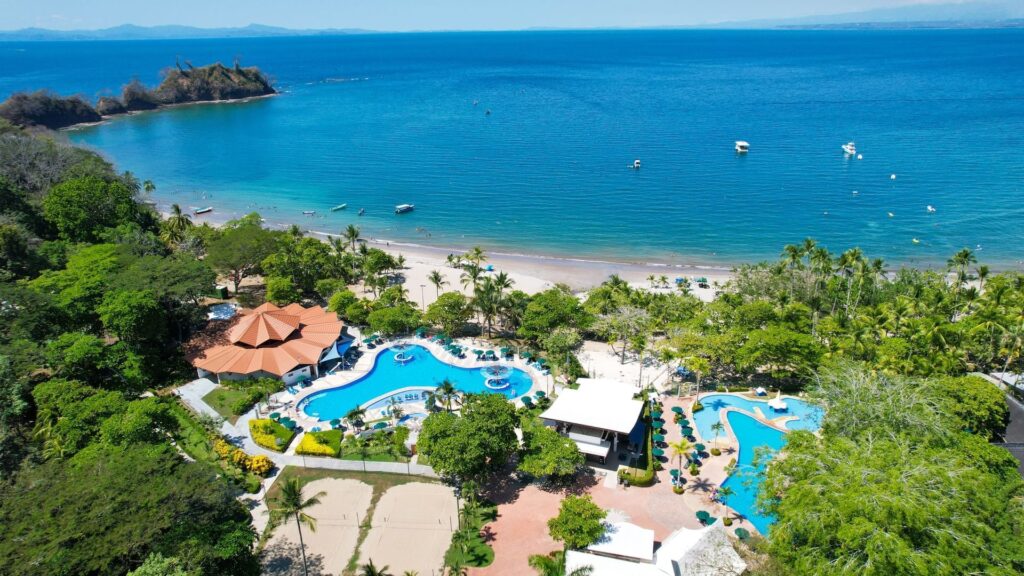
In 2024, administrators of the private Punta Leona resort in Garabito erected a two-meter metal fence and piled sand to block access to Playa Blanca and Playa Mantas—both segments falling within the first 50 meters of public domain.
6.2 Municipal Response
- Complaint Filed: Neighbors and beachgoers lodged formal reports with the Municipal Office, citing Articles 1–2 of Law 6043.
- Official Order: The Municipality of Garabito issued a written directive under Art. 43 of Law 7794, requiring removal of the fence and sand within 15 business days.
- Compliance Check: At deadline expiration, municipal inspectors confirmed the barrier remained in place.
- Forced Removal: The Municipality contracted heavy equipment to dismantle the fence and clear the sand, charging all incurred costs to the resort operator.
6.3 Legal Foundation
- Public Domain: Law 6043, Art. 1–2 mandates the first 50 m be free and inalienable.
- Constitutional Right: Constitution Art. 50 protects public environmental use.
- Municipal Authority: Law 7794, Art. 43 grants municipalities power for forced execution of legal orders.
6.4 Outcome
Within 48 hours of intervention, both beaches were reopened. The resort was held financially responsible for the operation, and the action reaffirmed the effectiveness of coordinated municipal enforcement in upholding Costa Rica’s coastal-zone regime.