
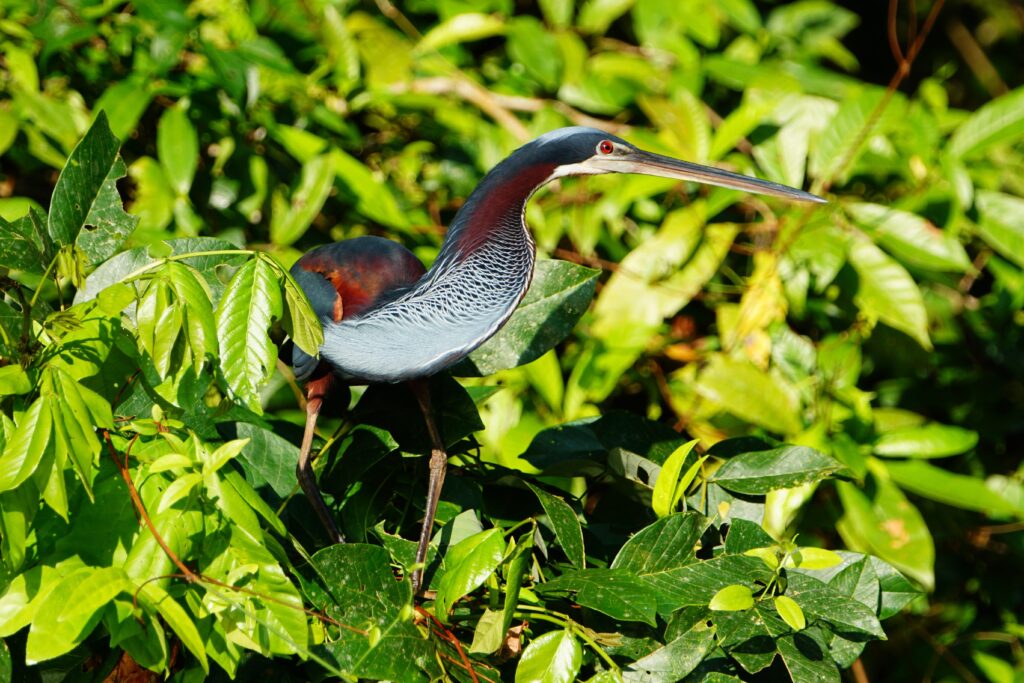
A private estate in Guatuso has become an unusual refuge for one of the most elusive and striking birds found in Costa Rica’s wetlands: the Agami Heron (Agamia agami).
According to a report published by The Tico Times on August 15, 2026, around 1,000 Agami Herons have established a breeding colony on the property near the Caño Negro wetlands. The concentration has attracted the attention of researchers from the National Distance Education University (UNED), local residents and the landowners, who are working together to study and protect the site.
The discovery highlights the ecological importance of the wetlands in northern Costa Rica while also presenting a challenge: how to allow this remarkable finding to contribute to nature tourism without turning human attention into a threat to the birds.
One of the Hardest Herons to Spot
The Agami Heron is known for its distinctive appearance and secretive behavior.
Unlike many heron species that can be easily observed in open areas, Agamia agami tends to remain in dense vegetation associated with wetlands, rivers and other aquatic environments. Its elusive nature means that even experienced birdwatchers can have difficulty finding it.
Costa Rica’s National System of Conservation Areas (SINAC) lists Agamia agami, known locally as the chestnut-bellied heron, among the country’s wildlife species of conservation importance. Official SINAC documents also include the species in inventories of birds recorded in Costa Rican wetlands and protected areas.
Its presence in official conservation documents reflects the importance of protecting the habitats on which the species depends.
A Refuge Discovered in Guatuso
The Guatuso colony began attracting attention after the property owner noticed the birds and contacted UNED for assistance in studying them.
Researchers are now monitoring the site and plan to continue conducting censuses. Their work will look not only at the number of adult birds but also at nests and chicks, allowing them to better understand the colony’s reproductive success and how it develops over time.
This scientific monitoring is particularly valuable because much remains to be understood about the species’ breeding behavior and the conditions that allow large colonies to establish themselves.
The Guatuso project also demonstrates the role that private properties can play in biodiversity conservation when landowners choose to maintain the natural conditions that allow wildlife to feed, rest and reproduce.
Connected to the Caño Negro Wetlands
The colony is located near the Caño Negro wetlands, one of the most important aquatic ecosystems in northern Costa Rica.
Wetlands provide food, shelter and breeding grounds for numerous species of birds and other wildlife. In this context, the presence of such a large Agami Heron colony further highlights the importance of protecting aquatic habitats and the vegetation surrounding them.
SINAC’s conservation work encompasses protected areas as well as collaboration with local communities and other stakeholders. This approach is particularly relevant in regions where biodiversity conservation depends not only on officially protected land, but also on responsible management of private properties and participation from local communities.
Science and Community Working Together
The UNED project goes beyond simply counting birds.
According to The Tico Times, people working on the property are also being trained to recognize potential threats and understand how their activities could affect the areas used by the herons for feeding, resting and nesting.
This educational component is particularly important for a species that may be vulnerable to disturbance during the breeding season.
The project also demonstrates the potential of cooperation between universities, private landowners and local communities. Researchers can collect valuable scientific data, while people living and working in the area can play an important role in protecting the colony on a daily basis.
Birdwatching Could Bring New Opportunities
A colony of this size could also create new opportunities for nature tourism in Guatuso and the nearby community of Katira.
Birdwatching already plays an important role in Costa Rica’s nature tourism sector. The possibility of observing a rare and elusive species can attract both national and international birders and generate opportunities for local guides, accommodation providers, restaurants and other businesses.
The presence of the colony could therefore become a new attraction for the region, particularly because of its proximity to the Caño Negro wetlands.
However, any tourism development would need to be carefully planned around the needs of the birds.
When Observation Also Means Protection
Interest in a bird colony can quickly become a problem if appropriate limits are not established.
Herons and other waterbirds can be particularly sensitive to disturbance while nesting. Visitors approaching too closely, excessive noise or constant human activity near nesting areas can cause adult birds to leave their nests temporarily, potentially exposing eggs and chicks to predators or other risks.
For this reason, researchers are considering measures such as minimum viewing distances, the use of binoculars and telescopes, and discreet observation areas that would allow visitors to see the birds without entering sensitive nesting zones. The objective is to prevent mass tourism from turning the colony’s popularity into a conservation problem.
This principle is particularly important when dealing with rare species: discovering a colony can increase its value for tourism, but it can also increase its vulnerability.
An Opportunity for Local Conservation
The story unfolding in Guatuso shows how a biodiversity discovery can become an opportunity for a community.
Protecting the colony could support new initiatives in environmental education, scientific research and responsible nature tourism. It could also encourage local residents and private landowners to recognize the value of preserving the ecosystems surrounding their communities.
The key, however, will be maintaining a balance between access and protection.
The conservation of the habitat and the successful reproduction of the species must remain the priority. Tourism can become a tool to support those goals, provided it develops at a scale compatible with the ecological sensitivity of the site.
A Discovery That Highlights the Value of Wetlands
The presence of around 1,000 Agami Herons on a single private property makes Guatuso a particularly interesting location for research and conservation.
But beyond the number itself, the colony offers an opportunity to better understand the biodiversity of northern Costa Rica and the role wetlands play in supporting species that are rarely seen.
The story also serves as a reminder that conservation does not happen only inside national parks. A private property, a local community, a university or a group of researchers can all become important partners in protecting wildlife.
In Guatuso, one of Costa Rica’s most elusive herons has found a place to breed. The challenge now is to ensure that this refuge remains a safe place for the birds for years to come.
Official Sources for Further Information
Costa Rica’s National System of Conservation Areas (SINAC) provides official documentation on Agamia agami and on the protection and management of the country’s natural ecosystems. The species is identified in official documents by its Spanish common name, garza pechicastaña.
SINAC’s National Wetlands Inventory also includes Agamia agami among the bird species recorded in Costa Rican wetland ecosystems.
The National Distance Education University (UNED) is another relevant institutional source for information on the scientific and community work being carried out in the northern region.
For the specific details concerning the Guatuso colony, The Tico Times report published on August 15, 2026, provides information from researchers, landowners and community members involved in the project.