A rare observation made on the Osa Peninsula has provided scientists with an unusual glimpse into the relationship between two marine species.
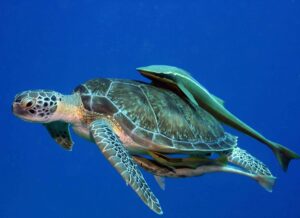
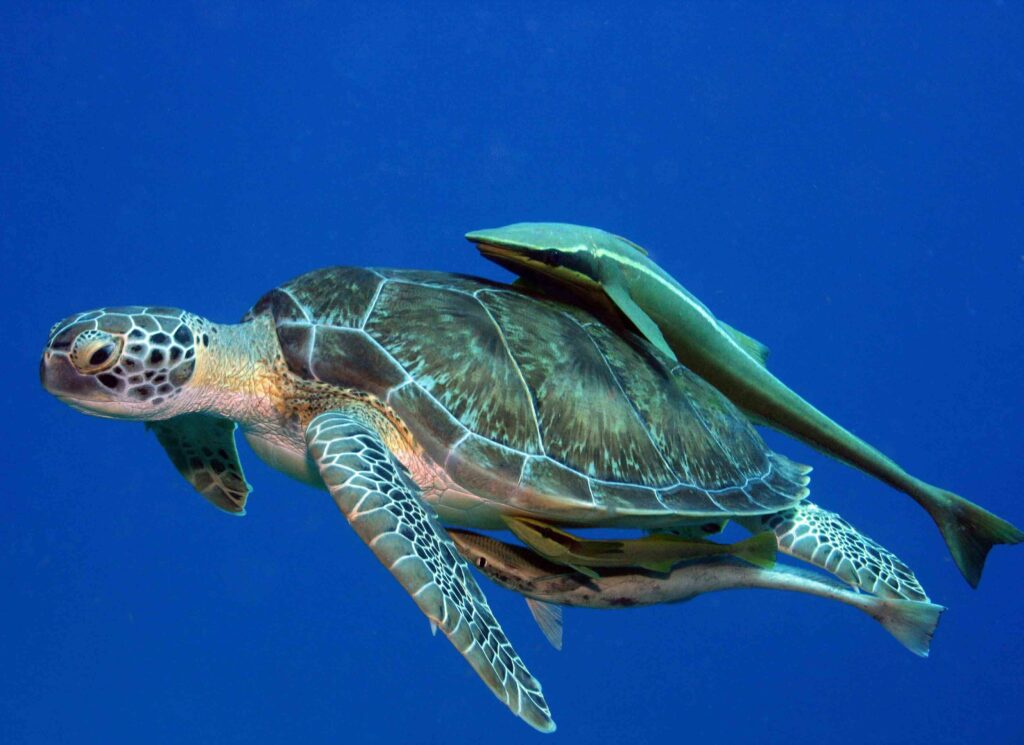
Researchers observed an olive ridley sea turtle (Lepidochelys olivacea) coming ashore to nest while carrying a common remora (Remora remora) attached to its shell.
What made the observation particularly remarkable was that the fish remained attached to the turtle for approximately 19 minutes while it was out of the water, as the female carried out the usual behaviors associated with nest construction and egg laying.
The encounter took place at Playa Pejeperro, on the Osa Peninsula, and was documented in a scientific study published in June 2026 in Frontiers in Marine Science.
An Unusual Encounter Outside the Ocean
Remoras are fish known for attaching themselves to larger marine animals in order to travel with them and take advantage of feeding opportunities.
They use a specialized adhesive disc located on the top of their heads, allowing them to attach themselves to a variety of animals, including sea turtles, sharks, rays, large fish, and marine mammals.
This type of relationship has frequently been observed in the ocean. However, finding a remora remaining attached to its host after the animal has completely emerged from the water is much less common.
The observation at Pejeperro provides additional evidence of the ability of these species to maintain their association even under physiologically challenging conditions.
The Turtle Continued Its Normal Behavior
The encounter took place during a nighttime patrol carried out by research assistants from the Comunidad Protectora de Tortugas de Osa (COPROT), an organization involved in monitoring sea turtle nesting at Playa Pejeperro.
On September 24, 2025, at approximately 10:29 p.m., researchers encountered an adult female olive ridley that had just emerged from the ocean.
A common remora measuring approximately 28 centimeters in length was attached to the left side of the turtle’s shell.
During the 19-minute observation period, the fish remained attached to the turtle. Researchers observed only small movements, mainly associated with the opening and closing of its opercula.
Meanwhile, the turtle continued its normal nesting behavior. It eventually began laying its eggs at approximately 10:48 p.m.
The researchers noted that the presence of the remora did not appear to affect the turtle’s behavior.
A Remora That Survived Out of Water
One of the most interesting aspects of the observation was the condition of the fish after remaining out of the water for several minutes.
When one of the researchers approached to remove the remora and return it to the ocean, the fish began changing its position on the turtle’s shell.
Once released, the remora continued moving and quickly swam away after being returned to the water, indicating that it remained alive despite the time spent outside its aquatic environment.
The researchers believe that observations of this kind can provide valuable information about the nature of associations between remoras and their hosts.
A Relationship That Still Raises Questions
The relationship between remoras and the animals they attach themselves to continues to be studied by scientists.
Traditionally, researchers have considered that remoras benefit by using other animals as a means of transportation and by reducing the energy required for movement.
However, the exact ecological nature of these relationships is not always clear. Scientists have suggested that such associations can range from relatively temporary interactions to more stable relationships.
The study conducted at Pejeperro points out that there is still limited knowledge about the stability, frequency, and factors that determine these associations.
Documenting unusual behaviors like this can therefore help researchers better understand the ecology of remoras and their hosts.
Playa Pejeperro, an Important Nesting Site
The observation also highlights the importance of Playa Pejeperro as a sea turtle nesting area.
The beach is part of the Pejeperro Mixed National Wildlife Refuge, located on the Osa Peninsula.
According to documentation from Costa Rica’s National System of Conservation Areas (SINAC), the beaches of Pejeperro, Piro, Río Oro, and Carate are among the sea turtle nesting areas in this part of the peninsula.
Species recorded in the area include the olive ridley, green sea turtle, hawksbill turtle, and leatherback turtle.
SINAC studies have identified the olive ridley as the species accounting for the largest proportion of recorded nests on these beaches.
The Importance of Protecting Nesting Beaches
Sea turtles depend on beaches during a fundamental stage of their life cycle. Protecting these areas is essential to ensure that females can return to shore, build their nests, and reproduce successfully.
Costa Rica’s coastline is used for nesting by five species of sea turtles: the olive ridley, green turtle, hawksbill turtle, leatherback turtle, and loggerhead turtle.
SINAC identifies several major threats to these species, including egg poaching, incidental capture in fisheries, loss of nesting habitat, poorly planned coastal development, erosion, and inadequate management of certain tourism activities.
Protecting nesting beaches therefore means protecting both the turtles and the coastal ecosystems on which they depend.
A Small Discovery with Scientific Value
The encounter between the olive ridley and the remora may initially appear to be a simple curiosity of marine life, but for researchers it represents much more.
Observations of unusual behavior can expand scientific knowledge of species that still contain many ecological mysteries.
In this case, the fact that a remora remained attached to a sea turtle while the turtle was out of the water provides an opportunity to study how long and under what conditions these associations can persist.
The observation also demonstrates the value of continuous monitoring programs carried out along the beaches of the Osa Peninsula.
In ecosystems as biologically rich as Osa, even a seemingly small observation can add an important piece to our understanding of marine life.
Osa’s Biodiversity Continues to Reveal Its Secrets
The Osa Peninsula is recognized for its extraordinary biological diversity and the importance of its terrestrial, coastal, and marine ecosystems.
Its beaches, forests, mangroves, and coastal waters are home to numerous species, including animals that are threatened or considered important for conservation.
The discovery documented at Pejeperro is a reminder that behaviors and ecological relationships can remain unnoticed even among relatively well-known species.
The sight of an olive ridley returning to shore with a remora attached to its shell is not only an extraordinary example of nature. It also demonstrates how much remains to be learned about the complex relationships connecting marine species.
Sources of Information
Frontiers in Marine Science — Bullock, M. J., Peña Eisele, V., and Yeager, E. A. (2026). Documentation of remora (Remora remora) attachment to a nesting olive ridley sea turtle (Lepidochelys olivacea) in Playa Pejeperro, Costa Rica.
Sistema Nacional de Áreas de Conservación (SINAC) — Information and documentation on the Pejeperro Mixed National Wildlife Refuge and sea turtle nesting sites on the Osa Peninsula.
SINAC – Programa Nacional de Monitoreo Ecológico (PRONAMEC) — Protocol for ecological monitoring of sea turtle nesting beaches in Costa Rica.
Área de Conservación Guanacaste (ACG) — Scientific information on olive ridley sea turtles (Lepidochelys olivacea) and nesting processes on Costa Rica’s Pacific coast.