A discovery that expands knowledge of prehistoric wildlife
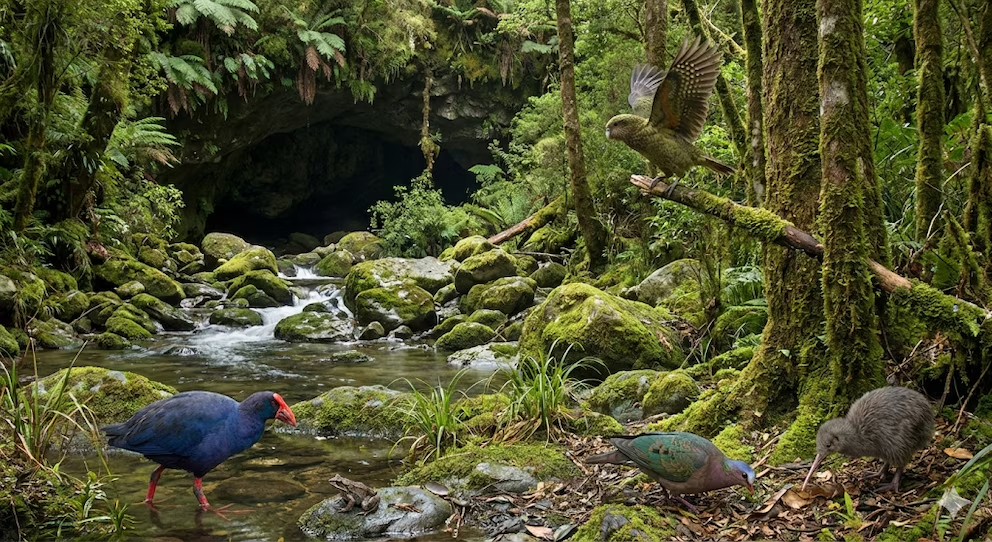
An international team of researchers has announced the discovery of an exceptionally well-preserved ecosystem inside a cave in New Zealand, with remains estimated to be more than one million years old. The finding offers a unique opportunity to understand what island ecosystems looked like before major climatic changes and the arrival of humans.
Scientists believe that discoveries of this kind provide highly valuable information about the evolution of numerous species and the environmental conditions that existed during the Early Pleistocene.
A natural archive preserved for hundreds of thousands of years
Caves are among the best natural archives for studying the history of life on Earth. Thanks to their stable temperature, humidity, and limited exposure to the outside environment, animal remains, plants, pollen, sediments, and other organic materials can remain preserved for hundreds of thousands or even millions of years.
In this case, researchers uncovered evidence that makes it possible to reconstruct an entire ecosystem, including species that no longer exist and ecological relationships that were previously little understood.
What this discovery contributes to science
The analysis of fossils and sediments will help scientists better understand the biodiversity that existed in New Zealand before major geological and climatic transformations.
The main objectives of the research include:
- Identifying extinct species that once inhabited the region.
- Reconstructing ancient habitats and food webs.
- Understanding how the island’s fauna evolved over time.
- Analyzing how ecosystems responded to natural environmental changes.
These studies also make it possible to compare ancient ecosystems with modern ones and better understand the processes of species extinction and adaptation.
The importance of caves for paleontological research
Caves serve as natural laboratories for disciplines such as paleontology, geology, and evolutionary biology. Sediments accumulated over long periods contain valuable information about the climate, vegetation, and wildlife of different eras.
New Zealand possesses an exceptional geological heritage that has led to the discovery of numerous fossils and remains of endemic species that evolved in isolation over millions of years.
A contribution to understanding the evolution of biodiversity
The discovery contributes to the study of the evolution of island ecosystems, which are considered particularly vulnerable to environmental changes and the introduction of invasive species.
Understanding what these environments looked like more than one million years ago allows scientists to compare them with present-day biodiversity and improve models explaining the evolution and disappearance of numerous species.
This type of research also provides valuable information for modern conservation strategies by identifying natural processes that have shaped ecosystems over millions of years.
International research and conservation of natural heritage
Research on this discovery will continue over the coming years through the analysis of fossils, sediments, ancient DNA, and other advanced scientific techniques.
The preservation of sites like this is essential for expanding knowledge of the planet’s natural history and gaining a better understanding of how ecosystems have evolved through time.
Official sources consulted
Museum of New Zealand Te Papa Tongarewa
New Zealand Department of Conservation (DOC)
GNS Science (New Zealand Geological Research Institute)
University of Otago
International Palaeontological Association