
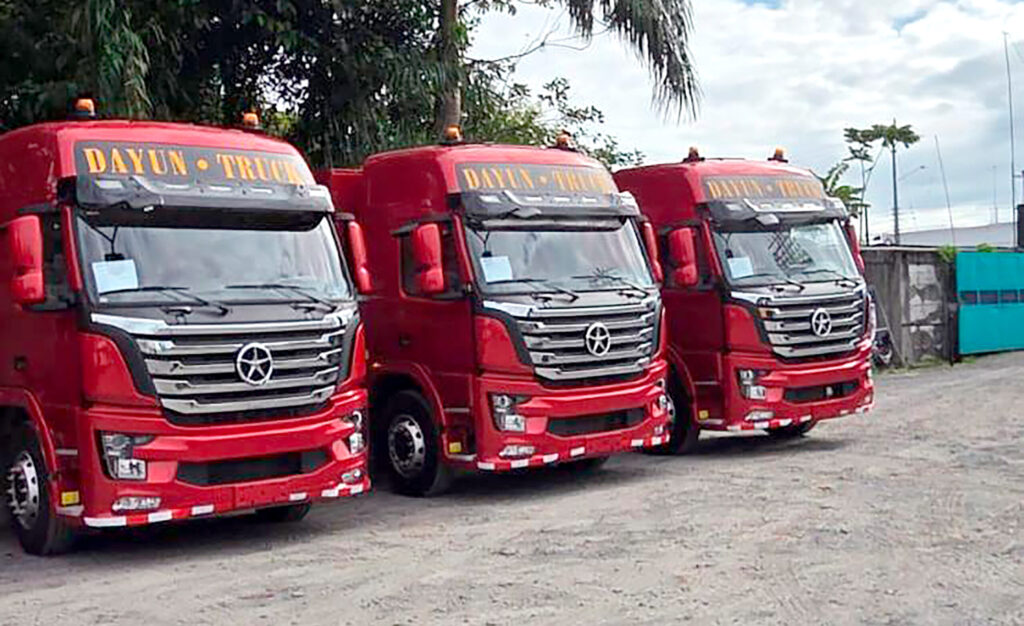
Costa Rica has just completed a pioneering fleet of 15 heavy-duty electric trucks, a key step toward bringing zero-emission mobility into the heart of the productive and agricultural sector. These units are already operating in strategic areas of the country and are showing concrete results in cost savings, noise reduction, and improved air quality in the communities where they circulate.
Costa Rica adds seven new electric trucks
The Costa Rican Electric Mobility Association (ASOMOVE) announced the arrival of seven new 50-ton electric trucks, joining eight units already in operation to complete a fleet of 15 zero-emission tractor units imported by Automotores CABUS. These are DAYUN brand units equipped with 600 kWh batteries and an approximate range of 450 kilometers per charge, allowing their use on heavy transport routes across different regions of the country. According to the importer, these trucks are designed to meet the demands of agricultural and industrial work while minimizing noise and local emissions in the communities they pass through.
Where these trucks are operating
The seven new electric units will be integrated into the operations of Piñas Cultivadas de Costa Rica in Pocosol, San Carlos, a key agricultural area for pineapple exports. In the northern region, six units are already operating at Ingenio Cutris, and two additional trucks are in Cartago with Grupo Coris, which produces pet food. According to CABUS, three more 50-ton trucks will soon be added for Terumo in El Coyol de Alajuela and one more for El Colono in Limón, expanding zero-emission technology to the Caribbean region and the main logistics corridor of the Central Valley.
Economic savings and lower maintenance
Carlos López, president of Automotores CABUS, stated that companies using this fleet are reporting up to 80% savings when comparing fuel costs to electricity costs alone, not yet including additional maintenance savings. Electric trucks have fewer moving parts, do not require oil or filter changes, and reduce wear on combustion-related components, lowering both direct costs and downtime. For agricultural and industrial companies transporting large volumes year-round, these savings can significantly improve competitiveness and create room for investment in innovation and sustainability.
Benefits for communities
ASOMOVE emphasizes that the impact of these trucks goes beyond business, as reduced noise and the elimination of exhaust fumes improve quality of life in the communities where they operate. In areas such as Boca de Arenal in San Carlos, authorities report that two schools near the route of the Ingenio Cutris trucks now experience a quieter and cleaner environment after replacing combustion trucks with electric units. For students and teachers, this means better learning conditions and reduced daily exposure to pollutants from heavy traffic.
Electric mobility and expanding charging network
ASOMOVE’s executive director, Silvia Rojas, highlighted that Costa Rica has not only advanced in light electric mobility but is also making strong progress in heavy transport, with 15 fully electric trailers delivering positive results in savings, performance, and driver comfort. These advances are supported by the expansion of charging infrastructure announced by the National Power and Light Company (CNFL) and the Costa Rican Electricity Institute (ICE), which plan to install 51 new fast chargers for electric vehicles in 2026, 17 of them in the Greater Metropolitan Area. Expanding fast and semi-fast charging networks is a strategic goal supporting adoption across all transport segments.
A model for decarbonizing heavy transport
The deployment of 50-ton electric trucks in sectors such as pineapple production, sugar, pet food, and medical manufacturing shows that decarbonizing heavy transport is technically feasible and economically attractive for the private sector. In addition to reducing local pollution, these trucks contribute to national goals of lowering greenhouse gas emissions from transport—one of the most fossil fuel–intensive sectors in Costa Rica. The combination of operational savings, public health benefits, and improved quality of life makes this fleet a practical example that can inspire other industries.
Official and reference sources
– Costa Rican Electric Mobility Association (ASOMOVE), communications on 50-ton electric trucks and progress in electric mobility.
– Automotores CABUS, technical and operational information on DAYUN 50-ton electric trucks.
– Delfino.cr, article “Costa Rica receives seven new 50-ton electric trucks to complete a fleet of 15 zero-emission tractor units.”
– PuroMotor, article “Costa Rica receives 7 new electric trucks to complete a fleet of 15 zero-emission tractor units.”
– CRHoy.com, article “51 fast chargers for electric vehicles will be installed in 2026,” with data from CNFL and ICE on the expansion of the charging network.
– CNFL and ICE communications and reports on fast charging centers and strategic objectives for electric mobility.