
The period between 1914 and 1949 represents the most critical transition in Costa Rica’s political history. During these decades, the country moved from a democracy of elites and fraudulent practices to a system of autonomous institutions and social guarantees that define the contemporary national identity.
The Exhaustion of the Model and the Tinoco Dictatorship
The advance toward democratization initiated in 1913 with direct voting suffered a severe setback in 1917. Federico Tinoco Granados led a coup d’état that established a two-year dictatorship. Although brief, this episode revealed the fragility of the institutions of the time and the need for a profound reform in the control of power.
The 1940s: A Country of Paradoxes
The 1940s are fundamental due to the convergence of opposing forces. On one hand, the government of Rafael Ángel Calderón Guardia promoted the Social Guarantees and the Labor Code, supported by an unusual alliance with the Catholic Church and the Communist Party (Vanguardia Popular).
On the other hand, this same administration was criticized for a growing deterioration in electoral transparency. Historical sources document that the system suffered from systemic corruption: deceased individuals appeared on voter rolls and the Executive Branch maintained direct control over vote counting, which fueled deep discontent within the opposition.
The Civil War of 1948: Causes and Outbreak
The final trigger was the annulment of the 1948 elections by Congress, which refused to recognize the victory of Otilio Ulate over Calderón Guardia. This provoked the uprising of the National Liberation Army, led by José Figueres Ferrer.
The armed conflict lasted 44 days. Unlike other civil wars in the region, its outcome was not the imposition of a prolonged dictatorship, but a transitional pact (Ulate-Figueres Pact) that allowed for the drafting of a new Constitution.
The Legacy of 1949: The Pillars of Modernity
The Political Constitution of 1949, still in force today, institutionalized changes that transformed the country’s DNA:
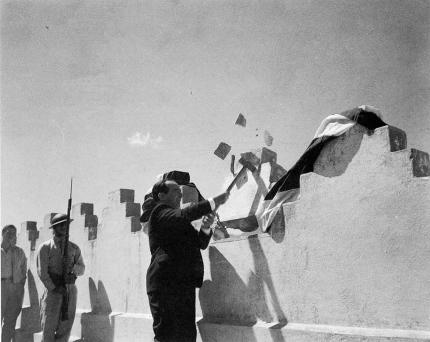
- Abolition of the Army: On December 1, 1948, in a symbolic act at the Bellavista Barracks, the military institution was eliminated. This allowed defense resources to be redirected toward education and health.
- Creation of the Supreme Electoral Tribunal (TSE): The TSE was granted the rank of “fourth branch of government,” with full independence to organize and oversee elections, eliminating fraud as a political tool.
- Universal Suffrage: The constitutional recognition of the right of women and the Afro-descendant population to vote and be elected, although its effective exercise would take place in the following years.
- Autonomous Institutions: Entities such as ICE were created and the banking system was nationalized to accelerate the country’s material and social development under a new conception of the State.
Sources consulted:
- Civil War of Costa Rica of 1948, Historical Archive and Wikipedia.
- Costa Rica: The Revolution of 1948, a cause-and-effect analysis, El Espíritu del 48.
- Causes and Consequences of the 1948 CIVIL WAR, Documents from the Ministry of Public Education.
- The Trajectory of Costa Rican Polyarchy, Institutional Analysis.
Historical account of legislative power (1949–2021), School of History UCR.