
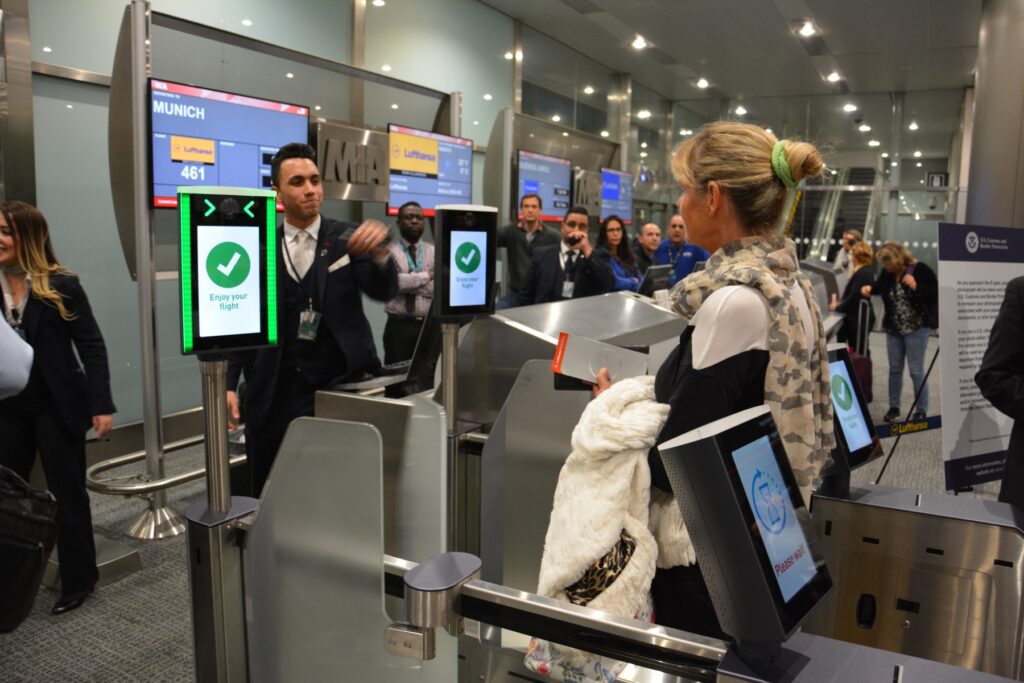
Technology to streamline controls at the country’s main airport
The Juan Santamaría International Airport will introduce new biometric gates designed to make the immigration control process faster and more efficient for Costa Rican citizens entering the country.
The implementation of this technology is part of broader efforts to modernize airport services, reduce waiting times, and improve the passenger experience through digital identification tools.
Biometric gates use automated systems capable of verifying a person’s identity through unique characteristics, such as information stored in electronic passports and the user’s biometric data.
How will the biometric gates work?
The new system will allow Costa Rican travelers to complete part of the immigration process automatically, reducing their dependence on traditional inspection counters.
The general process includes several steps:
- The traveler presents their passport to the system.
- The technology verifies the document information.
- A biometric comparison is performed to confirm identity.
- The system validates the information with the relevant authorities.
- Once verification is approved, the passenger is allowed to proceed.
This type of technology is already used at major international airports around the world to improve border control efficiency.
Faster and safer immigration procedures
One of the main objectives of this implementation is to reduce processing times and improve passenger flow during periods of high demand, such as holidays, vacation seasons, and peak travel periods.
In addition to speeding up procedures, biometric systems strengthen security by reducing the risks associated with identity fraud and improving accuracy in traveler verification.
Automation does not replace immigration controls but rather complements the work of officers through more efficient technological tools.
A step toward the digitalization of public services
The introduction of biometric gates reflects a global trend toward digital transformation in airports and international mobility systems.
More and more airports are adopting technologies such as:
- Facial recognition.
- Electronic passports.
- Automated entry and exit systems.
- Digital verification processes.
These solutions aim to create travel experiences that are faster, safer, and better adapted to the evolving needs of passengers.
Benefits for national and international travelers
Although the system will initially focus on Costa Rican citizens, the modernization of immigration controls can bring broader benefits to airport operations.
These include:
- Shorter waiting times.
- Greater passenger-handling capacity during busy periods.
- Improved organization of traveler flows.
- More efficient use of human resources.
- Better alignment with international standards.
Improved airport procedures also contribute to strengthening the country’s image as a tourism destination and regional transportation hub.
The role of Juan Santamaría Airport in national connectivity
The Juan Santamaría International Airport, located in Alajuela, is Costa Rica’s main airport and one of the country’s most important points for international arrivals.
Every year, it serves millions of passengers and plays a key role in tourism, trade, and Costa Rica’s connections with destinations throughout the Americas and the world.
Modernizing its systems responds to the continuous growth of air traffic and the need to provide services that meet current technological standards.
Biometric technology and the future of travel
Biometric systems have become one of the main tools transforming the airport experience worldwide.
International organizations such as the International Civil Aviation Organization (ICAO) have promoted the use of digital technologies to improve aviation security and efficiency.
However, their implementation also requires strong safeguards to ensure responsible management and protection of users’ personal and biometric information.
A step toward more modern and efficient airports
The arrival of biometric gates at Juan Santamaría International Airport represents another step in the modernization of Costa Rica’s airport infrastructure.
These tools will help provide faster procedures for national travelers while strengthening security systems and combining technological innovation with passenger protection.
Such initiatives reflect the evolution of air travel toward increasingly digital models, where technology aims to simplify journeys while maintaining safety and user privacy.
Official sources consulted
- General Directorate of Migration and Foreigners of Costa Rica (DGME)
- Costa Rican Tourism Board (ICT)
- Juan Santamaría International Airport / AERIS Costa Rica
- International Civil Aviation Organization (ICAO)
- Ministry of Science, Innovation, Technology and Telecommunications of Costa Rica (MICITT)