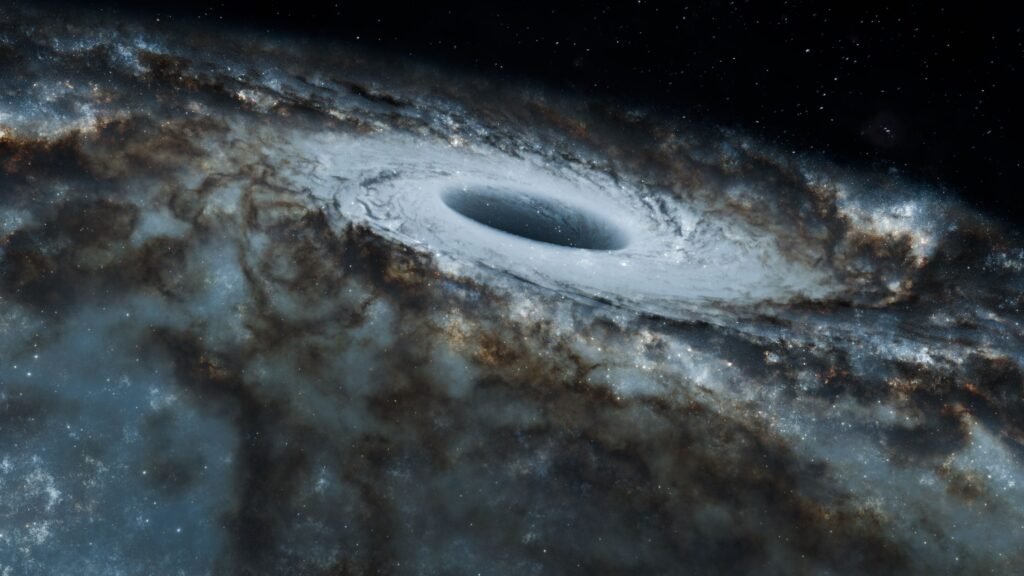
When the Royal Swedish Academy of Sciences announced on October 6 that the 2026 Nobel Prize in Physics would go to Francis Halzen, one Costa Rican physicist was not surprised. Vanessa López Barquero earned her PhD under his supervision at the University of Wisconsin–Madison. Today she studies black holes at the University of Maryland.
A Nobel for the observatory under the ice
Halzen, an 82-year-old Belgian-born physicist, won the prize alone for his decisive contributions to IceCube, the neutrino observatory buried in the ice at the South Pole. According to Physics Today, it was the first time since 1992 that the physics prize went to a single laureate. IceCube fills a cubic kilometer of ice, with 5,160 optical sensors set between 1,450 and 2,450 meters deep. In 2013 it made the first detection of high-energy neutrinos from beyond the solar system. The award ceremony takes place on December 10 in Stockholm.
“It’s the work of thousands of people,” López told Delfino about IceCube, a collaboration of more than 40 institutions. Of her former supervisor, she said: “Halzen is a perfect example of good leadership.”
From a UCR degree to Cambridge and Maryland
López studied physics at the University of Costa Rica, where she did research in nanotechnology, general relativity and black hole astrophysics. A summer internship in Wisconsin opened the door to graduate school, where she specialized in particle astrophysics at the Wisconsin IceCube Particle Astrophysics Center, supervised by Halzen and Paolo Desiati. Her thesis examined how magnetic fields, especially those of the heliosphere, bend the paths of cosmic rays before they reach Earth.
In 2021 she joined Christopher Reynolds’ X-ray group at the University of Cambridge’s Institute of Astronomy. Since 2023 she has been a postdoctoral associate in the Department of Astronomy at the University of Maryland, still working with Reynolds. Her recent work covers black hole coronae, variability in X-ray binaries and multimessenger astronomy, which combines observations of cosmic rays, X-rays and neutrinos.
Science in Spanish, with an eye on Costa Rica
While in Madison, López was scientific director of a Spanish-language science radio show for the Latino community on station WORT. She has also led initiatives to open physics to Latino students and other underrepresented groups.
Speaking to Delfino, she credited Costa Rica’s public universities for her training and called for more investment in research at home. She also noted that physics, especially theoretical physics, remains largely male-dominated, with the gap widening in graduate programs and academic careers. She would like to launch a science outreach project in Costa Rica similar to the one she ran in Wisconsin.
Sources
- Vanessa López: la científica costarricense que estudió con el Premio Nobel de Física e investiga los misterios del universo – Delfino.cr (November 18, 2026)
- Vanessa Maria Lopez Barquero – profile, Department of Astronomy, University of Maryland
- Vanessa López-Barquero’s personal website
- The Nobel Prize in Physics 2026 – NobelPrize.org
- Francis Halzen to receive 2026 Nobel Prize in Physics for cosmic neutrino detection – Physics Today (October 6, 2026)
- Scientist who hunts mysterious ghost particles in the Antarctic ice wins Nobel Prize for physics – Associated Press, via PBS Wisconsin (October 6, 2026)
- Detector – IceCube Neutrino Observatory, University of Wisconsin–Madison