After a particularly restless year, the country’s two most active volcanoes are showing signs of calm. According to the Volcanological and Seismological Observatory of Costa Rica (Ovsicori), Poás and Rincón de la Vieja produced almost all of the eruptions recorded in the first ten months of 2026, and both have become less active in recent weeks. For anyone planning a visit this high season, the news comes with a caveat: restrictions around their craters remain in place.
Rincón de la Vieja: its most intense year in a long time
The Guanacaste volcano began showing signs of activity between March and April, but its most intense phase started in July. On July 24, after 38 phreatic eruptions in just three weeks, Ovsicori raised its level to Caution, the third step on a four-level scale. The most energetic eruption of the year to that point had already occurred on July 20, but the strongest was still to come.
In late August, the volcano sent up a column more than 1,000 meters high, possibly close to 2,000, along with lahars, the flows of mud and volcanic debris that rush down river channels. It logged at least 20 eruptions in a few days, and Ovsicori volcanologist Geoffroy Avard described the activity as “very, very high.” By mid-September, the count had passed 200 eruptions since July 2, eight of them with lahars on the northern flank.
The National Emergency Commission (CNE) responded in two steps. On September 2, it declared a green alert for the districts of Cañas Dulces, Curubandé and Mayorga in Liberia, and Aguas Claras and Dos Ríos in Upala. On October 1, the same five districts moved to a yellow alert.
Calm returns in October
From mid-September, eruptions became less frequent and less explosive. The last moderate eruption with a lahar occurred on September 9, and the weekly report before the change in level recorded only seven eruptions, none larger than moderate. Based on that data, Ovsicori lowered the level from Caution to Warning on October 30. “It’s not that worrying,” Avard said, although the observatory stressed that eruptions, including some with lahars, can still happen without warning. Twelve small eruptions were recorded between November 9 and 13.
In Rincón de la Vieja National Park, the trail to the active crater remains closed, as it has been for years. The Las Pailas sector is open Tuesday through Sunday, with tickets sold online only.
Poás: mandatory helmets and half the visitors
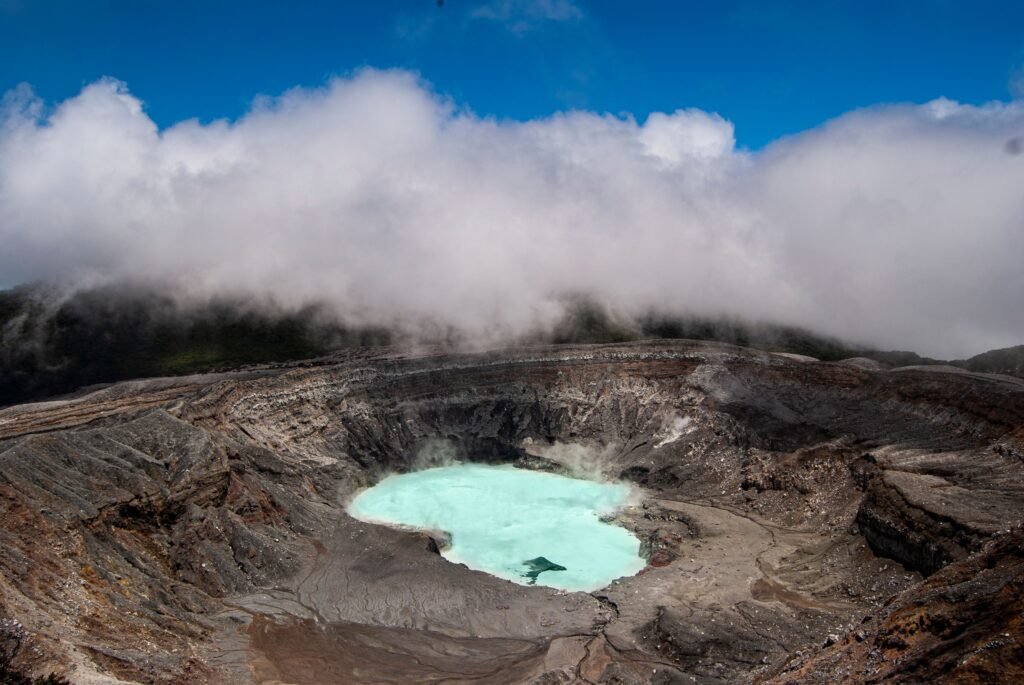
Poás has been less active than in 2025. Its strongest eruptions this year came in July and August, which Avard describes as isolated events. Inside the crater, the lake level rose and is now dropping, and two landslides were recorded on its inner walls.
On August 27 at 2:35 a.m., a moderate two-pulse eruption threw ballistic material about 600 meters. The next day, the Environment Ministry (Minae) and the National System of Conservation Areas (Sinac) cut the park’s daily capacity from 2,052 to 1,064 visitors, made helmets mandatory and kept only two trails open: the main trail to the crater lookout and Sombrilla de Pobre. Groups of 56 people are allowed at the lookout in 20-minute slots. The rules remain in force with no end date.
The park is open daily from 8 a.m. to 4 p.m., with last entry at 2 p.m., and online booking is required. According to Sinac’s website, admission for nationals and residents is ₡1,130 for adults and ₡565 for children aged 2 to 12. Children under 2 and nationals and residents over 65 enter free.
A volcano used to closing its gates
Poás, which figures cited in 2024 put at more than 200,000 visitors a year, knows these restrictions well. After the April 2017 eruptions, the park closed for 16 months and reopened on August 31, 2018, with timed visits and limited groups at the lookout. In April 2024 it closed again temporarily after its largest ash eruption since 2019. In 2025 it had a brief closure in early March, reopened on March 11 and then closed indefinitely on March 26, under a CNE yellow alert. It reopened on July 30, 2025, after about four months.
Elsewhere, the picture is calm. According to Ovsicori, Turrialba has not erupted during the period and its activity is declining very slowly, while Arenal remains quiet.
Sources
- The Tico Times – articles from July 27, October 1, November 12 and November 22, 2026
- El Observador – articles from August 27 and October 30, 2026
- Teletica (September 2, 2026) and CRHoy (September 14, 2026)
- Delfino.cr (August 29, 2018 and March 26, 2025) and La Nación (April 2, 2024 and July 22, 2025)
- Sinac – official page of Poás Volcano National Park