The deep waters of the Pacific Ocean off Costa Rica continue to reveal species that have remained largely beyond the reach of science. The latest discovery is particularly remarkable: researchers identified a coral so different from previously known groups that they had to establish not only a new species and genus, but also an entirely new family to classify it.
The species, Laurinque elenya, was formally described in June 2026 in the scientific journal ZooKeys. The study was led by Costa Rican marine biologist Odalisca Breedy of the University of Costa Rica, together with an international team of researchers.
The specimens were found on underwater seamounts in the Tropical Eastern Pacific, including areas near Cocos Island, at depths of several hundred meters.
A Coral That Looks Like a Golden Tree
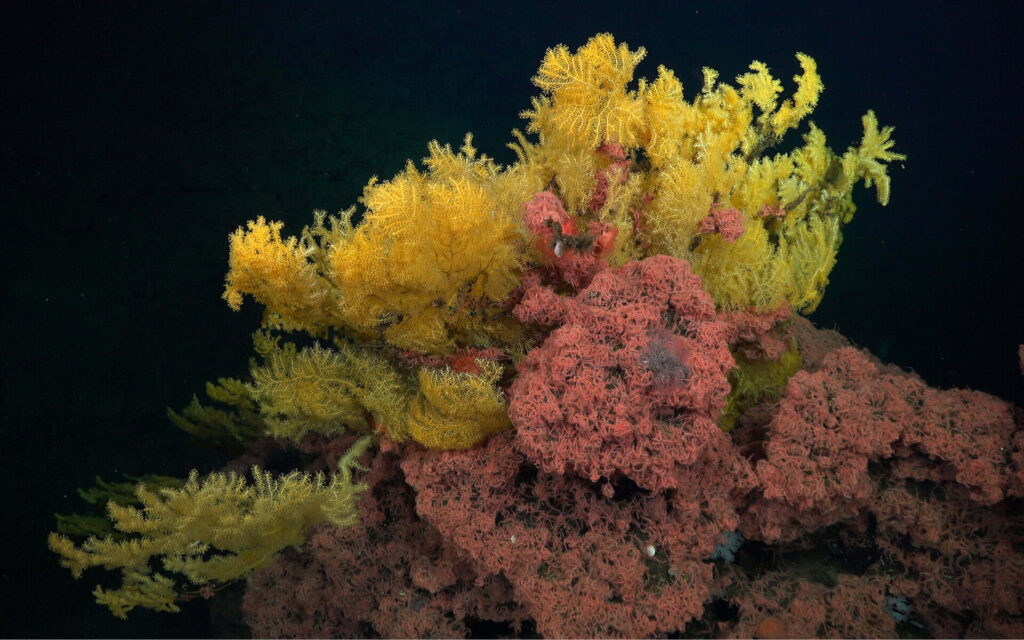
At first glance, Laurinque elenya immediately stands out because of its unusual appearance.
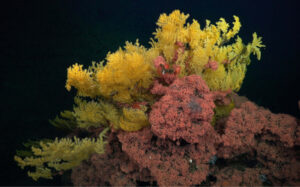
The colonies develop an irregular, branching structure reminiscent of small underwater trees or fans. When alive, they display a striking bright-yellow color. The scientific description records colonies growing to more than one meter in height and 1.2 meters in width, although the holotype itself measured around 50 centimeters tall and 60 centimeters wide.
The specimens examined by researchers were collected at depths ranging from approximately 360 to 529 meters, far beyond the reach of recreational divers.
The colonies grow on rocky surfaces and create complex three-dimensional structures. Around some of them, researchers observed dense concentrations of brittle stars, creating an unusual underwater landscape that later inspired the species’ scientific name.
A Name Inspired by Tolkien’s Elvish Language
The species’ name has an unusual story.
The researchers turned to Quenya, one of the Elvish languages created by British author J. R. R. Tolkien for The Lord of the Rings and The Silmarillion.
The genus name Laurinque derives from Laurinquë, referring to a golden tree. The name reflects both the coral’s bright-yellow color and its tree-like branching form.
The species name elenya refers to stars, inspired by the fields of brittle stars surrounding the coral colonies. The combination evokes the imagery of Tolkien’s Elvish world.
The result is a scientific name that sounds as though it could come straight from Middle-earth, but belongs to a real organism living hundreds of meters beneath the Pacific.
A Coral So Different It Required a New Family
The most significant aspect of the discovery is not its unusual name.
When scientists attempted to determine where Laurinque elenya belonged within the evolutionary tree of octocorals, they encountered an unusual problem.
Analyses based on several commonly used genetic markers produced conflicting results, with different genes suggesting different family-level relationships.
To resolve the question, the researchers conducted a phylogenomic analysis using hundreds of genetic markers.
The results demonstrated that the coral represents a distinct evolutionary lineage. Its closest relative is the family Eunicellidae, but its genetic and morphological characteristics were sufficiently different to prevent it from being placed within an existing family.
The researchers therefore established Laurinqueidae, a completely new family.
The study consequently describes a new species, a new genus, and a new family: Laurinque elenya, Laurinque, and Laurinqueidae.
Two Scientific Expeditions Made the Discovery Possible
The discovery was made possible through scientific expeditions carried out in 2019 and 2023.
Researchers used the remotely operated vehicle SuBastian, which can descend to great depths and collect images and samples from areas inaccessible to humans.
The specimens were collected aboard research vessels operated by the Schmidt Ocean Institute, during expeditions exploring underwater mountains and geological formations in the Tropical Eastern Pacific. The type locality of the species is Las Gemelas II, off Cocos Island.
The samples were subsequently examined using morphological, anatomical, and genetic analyses.
Cocos Island: A Natural Laboratory Beneath the Ocean
The discovery also highlights the scientific importance of Cocos Island and its surrounding marine ecosystems.
Located far from Costa Rica’s continental coastline, Cocos Island is one of the country’s most important marine conservation areas. Its surrounding waters contain highly diverse ecosystems, including deep-sea environments that remain comparatively poorly understood.
The new coral provides another example of how much biodiversity may still be hidden beneath the surface.
For researchers, documenting these organisms is essential not only for expanding the list of known species, but also for understanding how deep-sea ecosystems are structured and how they should be protected.
An Ocean Ecosystem We Still Barely Know
Although oceans cover most of the planet, the deep sea remains one of Earth’s least explored environments.
The discovery of Laurinque elenya demonstrates just how much remains to be learned in the deep waters of the Tropical Eastern Pacific.
Seamounts provide rocky habitats where octocorals can establish colonies and create complex structures that may serve as habitat for other marine organisms.
Identifying these communities therefore goes beyond simply discovering new species. It helps scientists understand the ecological relationships that exist in environments that are still largely unknown.
Why Deep-Sea Corals Matter
Deep-sea corals can grow slowly and create structures that persist for long periods.
Because of this, physical damage to the seafloor can have long-lasting consequences for these communities. Activities that disturb the seabed, including certain forms of fishing, can threaten deep-sea coral habitats.
Protecting marine areas such as those surrounding Cocos Island is therefore important not only for the species already known to science, but also for organisms that have yet to be discovered.
A Discovery That Shows How Much Remains Unknown
Laurinque elenya is much more than a coral with a Tolkien-inspired name.
Its discovery demonstrates that even in regions that have been the subject of decades of scientific research, the deep ocean can still contain completely unknown evolutionary lineages.
The fact that scientists needed to establish an entirely new family to classify this coral illustrates how little we still understand about deep-sea biodiversity.
For Costa Rica, the discovery is another reminder of the extraordinary scientific value of its marine ecosystems and of the importance of continuing to explore and protect its waters.
From the country’s coastlines to underwater mountains hundreds of meters beneath the surface, Costa Rica’s natural world still has many stories left to reveal.
Sources
University of Costa Rica — Center for Research in Marine Sciences and Limnology (CIMAR): research on Costa Rican marine biodiversity and octocorals.
SINAC — Cocos Marine Conservation Area: official information on the protection and management of Cocos Island and its surrounding marine ecosystems.
ZooKeys: original scientific publication, A coral among stars: A new octocoral family (Anthozoa, Octocorallia, Malacalcyonacea) from seamounts in the tropical eastern Pacific. The study formally describes Laurinque elenya and the new family Laurinqueidae.