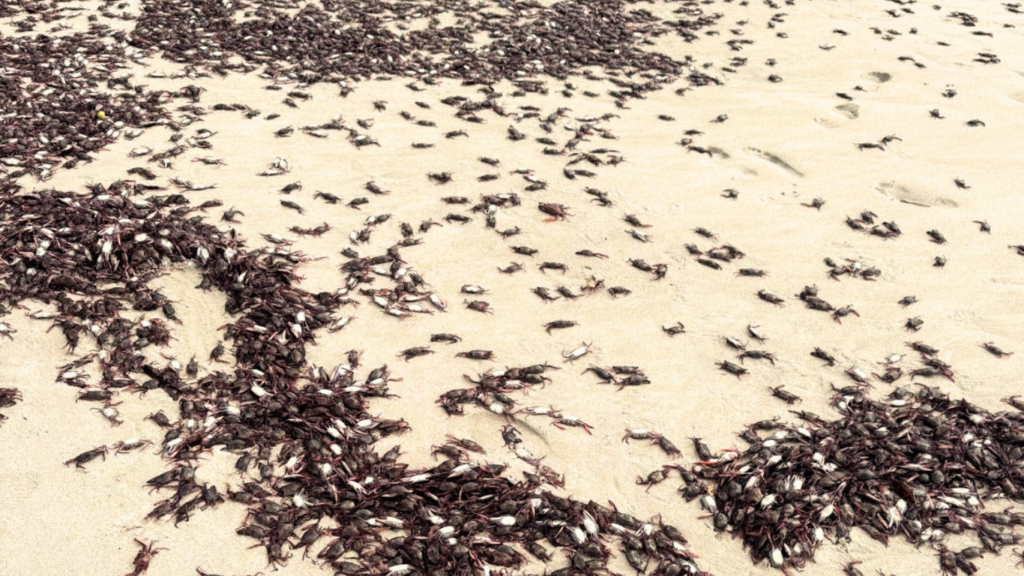
An unusual phenomenon has drawn attention along the coast of Guanacaste in recent days, where thousands of dead crabs have been found on several beaches in Costa Rica’s northern Pacific region.
Reports have come from areas including Conchal, Brasilito, Flamingo, Potrero, Ocotal, Guacamaya, Carrillo and Playa Negra. Images shared by local media show large numbers of crustaceans scattered across the sand and along the shoreline.
So far, no official cause has been confirmed for the mass mortality. Authorities and specialists are assessing the phenomenon before determining what may have caused the deaths.
The Species Identified
The animals are believed to be Dovii swimming crabs, scientifically known as Euphylax dovii. This marine crustacean is found in the tropical eastern Pacific.
The species lives in open waters and has rear legs adapted for swimming, distinguishing it from many of the crabs commonly seen along beaches.
The identification reported by national media should still be considered part of the ongoing assessment, as observations and analyses continue.
What Could Have Caused the Deaths?
One of the main hypotheses raised by specialists involves changes in oceanographic conditions, particularly rising sea temperatures.
Researchers consulted by Costa Rican media have pointed to unusually warm Pacific waters. Increased water temperatures can place physiological stress on marine organisms and affect oxygen availability.
However, this explanation has not yet been confirmed as the cause of the mortality event.
Other environmental factors may also be considered as part of the investigation. At this stage, there is no official evidence establishing that chemical pollution, a harmful algal bloom or another specific cause is responsible.
A Possible Connection With El Niño
The phenomenon has occurred amid significant changes in regional climatic and oceanographic conditions.
Some specialists have suggested a possible connection between ocean warming associated with El Niño and the conditions observed in the Pacific. Rising sea temperatures can alter the physical and chemical characteristics of marine ecosystems.
However, the relationship between El Niño and the crab mortality will need to be supported by scientific analysis before it can be considered a definitive explanation.
A Phenomenon Reported Along Several Beaches
The geographic distribution of the dead crabs is one of the most notable aspects of the event.
Reports have not been limited to a single beach but have covered several locations along Guanacaste’s coastline, from Conchal and Brasilito to Flamingo, Potrero and other coastal areas.
The extent of the phenomenon will be an important factor for specialists and authorities when determining whether a common environmental factor may be involved.
Authorities Continue to Monitor the Situation
The National System of Conservation Areas (SINAC) and the National Animal Health Service (SENASA) were consulted regarding the phenomenon. According to reports published on August 19, both institutions indicated that the case fell under the responsibility of the Costa Rican Institute of Fisheries and Aquaculture (INCOPESCA).
INCOPESCA indicated that it was assessing the situation.
The investigation will be important in determining whether this is an isolated event or whether a broader environmental phenomenon could be affecting other marine species.
Is It Safe to Eat the Dead Crabs?
Given the uncertainty surrounding the cause of the mortality, people should not consume crabs found dead on the beach.
Until the cause is known, it is impossible to determine whether the animals may have been exposed to an agent that could pose a health risk.
No authority has confirmed chemical contamination at this point, but neither has a definitive cause been established. The most cautious approach is therefore to avoid handling or consuming the animals.
Why Monitoring Ocean Health Matters
Mass mortality events involving marine wildlife can provide important information about changes occurring in coastal ecosystems.
Monitoring marine species can help identify environmental changes and improve understanding of the relationships between temperature, oxygen levels, pollution, ocean currents and biodiversity.
SINAC has official monitoring protocols for marine and coastal ecosystems that include indicators related to wildlife mortality and environmental conditions on beaches.
For this reason, documenting events such as the one observed in Guanacaste can provide valuable information for monitoring the health of marine ecosystems.
A Phenomenon That Still Needs Answers
The discovery of thousands of dead Dovii swimming crabs along Guanacaste’s beaches is an unusual event that remains under investigation.
Although ocean warming and changes associated with El Niño are among the hypotheses raised by specialists, there is still no definitive scientific explanation.
Further assessments and analyses will be essential to determine what happened and whether the event is connected to current environmental conditions in the Costa Rican Pacific.
For now, authorities continue to monitor the situation while scientists and specialists work to understand what is behind this unusual marine mortality event.
Information Sources
Costa Rican Institute of Fisheries and Aquaculture (INCOPESCA): institution responsible for managing and monitoring the country’s fisheries and aquaculture resources.
National System of Conservation Areas (SINAC): official information and protocols for monitoring marine and coastal ecosystems and biodiversity.
National Animal Health Service (SENASA): institution consulted following the discovery of the dead animals.
Center for Research in Marine Sciences and Limnology (CIMAR): researchers and specialists consulted regarding oceanographic conditions and possible causes of the phenomenon.
MarViva Foundation: organization specializing in marine conservation that has provided observations concerning ocean conditions and the possible relationship with warming seas.