Poás Volcano remains under scientific observation as specialists monitor changes in its internal activity. The Volcanological and Seismological Observatory of Costa Rica of the National University (OVSICORI-UNA) uses a combination of instruments to track seismic, acoustic, volcanic, geochemical, and deformation-related signals.
Monitoring is particularly important at Poás, one of Costa Rica’s best-known active volcanoes and one of the country’s major natural attractions. Its activity can change over relatively short periods, making continuous observation essential for assessing potential scenarios.
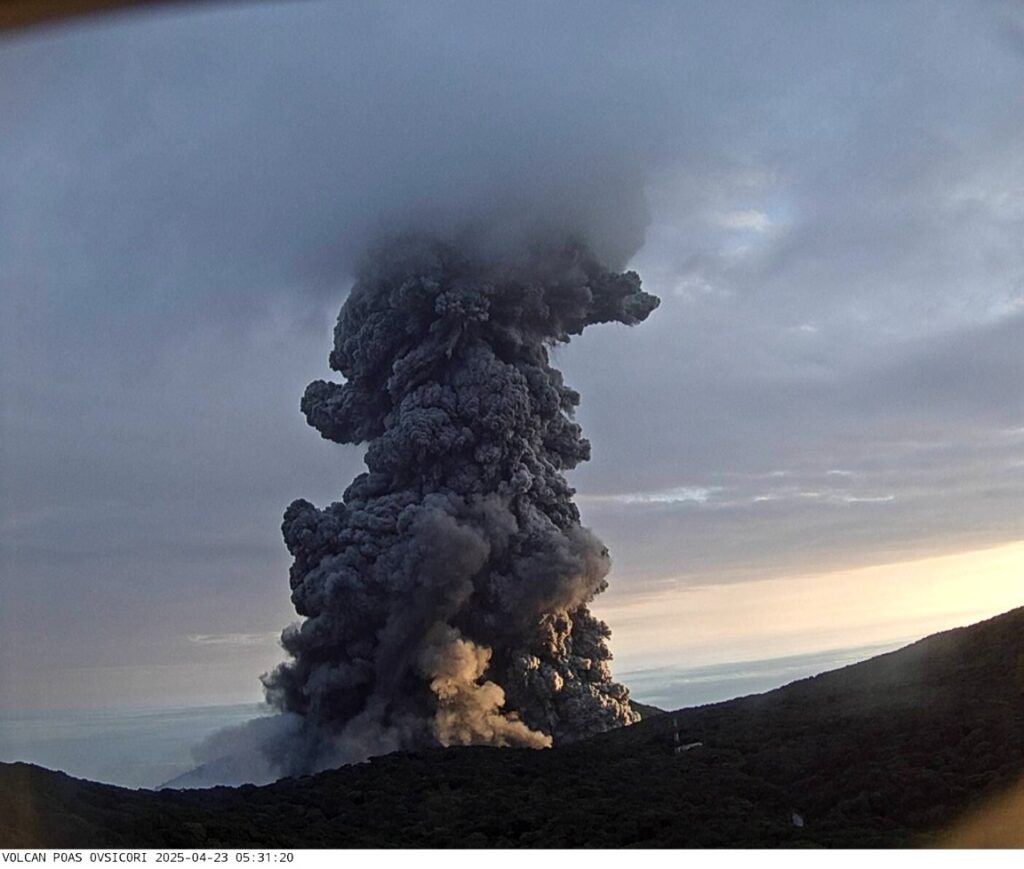
In July 2026, for example, OVSICORI recorded an eruption during the early hours of July 4. Cloud cover prevented researchers from directly observing the gas plume, but seismic and acoustic instruments detected the event.
What Scientists Monitor at Poás Volcano
Monitoring Poás does not depend on a single indicator. Scientists analyze several parameters to understand what is happening inside and around the crater.
These include seismic tremors, earthquakes associated with the volcanic system, acoustic signals generated by explosions or fluid movement, gas emissions, temperature, and changes in the shape of the volcanic edifice.
Together, these measurements help researchers identify changes in the volcano’s behavior and determine whether they represent a significant departure from previously observed conditions.
OVSICORI also operates automatic seismic recording systems and a monitoring network that allows specialists to locate and analyze events occurring in different parts of the country.
Why Seismic and Acoustic Signals Matter
Seismic and acoustic signals are particularly valuable when studying an active volcano.
Volcanic tremor is a seismic signal that can be associated with the movement of fluids, gases, and other processes within a volcanic system. Acoustic signals, meanwhile, can help identify explosions and other phenomena occurring inside the crater.
OVSICORI reports have shown that both parameters can change before, during, or after eruptive episodes. During the period of heightened activity recorded in 2025, for example, the observatory documented variations in both seismic and acoustic tremor and identified relationships between certain signal changes and eruptive episodes.
This makes seismic and acoustic monitoring an essential part of continuous observation at Poás.
A Volcano with Changing Behavior
Poás has demonstrated in recent years that its activity can evolve significantly over relatively short periods.
In March 2025, OVSICORI reported an increase in geophysical and geochemical signals and raised the volcano’s activity level to Level 3, known as “Precaution,” because of increased eruptive activity and the possibility of impacts within the national park and surrounding communities.
During that period, eruptive episodes, ash emissions, and changes in seismic and acoustic activity were recorded. The parameters subsequently began to decline, and the authorities lifted the alerts established in July 2025.
The National Commission for Risk Prevention and Emergency Response (CNE) reported that seismic activity had decreased, the acidic lake was recovering, and gas emissions were becoming more stable. However, authorities emphasized that Poás remains an active volcano and that its conditions can change at any time.
Why Monitoring Matters Even Without a Major Eruption
The absence of a major eruption does not necessarily mean that a volcano is completely inactive.
Volcanic systems can experience internal changes that do not always produce visible phenomena at the surface. That is why scientists examine seismic, acoustic, geochemical, and geodetic information together.
In June 2025, for example, OVSICORI reported decreases in tremor and degassing but continued monitoring because events could potentially affect tourist areas of the park or nearby communities through ash, gases, or aerosols.
This continuous observation provides authorities with scientific information that can support decisions related to visitor and community safety.
A Monitoring System Involving Several Institutions
Volcanic monitoring in Costa Rica is not handled by a single institution.
The country’s Technical Advisory Committee on Volcanology and Seismology brings together specialists from several organizations, including OVSICORI-UNA, the National Seismological Network (RSN) of the University of Costa Rica, the National Commission for Risk Prevention and Emergency Response, and the National System of Conservation Areas (SINAC).
This coordination makes it possible to combine scientific information with risk-management decisions and measures designed to protect the population.
The experience of 2025 demonstrated the importance of this coordination. Authorities established different alert levels according to changes in the volcano’s activity and subsequently reduced them once the monitoring parameters showed greater stability.
What Does This Mean for Visitors to Poás Volcano National Park?
Poás remains an important tourist attraction, but it is an active volcano, meaning safety conditions can change.
The CNE and SINAC have emphasized the importance of following instructions from park rangers and authorities and using only official access routes.
When the park reopened after the 2025 period of increased activity, authorities installed preventive signage informing visitors about risks including falling rocks, ash, and potentially dangerous volcanic gases.
Anyone planning to visit the volcano should therefore check official conditions before traveling and follow the instructions in effect at the time of their visit.
Monitoring That Also Protects Nearby Communities
Monitoring Poás serves more than a scientific purpose. It also plays a direct role in risk management.
Communities surrounding the volcano may be affected by phenomena such as ashfall or volcanic gases, depending on the evolution of the activity and weather conditions.
During periods of increased activity in 2025, authorities established alerts for several nearby cantons and recommended strengthening safety measures within the park while maintaining monitoring in higher-risk areas.
Information produced by volcanic observatories allows institutions to respond more quickly when changes in the volcano’s behavior are detected.
A Reminder That Poás Is Still an Active Volcano
Recent seismic and acoustic signals are part of a process that scientists monitor continuously. Rather than interpreting every fluctuation as a sign of an imminent major eruption, specialists examine how multiple parameters evolve together to determine whether there has been a significant change in the volcanic system.
Poás illustrates why scientific monitoring is so important in a country with significant volcanic activity. Instruments installed around the volcano can detect phenomena that are not always visible to the public and provide essential information for decision-making.
For residents and visitors, the most important recommendation remains to consult official sources and follow the instructions of the authorities. Volcanic activity can change rapidly, and access to updated scientific information is one of the most effective tools for reducing risk.
Information Sources
Volcanological and Seismological Observatory of Costa Rica (OVSICORI-UNA): technical reports, volcanic monitoring bulletins, and seismic activity records.
National Commission for Risk Prevention and Emergency Response (CNE): official alerts, risk-management information, and monitoring of Poás Volcano.
National Seismological Network (RSN-UCR): seismic monitoring and information concerning earthquakes and volcanic activity in Costa Rica.
National System of Conservation Areas (SINAC): official information regarding Poás Volcano National Park and visitor access conditions.