


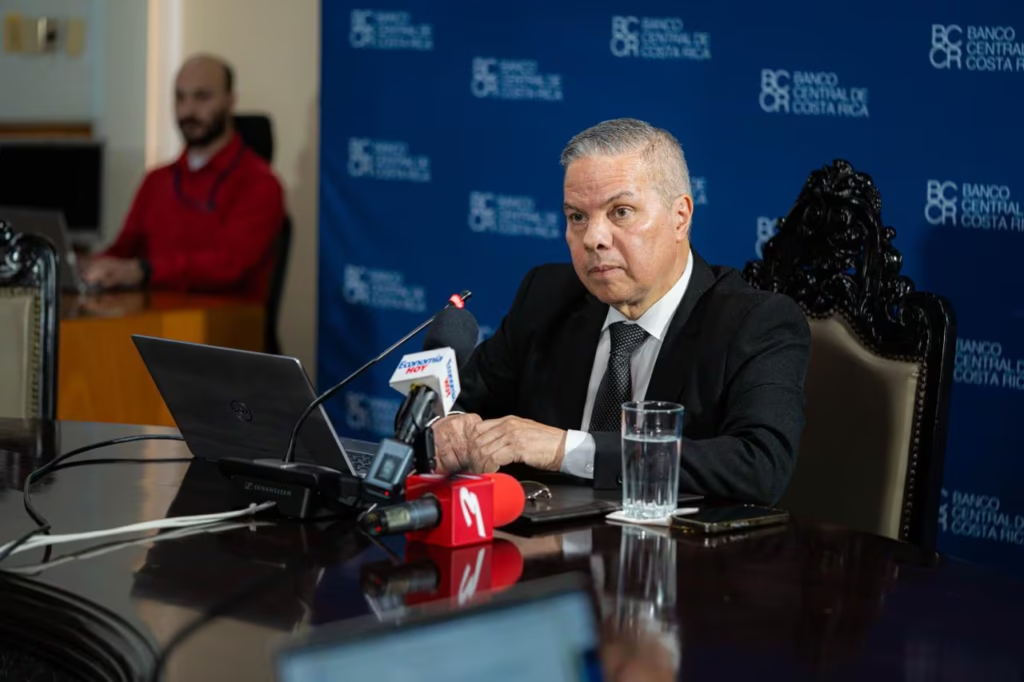
The Board of Directors of the Central Bank of Costa Rica (BCCR) agreed to keep its monetary policy rate (MPR) at 3.25% per year, despite pressure from various sectors calling for a reduction. The monetary authority justifies this decision based on a more uncertain international environment and a shift in the balance of risks toward higher inflationary pressures.
International context and conflict in the Middle East
According to Central Bank President Róger Madrigal, the escalation of the conflict in the Middle East since late February has led to increases in international prices of commodities such as oil and basic grains. These increases are later passed on to the prices of other goods and services, raise inflation expectations, and create greater uncertainty about global economic growth. In this scenario, the Board considers that inflation risks, which were previously tilted downward, are now shifting upward and require a more cautious monetary policy stance.
Negative inflation, but rising projections
Despite the decision to maintain the interest rate, Costa Rica has recorded negative inflation for more than 34 months, prompting calls from economists, business leaders, and the International Monetary Fund to ease monetary policy. Headline inflation stood at -2.7% year-on-year in February 2026, while core inflation—excluding more volatile prices—remains close to zero, both below the Central Bank’s target range of 3% ± 1 percentage point. However, BCCR projection models indicate that, incorporating recent increases in international prices, inflation would return to the tolerance range in the last quarter of 2026, two quarters earlier than expected at the beginning of the year.
Why the Central Bank chooses caution
In recent statements and in its January 2026 Monetary Policy Report, the Central Bank has emphasized that the country’s explicit inflation target is 3%, with a tolerance margin of ±1 percentage point, and that the MPR is set to align with a neutral monetary policy stance in the medium term. The combination of inflation still below target but with external shocks pushing prices upward leads the authority to prioritize stability and avoid decisions that could fuel future inflationary pressures. This approach aims to keep expectations of households, businesses, and investors anchored around the target, reducing volatility and allowing gradual adjustments as the international outlook becomes clearer.
Impact on the economy and people
Keeping the MPR at 3.25% means that benchmark conditions for borrowing costs and savings returns remain unchanged in the short term. Although banks and financial institutions do not automatically pass policy rate changes on to their products, this decision serves as a key signal to the financial system regarding the Central Bank’s outlook on inflation and growth. For individuals and businesses, this translates into a relatively stable interest rate environment at a time when the effects of negative inflation, economic slowdown, and international geopolitical tensions are still being felt.
Official and reference sources
– Central Bank of Costa Rica (BCCR), Monetary Policy Report, January 2026.
– Central Bank of Costa Rica (BCCR), communications on the Monetary Policy Rate and inflation target.
– CRHoy.com, article “Central Bank agrees to keep its monetary policy rate at 3.25% annually.”
– Infobae Costa Rica, article on the BCCR Board decision to maintain the MPR at 3.25%.
– National Institute of Statistics and Census (INEC), data on inflation and Consumer Price Index variations.