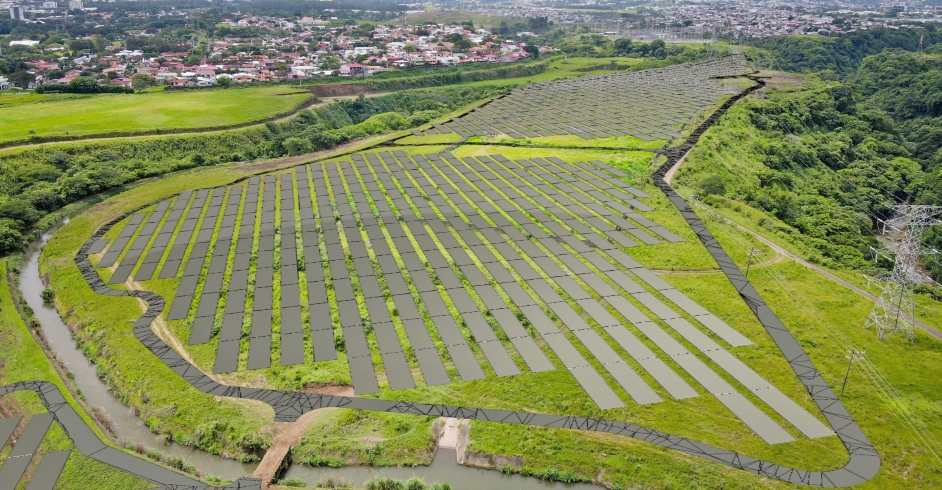
Guanacaste has taken another step forward in the expansion of solar energy in Costa Rica. On July 22, 2026, construction began on the Abangares Photovoltaic Solar Project, a joint initiative between the Costa Rican Electricity Institute (ICE) and CoopeGuanacaste that will become the country’s largest solar power plant by installed capacity.
Located in Colorado de Abangares, the project will have an installed capacity of 70 megawatts (MW) and is part of efforts to diversify electricity generation sources and strengthen Costa Rica’s National Electricity System.
The project is also being financed by Banco Nacional, with construction expected to be completed during the last quarter of 2027.
A Partnership Between ICE and CoopeGuanacaste
The project represents an unusual collaboration between two major players in Costa Rica’s electricity sector.
ICE and CoopeGuanacaste are jointly involved in financing, planning, design, construction, operation, maintenance, and electricity production at the solar plant.
The electricity and capacity generated will be divided equally: 50% will belong to ICE and 50% to CoopeGuanacaste.
Once construction is completed, ICE will be responsible for operating the plant, while CoopeGuanacaste will oversee maintenance. The cooperative will also contribute its experience operating other solar projects developed in Guanacaste.
70 Megawatts of Solar Power
With a capacity of 70 MW, the Abangares Photovoltaic Solar Project will become the largest solar power plant currently installed in Costa Rica.
Its electricity production will be incorporated into the National Electricity System (SEN), allowing the power generated to be integrated into the national grid and used according to the system’s needs.
The project is being developed in an area of Guanacaste with significant potential for solar energy production.
A facility of this scale will substantially increase the contribution of photovoltaic energy to Costa Rica’s electricity mix.
Why Is Solar Energy Important for Costa Rica?
Costa Rica has maintained an electricity system based primarily on renewable sources for many years. Hydropower remains the country’s main source of electricity generation, while renewable energy as a whole forms the backbone of the national system.
Diversification is important because each energy source depends on different environmental conditions.
Hydropower, for example, is closely linked to water availability and rainfall patterns. During dry periods or climate phenomena such as El Niño, hydroelectric production can be affected.
Solar power provides an additional source that can complement other renewable technologies, particularly during periods of strong solar radiation.
Greater Resilience to Climate Conditions
One of the objectives highlighted by ICE is to increase the resilience of the electricity system to climate-related events.
By adding more photovoltaic generation, Costa Rica can reduce its dependence on a single renewable source and create a more diversified energy mix.
ICE indicates that the project will help the country respond to phenomena such as El Niño by increasing the contribution of solar energy within the overall electricity generation system.
This diversification is particularly important as changing weather patterns can affect water availability and, consequently, the production of hydroelectric plants.
Could It Affect Electricity Rates?
Another aspect highlighted by ICE is the project’s potential economic impact.
The institution states that the addition of the solar plant could reduce costs within the National Electricity System and potentially contribute to lower electricity rates.
However, consumer electricity bills do not depend on the cost of a single power plant. In Costa Rica, the Public Services Regulatory Authority (ARESEP) regulates the different stages of the electricity service — generation, transmission, distribution, and public lighting — and establishes the corresponding rates.
ARESEP also uses specific methodologies to calculate electricity generation rates according to the source of energy, including solar power.
The final impact on consumers’ electricity bills will therefore depend on the performance of the electricity system as a whole and on the corresponding regulatory processes.
Guanacaste Continues to Expand Solar Generation
The Abangares project is not an isolated initiative.
Guanacaste is becoming increasingly important in the development of Costa Rica’s solar energy sector. CoopeGuanacaste already operates other solar projects in the province and has accumulated significant experience in photovoltaic electricity generation.
At the same time, ICE has promoted additional solar projects. In 2026, five private initiatives totaling 86 MW of capacity in different cantons of Guanacaste were approved.
These plants are part of a broader expansion of renewable electricity generation designed to meet the country’s growing demand for power.
A New Chapter for Solar Energy
The construction of the Abangares solar plant represents a significant change in scale for photovoltaic electricity generation in Costa Rica.
With 70 MW of capacity and a partnership between ICE and CoopeGuanacaste, the project combines public investment, cooperative expertise, and solar technology to expand the country’s available electricity-generation resources.
Construction is expected to be completed during the last quarter of 2027, when the plant is scheduled to begin supplying electricity to the National Electricity System.
For Guanacaste, the project also represents a new stage in the use of one of the region’s most abundant natural resources: sunlight.
For Costa Rica as a whole, it marks another step toward a more diversified and resilient electricity mix, combining hydropower, wind, geothermal energy, biomass, and solar power to meet the country’s energy needs in the decades ahead.