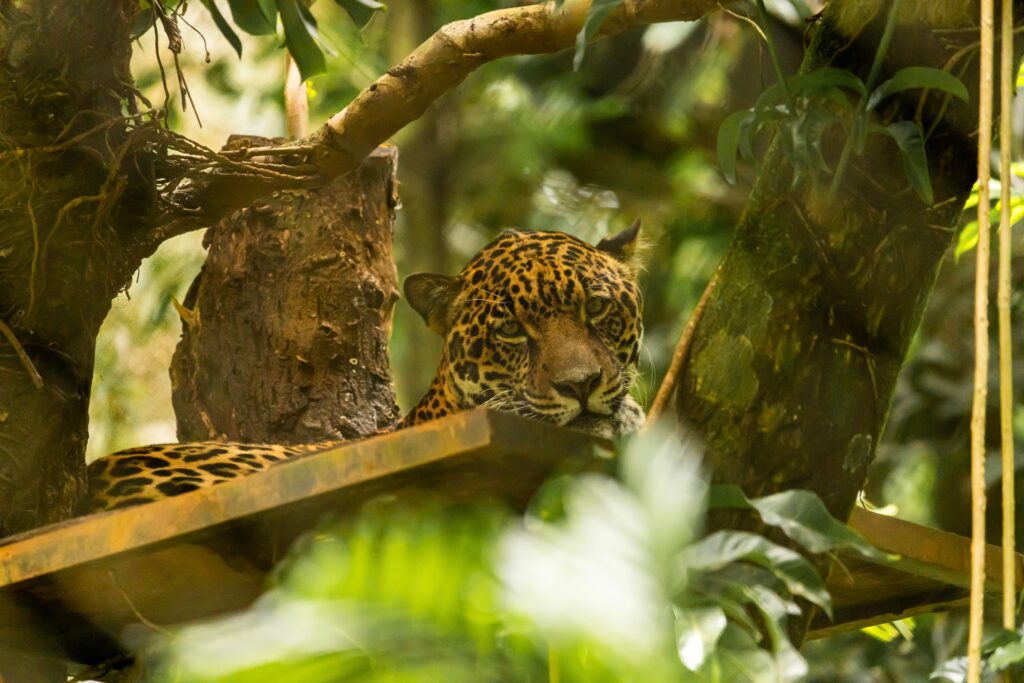
Amid the forests and beaches of Costa Rica’s Caribbean coast, a monitoring project is helping researchers better understand one of the region’s largest predators.
Since 2023, camera traps installed in Tortuguero National Park and at Playa Tres, in Barra de Parismina, have made it possible to identify 11 jaguars within the study area. The images not only confirm the presence of these felines, but also provide information about their movements, behavior and interactions with the ecosystem.
The project is developed by the organization Turtle Love and uses cameras equipped with infrared light to record animal activity, particularly at night.
A network of cameras to observe without interfering
Twelve monitoring stations have been installed in Tortuguero National Park, while another seven operate at Playa Tres. Each station has one or two cameras that remain active to record wildlife passing through the area.
The system makes it possible to obtain information without having to constantly follow the animals or alter their behavior. The cameras are activated when they detect movement and can record jaguars as they move through the forest, search for food or interact with other animals.
Maintenance also requires constant work. Project members visit the stations approximately once a month to inspect the equipment, replace batteries and make sure the cameras continue to operate properly.
The use of camera traps is not new in Tortuguero. The Tortuguero Conservation Area (ACTo-SINAC) has maintained a long-term monitoring program since 2013 focused on jaguars, other wild cats and their prey species using this technology. The program has made it possible to record four species of wild cats: jaguar, puma, ocelot and margay.
A park that is essential for conservation
Tortuguero National Park was created in 1970 and currently covers 76,937 hectares, of which 26,653 hectares are terrestrial territory and 50,284 hectares are marine surface.
The area protects a wide diversity of ecosystems and species. According to SINAC, 734 plant species, 442 bird species, 138 mammal species, 118 reptile species and 58 amphibian species have been identified there, in addition to hundreds of arthropod species.
Within this diversity, the jaguar holds a particularly important position. The Jaguar Program of the International Institute for Conservation and Wildlife Management (ICOMVIS) at the National University notes that large predators such as jaguars and pumas serve as indicators of ecosystem integrity and play an important role in maintaining ecological balance.
For this reason, studying where jaguars are found and how they use the territory also provides information about the condition of the ecosystems that support them.
Why are camera traps important?
Identifying a jaguar in the wild is not simply about confirming that the species is present. Researchers need to know how many individuals may be found in an area, where they move, which habitats they use and how they interact with their prey and other animals.
Camera traps make it possible to collect large amounts of information over long periods without requiring a permanent human presence.
An earlier study carried out in Tortuguero National Park by researchers from the University of Costa Rica used camera traps between 2012 and 2013 to study jaguar habitat occupancy. During that study, 18 individuals were identified within the protected area, 17 of them detected exclusively in coastal habitat.
These studies show that camera trapping can become a fundamental tool for understanding the distribution of a species that is difficult to observe directly.
A predator connected to sea turtles
In Tortuguero, there is also a particular interaction between jaguars and sea turtles that come to the beaches to nest.
Since 2005, the Tortuguero Conservation Area has maintained specific monitoring of sea turtle predation by jaguars. The study covers four species: green turtle, leatherback, hawksbill and loggerhead.
According to results published by ACTo-SINAC, this interaction is part of the natural dynamics of the ecosystem, and available data indicate that jaguars do not represent a threat to the population of green turtles nesting in Tortuguero, nor are they the main cause of declines in leatherback and hawksbill turtle populations.
The relationship between the two species is precisely one of the phenomena that monitoring makes it possible to study in greater detail.
Protecting jaguars also means protecting their habitat
Monitoring is not aimed solely at determining how many jaguars exist. The information collected can help researchers understand how the animals use the territory and what factors could affect their continued presence.
The Jaguar Program at the National University identifies habitat loss, hunting of prey and the killing of animals in retaliation for conflicts between wild cats and humans among the main threats facing these large felines.
In Tortuguero, SINAC itself has taken specific measures to protect jaguar habitat. In 2017, the Tortuguero Conservation Area closed a section of the Jalova public-use area in order to reduce possible impacts of human presence on the species’ behavior and habitat.
The measure reflects one of the challenges of conserving large predators in natural areas that also receive visitors: finding a balance between human access and wildlife protection.
Work that goes beyond the images
Every photograph captured by a camera trap represents only one part of a much broader research and conservation process.
In addition to monitoring jaguars, the organization responsible for the project carries out activities such as beach cleanups, workshops and community initiatives. According to Teletica’s report, cleanup efforts can remove around 1,000 kilograms of waste per year.
Meanwhile, scientific monitoring of jaguars continues through different methods. The Tortuguero Conservation Area and ICOMVIS-UNA have even promoted research using satellite collars to more precisely understand the movements, space use and behavior of these animals.
The combination of camera traps, scientific tracking and conservation work makes it possible to build an increasingly complete picture of the jaguar population in this region.
Knowing in order to protect
The 11 jaguars identified by the Turtle Love project are a sample of the wildlife that continues to use the forests and coastal areas of the Caribbean.
Beyond the photographs, each record provides information that can help researchers understand how this species moves, what spaces it needs and how it interacts with the rest of the biodiversity.
In a territory such as Tortuguero, where tropical forests, wetlands, rivers and beaches form a single ecological system, studying the jaguar also means studying the health of the ecosystem that supports it.
Research continues, and each new image can provide another piece of the puzzle needed to understand and protect one of the large cats that still inhabit Costa Rica’s wild landscapes.