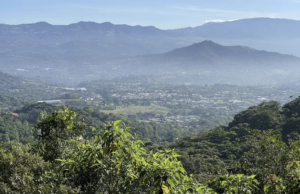
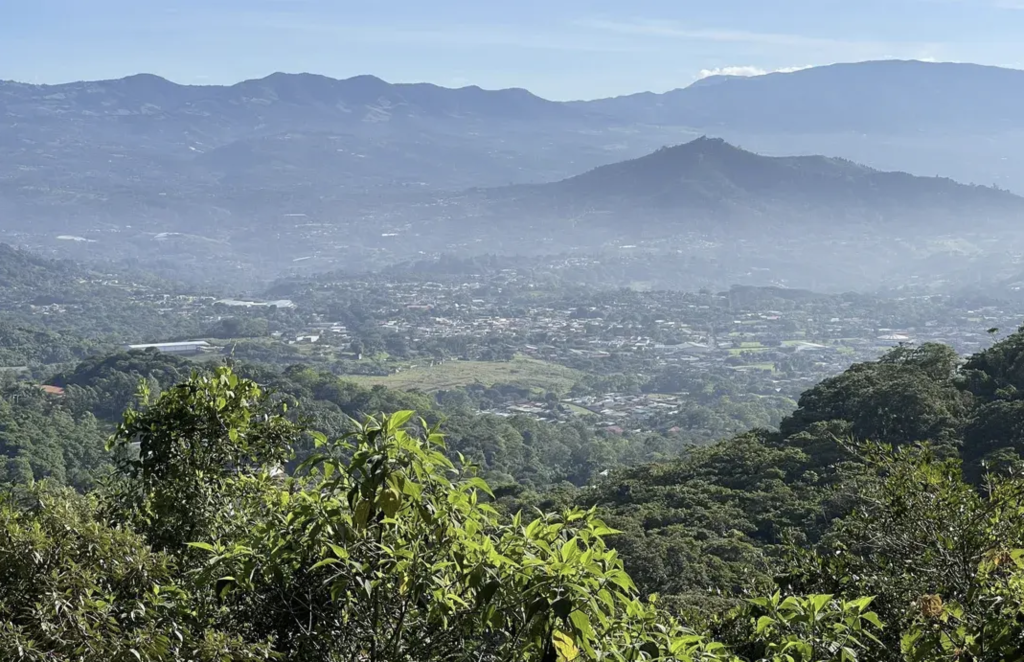
In La Granja de Palmares, Alajuela, a piece of land that for years was used for cattle farming and agricultural production has been transformed into a conservation area that today protects 31 hectares of forest, water resources and an important diversity of species.
This is the Madre Verde Natural Reserve, a community-based conservation project that began taking shape in 2000 and, more than two decades later, has become one of the examples of ecological restoration developed in the western part of the Central Valley.
An Initiative Born From the Community
The history of Madre Verde is closely linked to concerns among residents of Palmares about the loss of forest cover and the protection of water resources.
In 2000, the community acquired the land where the reserve is now located. At that time, the property had been used mainly for cattle farming and agriculture. From then on, a process of reforestation and natural regeneration began, gradually restoring forest cover.
The Madre Verde Foundation states that the reserve currently has 31 hectares of forest and protects three water springs. The site is also part of the Montes del Aguacate Biological Corridor and the Network of Public and Private Reserves.
The experience has also been documented in academia. Research presented by the National University on the monitoring of ecological restoration at Madre Verde compared vegetation conditions between 2005 and 2020 and found significant changes in the richness, diversity, composition and structure of vegetation in areas that had undergone restoration processes.
When Natural Regeneration Becomes Conservation
The recovery of Madre Verde has not been based solely on planting trees.
The process has combined active reforestation with natural regeneration, allowing different areas to progressively develop into more established forest communities.
The National University study highlights that native pioneer species of the life zone predominate in the restored areas, contributing to the natural recovery process of the forest. These results have also helped identify species and processes that may be useful for restoring similar areas.
The Madre Verde Foundation explains that the reserve also forms part of the Calabazo Creek micro-watershed, one of the important tributaries in the canton of Palmares. Protecting forest cover therefore has a direct relationship with the conservation of water resources.
A Refuge for Biodiversity
The recovery of the forest has also created new conditions for the area’s flora and fauna.
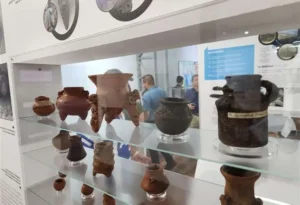
The reserve maintains biodiversity and bird-observation records, and different studies have examined the species found there. The National Museum of Costa Rica, for example, includes in its scientific bibliography a study dedicated to the vertebrate fauna of the Madre Verde Reserve.
The importance of this space has also been highlighted beyond the strictly environmental field. In 2024, Correos de Costa Rica issued a series of postcards featuring species photographed in Madre Verde, including the quetzal, mountain hummingbird, tayra and emerald toucanet. The activity took place at the reserve itself and included representatives of the Madre Verde Foundation and the local government of Palmares.
Part of the Montes del Aguacate Biological Corridor
Madre Verde does not function as an isolated space.
Its location within the Montes del Aguacate Biological Corridor helps maintain connections between different natural areas in the region. The Foundation itself identifies this relationship as part of its conservation work.
The connection with environmental conservation initiatives also appears in official SINAC records. The institutional platform includes Madre Verde among the COVIRENA groups associated with the Central Conservation Area, a community participation framework that supports actions related to the protection and monitoring of natural resources.
A Forest That Also Serves as a Place to Learn
Conservation at Madre Verde is not limited to protecting the land.
The reserve organizes environmental education activities, guided tours, workshops and visits for educational institutions, universities, companies and other groups. It also offers daytime and nighttime tours, as well as activities related to birdwatching and learning about biodiversity.
In this sense, the site functions as a place where restoration can be observed directly. What was once land dedicated to productive activities has become a setting for learning about the processes involved in forest recovery and the relationship between conservation, water, biodiversity and community participation.
The CIENTEC Foundation has also included Madre Verde in educational activities related to science and the environment, presenting it as an example of community conservation and the restoration of an area that was previously dedicated to cattle farming and crops.
More Than Two Decades of Recovery
The process that began in 2000 shows that ecosystem restoration does not happen overnight.
Studies carried out at Madre Verde show changes in vegetation after years of intervention and regeneration, while the current forest cover allows the site to continue fulfilling functions related to water protection and biodiversity conservation.
Today, the reserve has four trails totaling approximately three kilometers, as well as viewpoints and spaces dedicated to educational and conservation activities. The former productive area is now part of a recovering forest that can be visited and explored by the community.
The story of Madre Verde thus reveals a lesser-known dimension of conservation in Costa Rica: not all protected forests are large national parks. Some emerge from decisions made by communities that identify a local problem, acquire a piece of land and work for years to restore its natural resources.
In Palmares, this process continues to grow among trees, water springs, trails and environmental education projects.
Sources: Madre Verde Foundation, National University of Costa Rica (UNA), National System of Conservation Areas (SINAC), National Museum of Costa Rica, Correos de Costa Rica and CIENTEC Foundation.