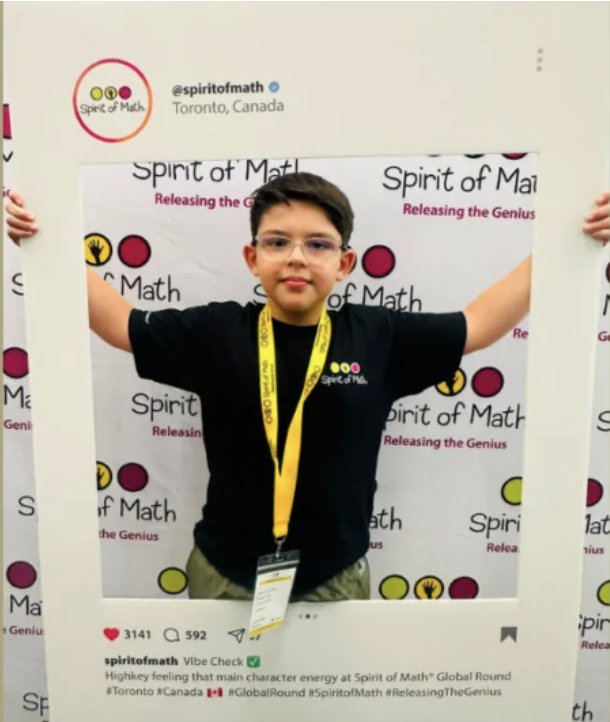
A Costa Rican second-grade student represented the country at the final stage of the International Spirit of Math® Contest, an international mathematics competition held in Canada that brings together students from different countries.
The student, Leonardo Quesada, stood out through his participation in the competition, offering an example of the interest that Costa Rican children and young people can develop in mathematics and in fields related to science, technology, engineering and mathematics (STEM). His participation was reported by La República on August 17, 2026.
Beyond the individual achievement, experiences of this kind allow Costa Rican students to face academic challenges at an international level from an early age and meet young people from other parts of the world who share similar interests.
An International Competition From the Early Years of School
Taking part in an international mathematics competition during primary school is an unusual experience for a student of such a young age.
The International Spirit of Math® Contest presents mathematical challenges designed to develop logical reasoning, analytical skills and problem-solving abilities. The final stage in Canada brought together participants who had previously advanced through the different stages of the competition.
For Leonardo, reaching this stage meant representing Costa Rica in an international academic setting and demonstrating his skills alongside students from other countries.
Competitions of this kind are not necessarily limited to testing knowledge acquired in the classroom. They can also encourage curiosity, concentration and the ability to approach problems from different perspectives.
Mathematics as a Tool for Developing Critical Thinking
Mathematics plays a central role in scientific education.
Solving a mathematical problem is not simply about remembering a formula. In many cases, it requires recognizing patterns, analyzing information, establishing relationships and developing a strategy to reach a solution.
Costa Rica’s Ministry of Public Education (MEP) considers mathematics one of the fundamental areas of the national education system. The ministry also provides practice materials for national standardized assessments, including mathematics resources for students.
The country’s participation in the PISA international assessment also reflects the importance placed on measuring and strengthening mathematical competencies. The MEP defines mathematical literacy as the ability to reason mathematically and formulate, use and interpret mathematics to solve problems in different real-world contexts.
The Challenge of Strengthening Mathematics Education
Leonardo’s participation takes on an additional dimension when considered alongside the broader picture of mathematics education in Costa Rica.
According to the MEP’s information on PISA 2022, 28% of Costa Rican students reached at least Level 2 in mathematics, compared with an OECD average of 69%. The MEP also reports that almost no Costa Rican students reached the highest performance levels, Levels 5 or 6, in mathematics.
These figures concern 15-year-old students and do not describe the abilities of every student in the country. They do, however, highlight one of the challenges facing Costa Rica’s education system: strengthening mathematical learning while creating more opportunities for students to develop advanced skills.
In this context, international experiences involving students with a particular interest in mathematics can help highlight existing potential and the importance of encouraging that potential from an early age.
A Tradition of Mathematics Competitions
Costa Rica already has a history of initiatives designed to identify and encourage students with strong abilities and an interest in mathematics.
The country’s educational system includes specialized programs and competitions that give students opportunities to develop their mathematical and scientific skills beyond the regular classroom.
The Costa Rican Scientific Colleges, for example, are public, free, pre-university institutions with an intensive focus on mathematics, physics, chemistry, biology and computer science. According to the MEP, students from these schools have successfully participated in national and international competitions in mathematics, physics, chemistry, biology, robotics and science fairs.
This tradition demonstrates that academic excellence in mathematics and science is already being encouraged through different educational pathways in the country.
The goal is not simply to obtain awards. These experiences can also help students develop discipline, critical thinking, problem-solving skills and confidence when facing increasingly complex academic challenges.
The Role of STEM Education
Mathematics is part of the broader group of disciplines known as STEM: science, technology, engineering and mathematics.
In Costa Rica, the MEP’s Scientific Colleges are specifically designed to provide intensive training in these areas. The ministry describes them as pre-university institutions focused on developing students’ abilities in mathematics, physics, chemistry, biology and computer science.
The program is intended for students with a strong interest in the exact sciences and provides specialized academic preparation before university.
Developing these skills can have long-term implications. Mathematics and science are fundamental to careers in engineering, computer science, scientific research, technology and many other fields requiring analytical abilities.
The experience of a primary-school student participating in an international mathematics competition shows that interest in these areas can begin well before secondary school or university.
An Experience That Goes Beyond the Final Result
In an international competition, the final result is only one part of the experience.
Traveling to another country for an academic event allows students to discover other cultures, interact with participants from different backgrounds and encounter problems and approaches that may differ from those they normally experience at school.
It can also help develop personal qualities such as concentration, perseverance and the ability to adapt to unfamiliar situations.
For a child still in the early years of primary education, an experience of this kind can become an important memory and potentially encourage a lasting interest in mathematics and other scientific disciplines.
Talent Needs Opportunities to Grow
Leonardo’s story also raises a broader question: how can students who demonstrate particular abilities be identified and supported?
A strong mathematics education should not only help students who are struggling. It should also provide opportunities for those who progress quickly and need more challenging material.
Competitions, academic clubs, mathematics olympiads, science fairs and specialized programs can provide precisely that environment.
The challenge is ensuring that these opportunities are accessible to students from different regions and socioeconomic backgrounds, so that talent can develop regardless of where a child grows up.
A Small Representation With a Broader Meaning
Leonardo Quesada’s participation in Canada is, first and foremost, a personal and family achievement.
But it also offers an opportunity to remember that academic talent can emerge at a very young age and that mathematics can provide Costa Rican students with a path toward international academic communities.
For a country seeking to strengthen its scientific and technological capabilities, encouraging curiosity and logical thinking from childhood can be a long-term investment.
The goal is not simply to educate students who can solve mathematical problems. It is also to help develop young people who can analyze, question, create and look for solutions to increasingly complex challenges.
A New Generation Looking Beyond Its Borders
The participation of a second-grade student in an international competition demonstrates that academic opportunities can begin much earlier than many people might expect.
Experiences like Leonardo’s can inspire other children who enjoy mathematics, as well as families and schools interested in helping them develop that potential.
Talent does not always need a large platform to begin. Sometimes it starts with a child who simply enjoys solving problems and discovering how things work.
The role of education is to provide the tools, challenges and opportunities that allow that curiosity to grow.
Official Sources for Further Information
Costa Rica’s Ministry of Public Education (MEP) provides official information on mathematics education and assessment, including its national and international evaluation programs.
The MEP’s PISA information provides official data on Costa Rican students’ performance in mathematics. In PISA 2022, 28% of students reached at least Level 2 in mathematics, compared with an OECD average of 69%.
The MEP also provides information about the Costa Rican Scientific Colleges, public pre-university institutions specializing in mathematics, physics, chemistry, biology and computer science. Their students have participated successfully in national and international academic competitions.
The specific information about Leonardo Quesada’s participation in the international final in Canada was reported by La República on August 17, 2026.