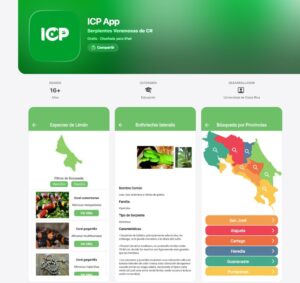


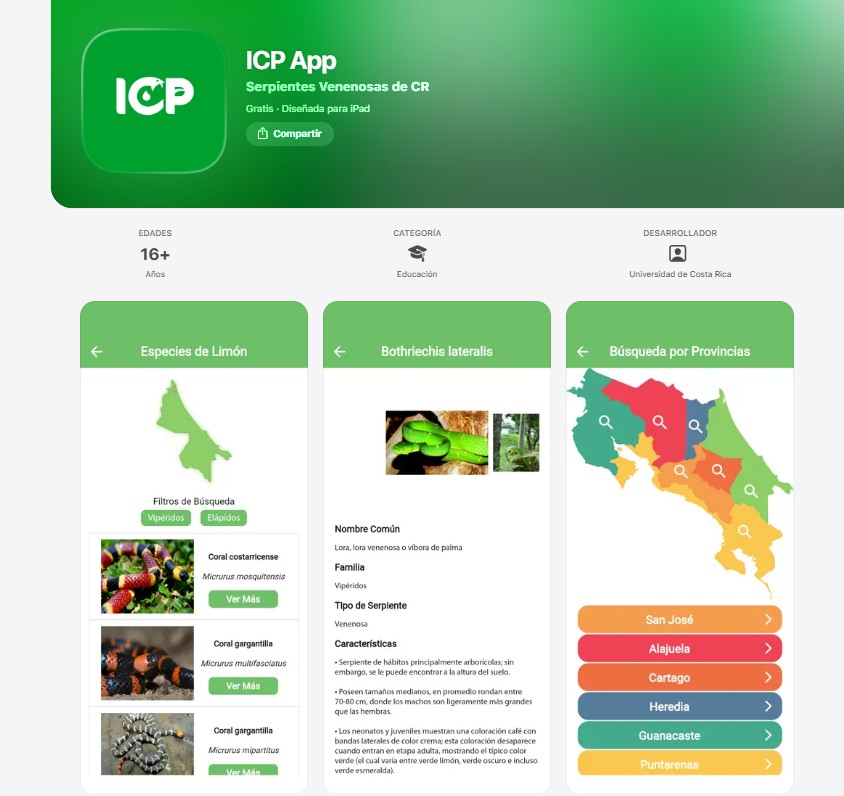
Costa Rica has taken an innovative step in public health and environmental education with the launch of a mobile application that allows users to identify venomous snakes in the country. The tool was developed by the Clodomiro Picado Institute of the University of Costa Rica, an institution internationally recognized for its work in antivenom production.
The application, called ICP App, represents a significant advancement in the use of technology to prevent snakebite accidents, an issue that remains relevant, especially in rural areas of the country.
A scientific tool accessible to the public
The ICP App is the first free application in Costa Rica specifically designed to identify venomous snakes. It allows users to recognize the 25 dangerous species present in the national territory and provides clear information on how to act in case of a bite. (UCR, 2026)
Available on both Android and iOS, the tool responds to a real need: the widespread lack of knowledge among the population about wildlife and associated risks. According to specialists from the Clodomiro Picado Institute, public inquiries about snakes are frequent and highlight the urgency of having reliable and accessible information. (UCR, 2026)
In addition, the application includes scientifically validated content, reducing reliance on informal or inaccurate sources that could put lives at risk.
Key features for prevention and emergency response
One of the main contributions of the ICP App is its practical approach. It not only helps identify species but also serves as a guide for responding to emergencies.
Its main features include:
- Identification of venomous and non-venomous snakes
- First aid guidelines for snakebites
- Information on species behavior
- Support for medical decision-making
Immediate access to this information can make a critical difference, especially in remote communities where medical response times are longer. (UCR, 2026)
The tool may also help improve epidemiological records by facilitating data collection on incidents and the species involved. (Delfino.cr, 2026)
A contribution to conservation and environmental education
Costa Rica is home to a rich diversity of reptiles, with more than 140 species of snakes, of which around 23 are venomous.
In this context, the application serves not only a health function but also an educational one. By enabling proper species identification, it helps reduce the unnecessary killing of snakes, often driven by fear or misinformation.
The Clodomiro Picado Institute has pointed out that many people kill snakes unnecessarily, even though most do not pose a direct threat if left undisturbed. (UCR, 2026)
In this way, the app promotes a more informed coexistence between people and the country’s biodiversity.
Technological innovation with public health impact
The development of this application also reflects the growing role of technology in risk management and public health. In the future, the integration of artificial intelligence tools is expected, allowing snake identification through photographs and the generation of georeferenced data. (Delfino.cr, 2026)
This type of innovation positions Costa Rica as a regional leader in integrating science, technology, and social well-being.
A step forward in preventing snakebite incidents
Snakebite accidents remain a challenge in tropical countries. In Costa Rica, hundreds of cases are reported each year, mainly in rural areas linked to agricultural activities.
In this context, tools like the ICP App can play a key role in risk reduction by providing immediate, reliable, and science-based information.
The combination of academic knowledge, digital innovation, and public accessibility makes this initiative a concrete example of how technology can save lives.
Official and reference sources
– University of Costa Rica (UCR), official article on the launch of the ICP App
– Clodomiro Picado Institute, scientific development and validation of the application
– Delfino.cr, article on the launch of the mobile application
– La Nación, report on the use and impact of the app
– Observador.cr, explanation of features and benefits
– General biodiversity data on snakes in Costa Rica