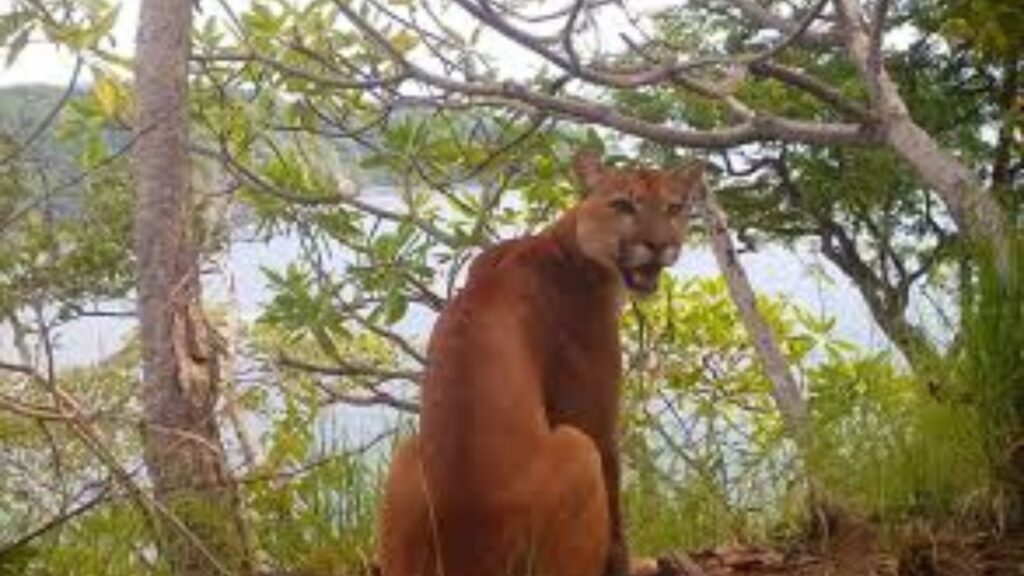
A new visual record has surprised the country’s scientific and conservation community. A wildlife monitoring camera, strategically located on a cliff facing the Pacific Ocean, managed to capture an exceptional sequence of a puma (Puma concolor) in a natural setting of great beauty.
The monitoring device was installed more than a year ago at an elevated point on the coast, selected mainly for its wide visual range and the aesthetic quality of the landscape. Although this type of location does not always guarantee wildlife traffic, the recent results exceeded the researchers’ expectations.
In the audiovisual material, the feline can be seen approaching the edge of the precipice. Instead of continuing on its path, the animal stops, sits down, and looks directly toward the horizon before turning its head toward the camera, achieving a natural composition that is extremely difficult to obtain in the wild.
Analysis of the camera data revealed a disturbing yet fascinating detail about the species’ behavior: its proximity to the researchers. According to time records, a robust puma specimen was captured stalking the area just one hour before the technical team arrived at the site to perform equipment maintenance.
This phenomenon highlights the ability of these predators to remain invisible to the human eye, maintaining constant surveillance over their territory without being detected, even when people are present nearby.
Findings on private lands
The monitoring project, which also extends to various farms in the province of Guanacaste, has yielded valuable data on the health of large feline populations outside state-protected areas. Among the most notable findings of recent months are:
• Large-sized specimens: The passage of a male with musculature notably above average was recorded, indicating an abundance of prey in the area.
• Relaxed behaviors: In other sequences, pumas are seen rolling on the grass, a behavior that demonstrates comfort and dominance of their environment.
• Importance of private conservation: The constant presence of these animals reaffirms that forests within private properties function as vital biological corridors for the survival of the species.
This type of technical documentation is essential to promote coexistence between agricultural activities and wildlife, demonstrating that the Costa Rican ecosystem maintains its capacity to shelter its most emblematic predators.