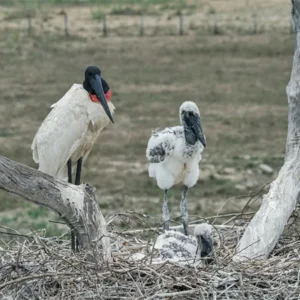
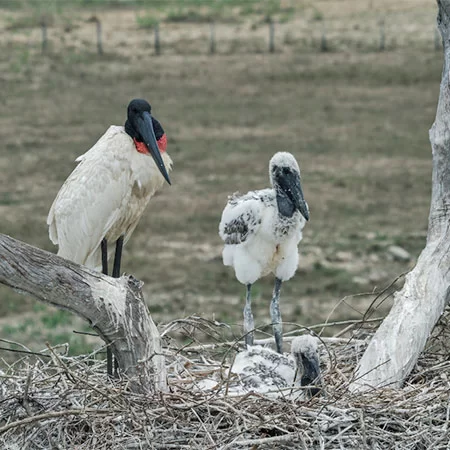
The jabiru, one of the most emblematic birds of Costa Rica’s wetlands, has recorded another breeding season that provides valuable information about the status of its population.
The latest national monitoring carried out by the Universidad Estatal a Distancia (UNED) confirmed nine active nests and 19 chicks during the 2026 breeding season. The study also estimated a minimum population of 148 individuals in the country.
The results are part of the Ecology and Conservation of the Jabiru in Costa Rica research project, a long-term program developed by UNED to study the species and generate information that can contribute to its conservation.
An Emblematic Species of Costa Rica’s Wetlands
The jabiru (Jabiru mycteria), also known in Costa Rica as the galán sin ventura, is one of the country’s largest waterbirds.
Its presence is closely linked to wetlands, lagoons, rivers, and seasonally flooded areas. In Costa Rica, some of its main distribution areas are located in the basins of the Tempisque and Frío rivers, where researchers conduct much of their annual monitoring.
Palo Verde National Park, in Guanacaste, is one of the important areas for the species. The National System of Conservation Areas (SINAC) identifies the park as an important habitat for numerous aquatic birds, including the jabiru, which is considered an endangered species in Costa Rica.
Nine Active Nests and 19 Chicks
During the 2026 breeding season, national monitoring identified nine active jabiru nests in Costa Rican wetlands and confirmed the birth of 19 chicks.
These figures are particularly important because they provide information not only about the species’ presence, but also about its ability to reproduce in ecosystems where suitable conditions remain available.
According to UNED researchers, each breeding season provides valuable information for understanding the population status and behavior of the jabiru.
The estimate of 148 individuals corresponds to the minimum population identified through the monitoring of historical nesting sites and simultaneous counts carried out in the species’ main distribution areas.
More Than Three Decades of Monitoring
Scientific monitoring of the jabiru in Costa Rica is not a recent initiative.
UNED has conducted research and monitoring programs focused on the species since 1993, collecting annual information about its population, reproduction, and use of wetlands.
The university’s research project examines several aspects of jabiru ecology, including population size, nesting locations, and feeding areas.
This continuity is particularly important for a species with a relatively small population. Long-term data make it possible to compare breeding seasons and identify changes in distribution or population numbers.
How Is the Jabiru Monitored?
The monitoring program uses two main methods to assess jabiru reproduction and presence.
The first is the Jabiru Expedition, carried out in February. Researchers visit historically documented nesting sites to determine which nests remain active and which are being used during the breeding season.
The second method consists of simultaneous counts carried out during the first Saturdays of March and April. Researchers and volunteers are distributed around lagoons and other strategic observation points in the Tempisque and Frío river basins.
Combining these two methods provides a more complete picture. Nest monitoring provides information about breeding pairs, while simultaneous counts help estimate how many individuals are present in the territory during the season.
Wetlands Are Important Even for Non-Breeding Birds
The 2026 monitoring also revealed another important aspect of the jabiru’s use of Costa Rican wetlands.
Researchers identified jabirus that were not breeding but were using wetlands as temporary feeding and resting areas during the dry season.
In May, at least 100 individuals were recorded concentrated around Laguna Jicote, in the Tempisque River basin. According to UNED, these birds remained in the area for several days before leaving the country again.
This behavior demonstrates that the importance of Costa Rican wetlands extends beyond providing nesting sites. They also serve as feeding and resting areas for individuals that may travel between different regions.
A Species Still Facing Major Threats
Despite the encouraging results from the 2026 breeding season, the jabiru remains vulnerable.
Among the main threats identified by researchers are the loss and degradation of wetlands, the cutting of trees used for nesting, forest fires, irresponsible tourism near nesting sites, and the effects of climate change.
SINAC also recognizes the jabiru as an endangered species in Costa Rica. Official conservation documents identify habitat loss as one of the factors that has historically affected its populations.
Protecting wetlands is therefore inseparable from protecting this remarkable bird.
More Than 75% of Nests Are on Private Land
One of the most distinctive aspects of jabiru conservation in Costa Rica is the importance of privately owned land.
According to UNED, more than 75% of recorded nests are located on private properties, outside protected areas. This means that protecting the species does not depend solely on national parks or wildlife refuges.
Farm owners, local communities, researchers, and public institutions all play an important role in protecting nesting trees and the wetlands that provide food.
This approach also demonstrates how biodiversity conservation can extend beyond the traditional boundaries of protected areas.
The Jabiru as an Indicator of Wetland Health
The importance of the jabiru extends beyond the species itself.
Researchers consider the bird a potential indicator of wetland health. Its presence, reproduction, and use of these ecosystems can provide valuable information about environmental conditions in the areas where it lives.
Protecting the places where jabirus feed and reproduce also means conserving ecosystems that support numerous other species of birds, fish, reptiles, amphibians, and mammals.
Wetlands also perform essential ecological functions related to water, biodiversity, and ecosystem balance.
A Promising Season — and a Continued Responsibility
The nine active nests and 19 chicks recorded in 2026 represent an encouraging sign for the conservation of one of Costa Rica’s most threatened birds.
However, researchers continue to emphasize the importance of protecting wetlands and strengthening collaboration between institutions, communities, and private landowners.
The birth of new chicks shows that jabirus still find suitable places to reproduce in Costa Rica. The challenge now is to ensure that these habitats remain available in the future.
Every protected nest, conserved wetland, and engaged community can help preserve the presence of one of Central America’s most remarkable birds in Costa Rica.
Official Sources
Universidad Estatal a Distancia (UNED) — Research and monitoring of the jabiru in Costa Rica.
UNED Acontecer — National 2026 jabiru monitoring results.
UNED, Biocenosis Journal — Scientific research on the jabiru population and conservation in Costa Rica.
Sistema Nacional de Áreas de Conservación (SINAC) — Information on the conservation status of the jabiru and its habitat in Costa Rica.
Parque Nacional Palo Verde — SINAC — Information on the park’s wetlands and biodiversity.